Crochet Hexagon Blanket: One Easy Treasure in 4 Rounds
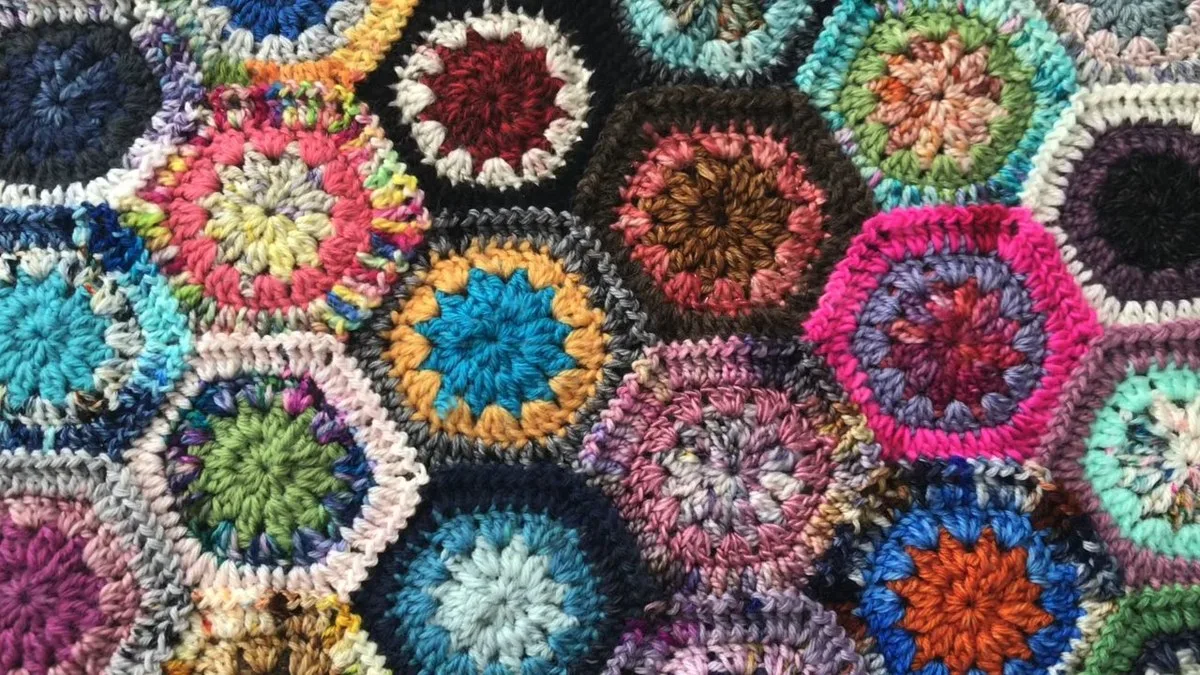
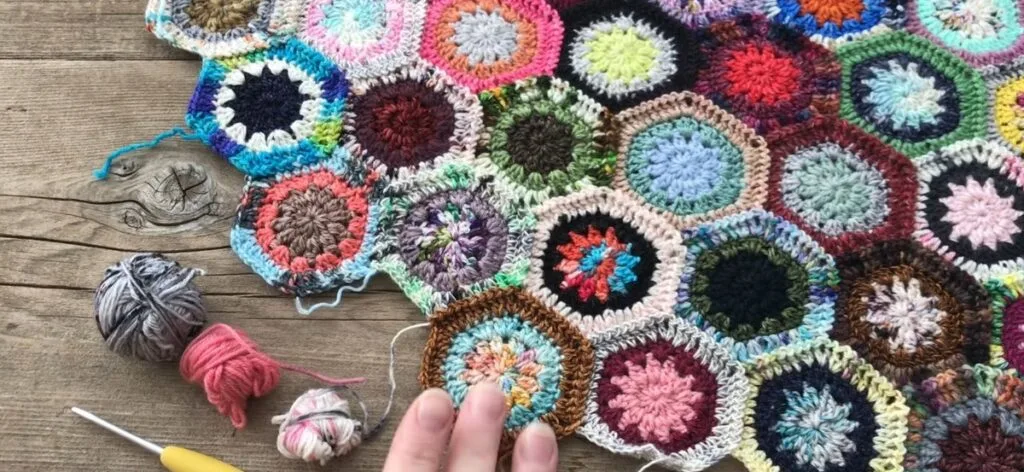
A crochet hexagon blanket made from scrap yarn is built from small four-round hexagons that you join to each other as you crochet the last round, so there is no sewing at the end and almost no ends to weave in. This guide gives every step with a photo, a table that turns a blanket size into a number of hexagons, and the mistakes that make the joins pucker.

What makes it scrappy: each hexagon uses three tiny amounts of fingering weight yarn, one for each of the first three rounds, and a third colour for the joining round. The creator says many of the leftover pieces weigh less than a gram and still do the job, because one round needs very little yarn. Nothing here needs a full skein.
Three things below are the creator’s own choices, not rules: fingering weight scraps, a C/2.75 mm hook, and joining while crocheting the last round. The creator prints no hexagon size, no gauge and no yardage, so the size table is our own arithmetic, labelled as such, because we have not made this blanket ourselves.
- Crochet Hexagon Blanket at a Glance
- Two Ways to Name the Stitches
- What You Need for a Crochet Hexagon Blanket
- Crochet Hexagon Blanket Size: How Many Hexagons
- Crochet Hexagon Blanket: Step by Step
- Where a Crochet Hexagon Blanket Goes Wrong
- Five More Free Crochet Hexagon Blanket Patterns
- Crochet Hexagon Blanket FAQ
- More Scrap-Friendly Patterns to Try Next
Crochet Hexagon Blanket at a Glance
Every hexagon in this crochet hexagon blanket is four rounds: a wheel of 12 double crochets, a round of 12 double crochet two together stitches, a round of 12 clusters of 3, and a last round with six corners. The last round is the one that joins.
| Round | What you work | Count |
|---|---|---|
| Round 1 | Chain 4, then 11 double crochets in the 4th chain from the hook; slip stitch into the top of the first chain 3 | 12 double crochets |
| Round 2 | Chain 2 and a first dc2tog in the first space, chain 1, then dc2tog and chain 1 in each space around; join, fasten off | 12 dc2tog and 12 chain-1 spaces |
| Round 3 | New colour in a chain-1 space, chain 3, 2 double crochets in the same space, 3 double crochets in each chain-1 space; join, fasten off | 12 sets of 3 double crochets |
| Round 4 | New colour in the right-most stitch of a cluster, chain 3, then double crochets with corners every second cluster; join | 54 double crochets and 6 corners (our count) |
Stitch multiple: round 3 has a stitch multiple of 3, one cluster per chain-1 space, and round 4 works in a stitch multiple of 6, one plain cluster of 3 followed by one corner cluster. The count of 54 double crochets in round 4 is ours: six repeats of 3 plain plus 6 corner double crochets. The creator does not say it aloud, and the written pattern leaves it to you to count.
The special stitch: dc2tog means yarn over, insert the hook in the space, yarn over, pull up a loop, yarn over and pull through 2 loops; repeat in the same space; yarn over and pull through all 3 loops on the hook. It makes a neat flat peak, and the round of them is what gives the centre its star.
Two Ways to Name the Stitches
The written pattern uses a naming convention where a double crochet starts with a yarn over before you insert the hook. In other conventions that same stitch is called a treble, and a short stitch with no yarn over is the double crochet. Mixing the two is the commonest reason a crochet hexagon blanket motif comes out too tall or too flat.
| In this guide | What you do | Called in other conventions |
|---|---|---|
| Double crochet | Yarn over, insert the hook, pull up a loop, yarn over and pull through 2 loops, twice | Treble |
| dc2tog | Two unfinished double crochets worked into the same space, then closed together | Treble two together |
| Slip stitch | Insert the hook, pull the yarn through the stitch and the loop on the hook | Same |
| Chain space | The gap made by a chain between two stitches | Same |
Other designers write round 1 differently. We read five free hexagon blankets, and they start with a ring or with a chain; the Snowflake Hexagon Blanket, the Wildflower Hexagon Motif Blanket and the Simply Yarn hexagon blanket are all six-round or three-round motifs in thicker yarn. The creator here starts with a chain of 4, and the 4th chain from the hook is where the 11 double crochets go. Follow one written pattern to the end rather than blending two.
What You Need for a Crochet Hexagon Blanket
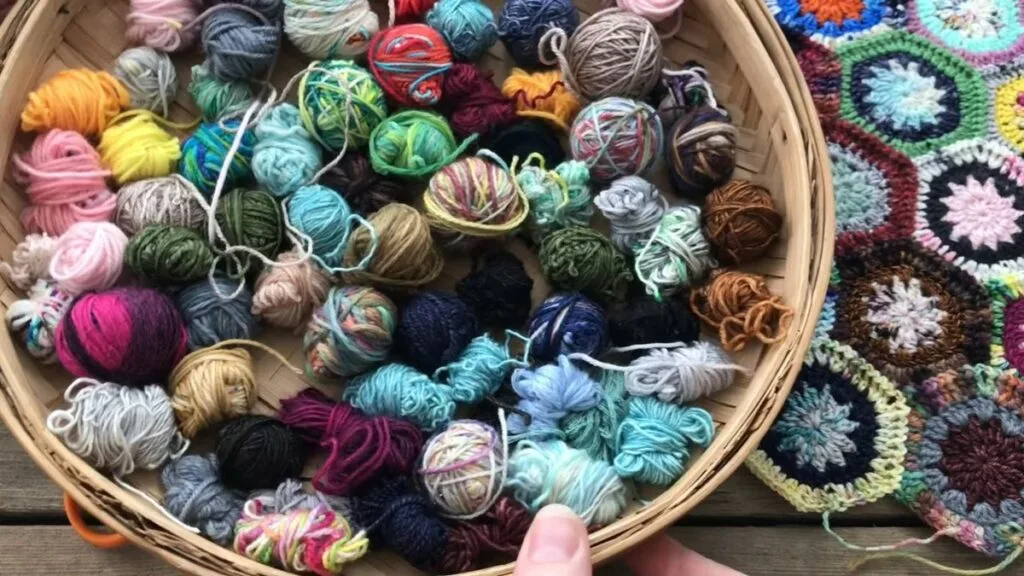
The kit for this scrap crochet hexagon blanket is almost nothing: fingering weight leftovers in many colours, a small hook, scissors and a yarn needle. The creator keeps a basket of tiny balls and picks three that look good together for each hexagon.
| Item | What to use |
|---|---|
| Yarn | Fingering weight leftovers (Craft Yarn Council category 1), three colours per hexagon; any bits left over from socks or shawls |
| Hook | C/2.75 mm in the sample |
| Tools | Scissors; a yarn needle only for the last tails along the edge |
| Skill level | Comfortable beginner: chain, double crochet, slip stitch, dc2tog |
Hook note: the Craft Yarn Council lists 2.25 to 3.5 mm for fingering weight, so the creator’s 2.75 mm sits inside that range. The five designers we read all use thicker yarn, with hooks from 4 to 6 mm, and print 6.5 to 7 inch hexagons for worsted. A fingering weight hexagon will usually be smaller, which is why a small hook and thin scraps suit this style of crochet hexagon blanket.
Crochet Hexagon Blanket Size: How Many Hexagons
The creator shows how to make hexagons and join them, not a finished size, so no hexagon width, gauge or yardage is printed. We worked out the number of hexagons for three blanket sizes that designers print. Make one hexagon, press it flat, and measure it from one flat side to the opposite flat side. Then use the table: a regular hexagon covers 0.866 x width x width square inches, and joined hexagons share their edges.
| Blanket size | Area | Hexagons at 3 in wide | Hexagons at 4 in wide | Hexagons at 5 in wide |
|---|---|---|---|---|
| 52 x 59 in | 3,068 sq in | 394 | 222 | 142 |
| 54 x 60 in | 3,240 sq in | 416 | 234 | 150 |
| 68 x 44 in | 2,992 sq in | 384 | 216 | 139 |
How we got these: a 52 x 59 in blanket has 3,068 square inches; one 4 in hexagon covers 0.866 x 4 x 4 = 13.9 square inches, so 3,068 divided by 13.9 gives 222 hexagons. The sizes come from three printed blankets: the Wildflower blanket at 52 x 59 in, the Red Heart Hexagon Granny blanket at 54 x 60 in and the Snowflake blanket at 68 x 44 in.
A reality check: the table is an upper estimate before borders and half hexagons. The Snowflake blanket prints 60 hexagons about 7 in across for 68 x 44 in, and the Wildflower blanket needs 44 full hexagons plus half, quarter and partial ones for 52 x 59 in, which are fewer than the formula gives, because a straight edge, a border or an applique fills the space. Use the table to plan yarn and time, and lay your hexagons out on the floor before you decide the last row. Our guide on how big a baby blanket should be covers smaller sizes.
| Pattern | Area | Printed yarn | Yards per square inch |
|---|---|---|---|
| Wildflower (worsted, 5.5 mm) | 3,068 sq in | 5,390 yd | 1.76 |
| Snowflake (worsted, 6 mm) | 2,992 sq in | 1,920 yd | 0.64 |
| Simply Yarn (DK, 4 mm) | 2,386 sq in | 2,871 yd | 1.20 |
Yarn, honestly: the creator names no yardage, and fingering weight scraps are a different thing from the worsted and DK yarns above. Three designers print both a size and a total, and they work out between 0.64 and 1.76 yd per square inch for heavier yarn, so a blanket of this size is a long project: the Snowflake total is 1,920 yd, the Wildflower total about 5,390 yd and the Simply Yarn total 21 balls of 125 m, about 2,871 yd. We do not turn those into a fingering weight figure. Instead, count hexagons and keep a tally.
Crochet Hexagon Blanket: Step by Step
Work every step of the crochet hexagon blanket with the C/2.75 mm hook and fingering weight yarn. Steps 1 to 3 make the wheel of round 1, steps 4 to 6 add the dc2tog round, steps 7 and 8 add the cluster round, and steps 9 to 14 work the joining round that makes the crochet hexagon blanket.
Step 1: Make a slip knot and chain 4
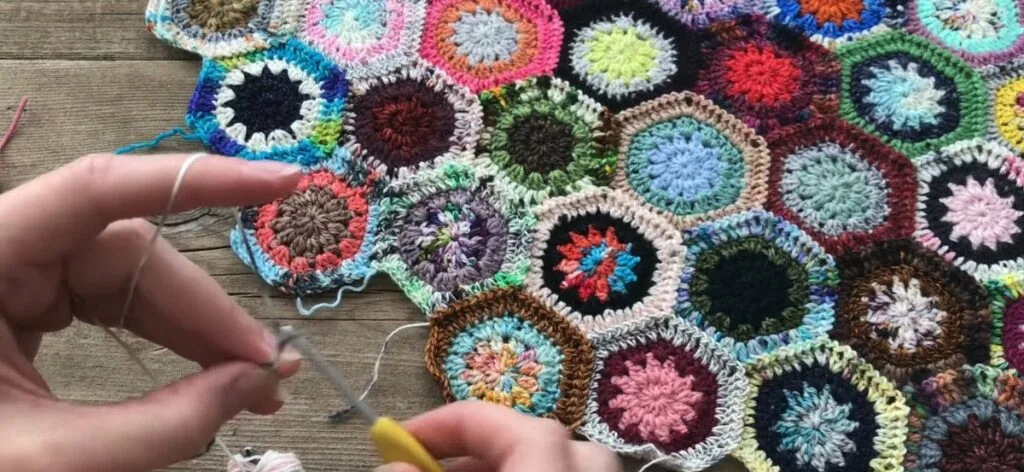
Start with a slip knot and chain 4. Leave a tail of a few inches; you will crochet over it, so it never needs weaving in. The chain of 4 is only a base for the first round.
Step 2: Work 11 double crochets in the 4th chain from the hook
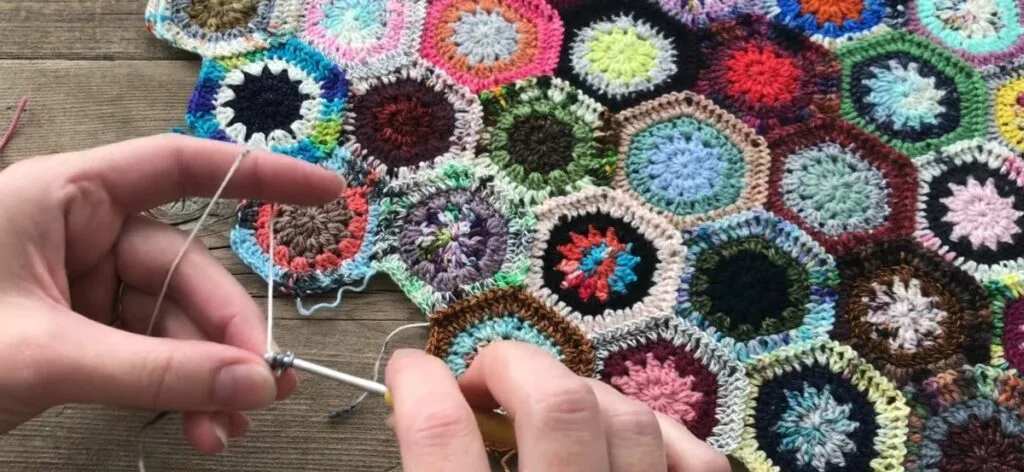
Put 11 double crochets into the 4th chain from the hook, which is the very first chain you made. The first chain 3 counts as a double crochet, so the round holds 12 stitches in all. Count the spokes and give the tail a firm pull, so the centre has no gap.
Step 3: Join round 1 with a slip stitch
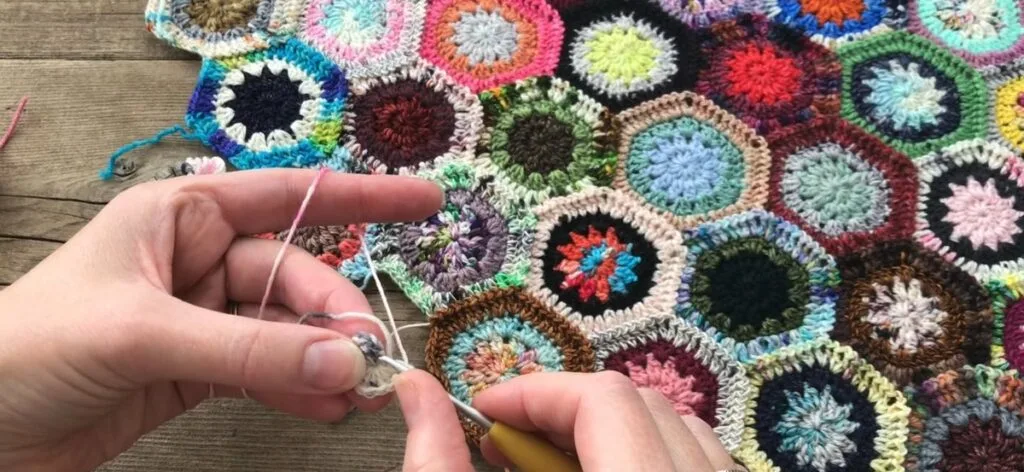
Slip stitch into the top of the first chain 3. It is fiddly, so check that you have two strands of yarn on top of the hook. Crochet over the tail now, in the next stitches, and it is hidden. Slip stitch into the next space between two spokes, ready for round 2 of your crochet hexagon blanket motif.
Step 4: Chain 2 and make the first dc2tog of round 2

Round 2 starts differently from the rest. Chain 2, then yarn over, insert the hook in the same space, yarn over, pull up a loop, yarn over and pull through all 3 loops on the hook. Chain 1. The chain 2 stands in for the first half of the stitch.
Step 5: Work dc2tog and chain 1 in each space around
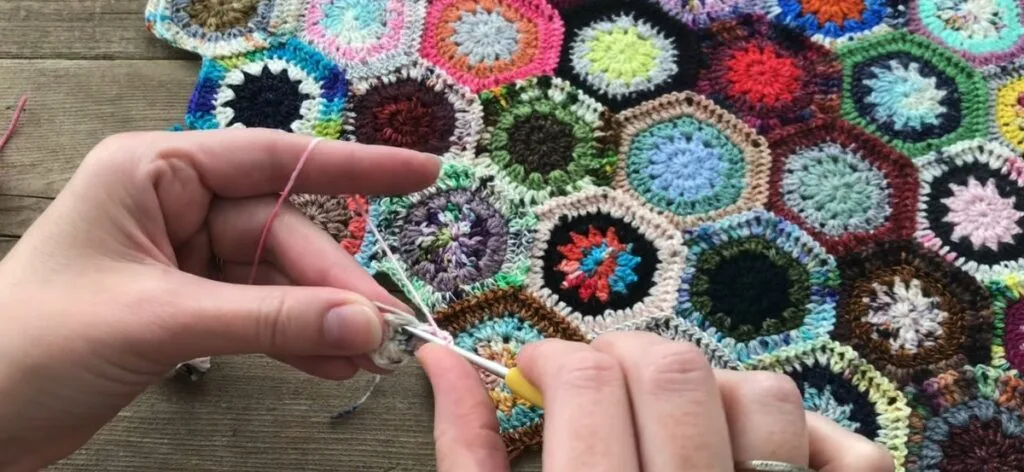
Now work a full dc2tog in the next space between spokes, then chain 1. Repeat all the way around; keep crocheting over the tail. The count is 12 dc2tog stitches with a chain 1 between each pair.
Step 6: Join and fasten off round 2
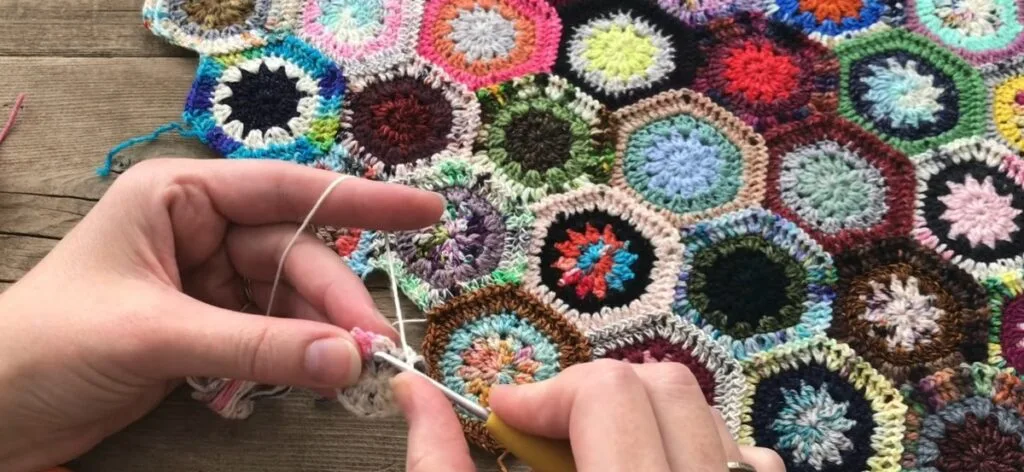
Count 12 dc2tog stitches and 12 chain-1 spaces. Slip stitch into the top of the first dc2tog, with two strands on the hook, then cut the yarn and pull it through. Keep the last scrap: the next round uses even less yarn.
Step 7: Join the second colour and chain 3

For round 3 of the crochet hexagon blanket, pick up the second colour and join it in any chain-1 space, a couple of stitches away from the previous join. Pull a loop through, chain 1 holding the tail and working yarn together to lock them, drop the tail, and chain 2 more: 3 chains in all. Work 2 double crochets in the same space.
Step 8: Work 3 double crochets in every chain-1 space
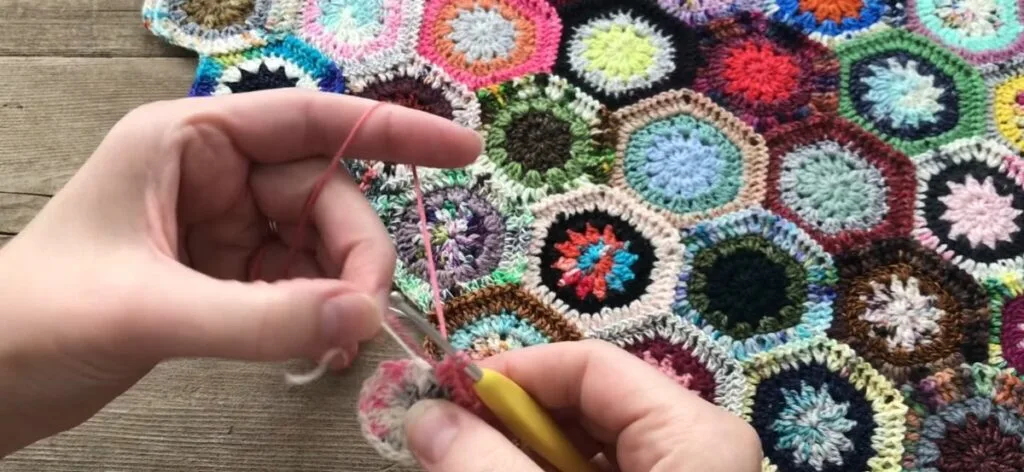
This is the easiest round: 3 double crochets into each chain-1 space, all the way around, crocheting over the old tail. When you come back to the start, you have 12 sets of 3. Slip stitch into the top of the chain 3 and fasten off.
Step 9: Join the third colour on round 4
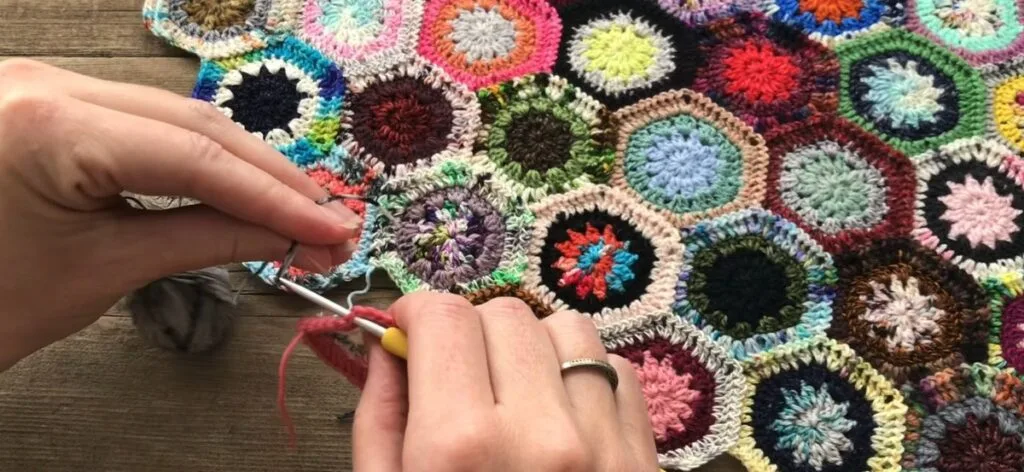
Round 4 is the joining round. Pick the third colour, skip 2 clusters from the old joining spot, and join in the right-most stitch of the next cluster of 3. Chain 3, work a double crochet in each of the next 2 stitches, and you have worked your first plain cluster. For the first hexagon of a crochet hexagon blanket, with no neighbours, you can simply work the round all the way around.
Step 10: Work the first corner
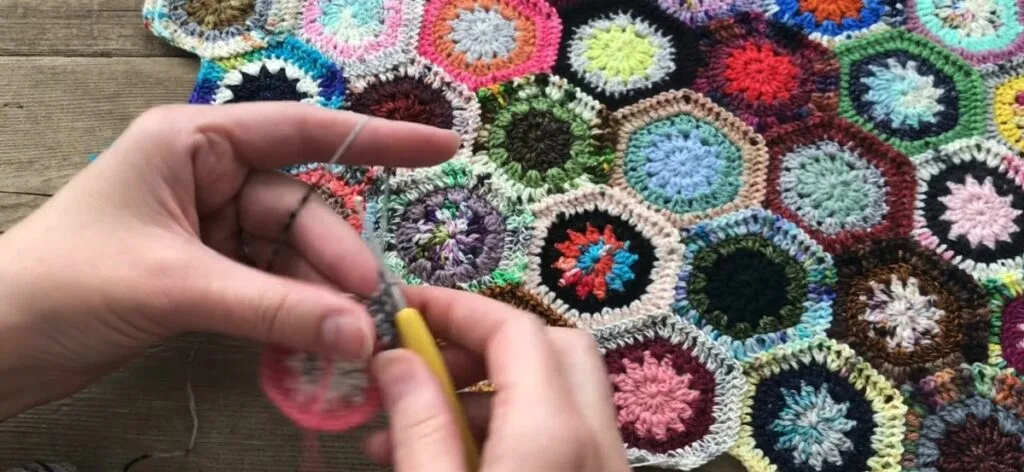
The next cluster is a corner: 2 double crochets in the first stitch, a double crochet, chain 2 and a double crochet in the middle stitch, then 2 double crochets in the last stitch. From here on you alternate: 3 plain double crochets, then a corner cluster. That makes 6 corners around the hexagon.
Step 11: Join to the first neighbour with a slip stitch
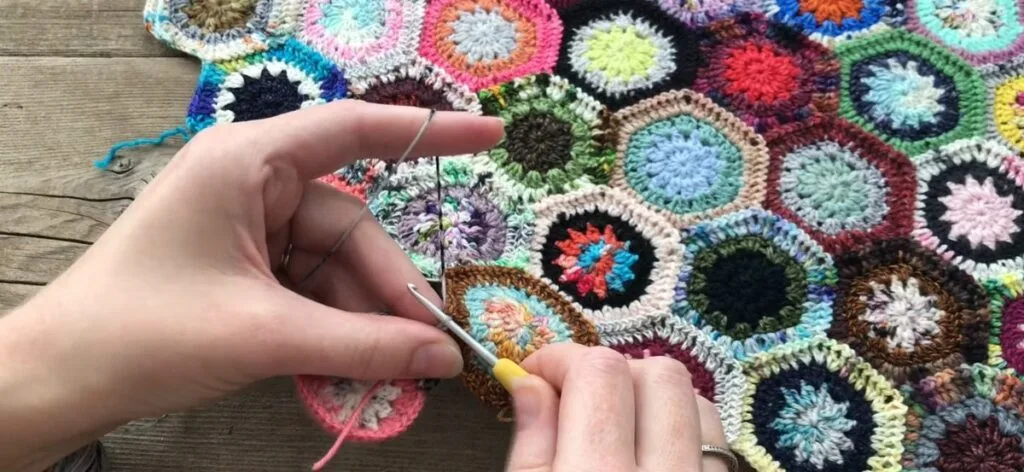
When a corner touches a neighbour, work a double crochet, chain 1 and slip stitch into the neighbour’s corner space instead of chain 2; the slip stitch counts as the second chain. Then work the next double crochet in the same stitch. Along the joined side, after each double crochet, slip stitch into the next space between posts on the neighbour.
Step 12: Join the second corner to two neighbours
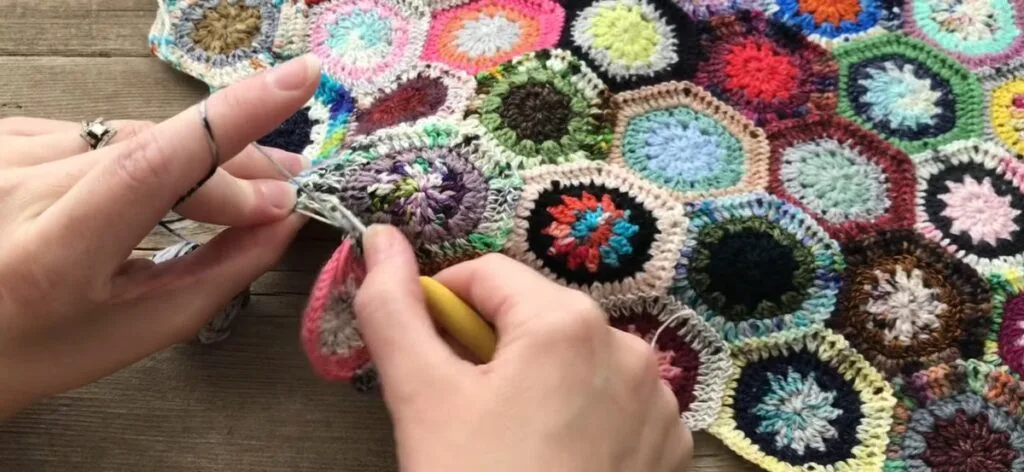
A corner next to two neighbours gets two slip stitches, one into each neighbour’s corner space. Crochet over the tails of the neighbours as you go; they hide in the stitches, and the back stays neat. Pull a stray tail up out of the way if it flips over.
Step 13: Join the last corner and finish the round
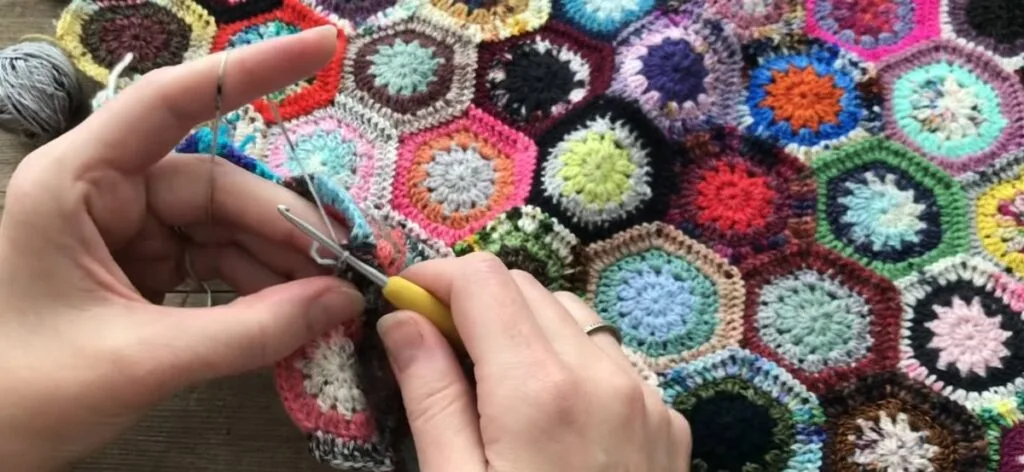
At the last corner, join with a slip stitch into the corner space, chain 1 to finish the corner, work a double crochet and then 2 double crochets in the next stitch. Repeat the pattern to the end of the round. This crochet hexagon blanket hexagon has joined on 3 sides.
Step 14: Slip stitch, fasten off and trim the tail
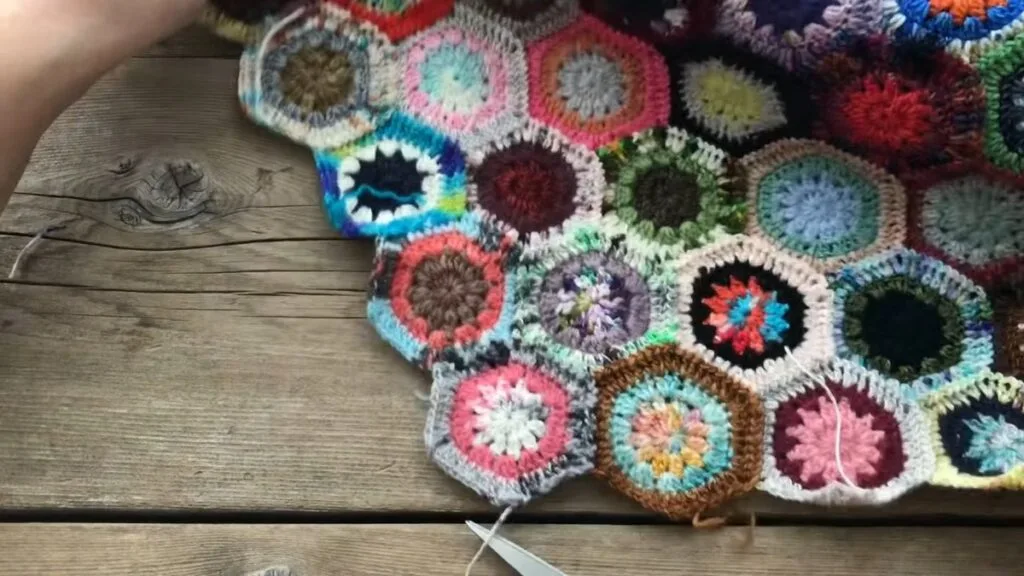
Slip stitch into the top of the chain 3, cut the yarn, pull it through and snip the one tail left on the back. Every other end of the crochet hexagon blanket motif is already inside a stitch, and only the ends along the edge are left, which you crochet over when you join the next hexagon.
Where a Crochet Hexagon Blanket Goes Wrong
The centre has a gap
A loose start leaves a hole in the middle of every hexagon, and in a crochet hexagon blanket you see dozens of them. After the 12 double crochets of round 1, give the starting tail a firm extra pull, then crochet over it. The creator does this every time.
The joins pucker or skip a space
The usual cause in a crochet hexagon blanket is joining into the wrong space. Find the corner space of the neighbour, the bigger hole made by the chain 2, and slip stitch into that. Along the sides, go over the post and into the space after it. If you miss one, the seam pulls the two hexagons out of line, so check each side as you pass it.
The slip stitch into the chain 3 is awkward
Closing a round into the top of the chain 3 is fiddly on thin yarn, because the stitch is tiny. Look for two threads on top of the stitch and hook both. If you pick only one, the join leaves a gap you will see on the right side.
Tails get tangled in the join
When you crochet over tails, a neighbour’s tail can flip over and end up in the wrong hexagon. Tuck it under and keep it on its own hexagon, as the creator does, then cut the leftover ends after the round. A tidy back is the reward for crocheting over tails in a crochet hexagon blanket.
Five More Free Crochet Hexagon Blanket Patterns
These are five other free hexagon blankets we read. We list only what each page prints, and say what is missing.
| Pattern | Yarn and hook | Printed size | Printed yarn |
|---|---|---|---|
| Snowflake Hexagon Blanket (The Purple Poncho) | Red Heart With Love, worsted; 6 mm | 68 x 44 in, 60 hexagons about 7 in across | 1,920 yd |
| Wildflower Hexagon Motif Blanket (Marly Bird) | Herrschners Worsted 8; 5.5 mm | 52 x 59 in, hexagon 6.5 in | about 5,390 yd |
| Colourful Crochet Hexagon Blanket (Simply Yarn) | Rico Baby Cotton Soft DK; 4 mm | about 140 x 110 cm | 21 balls of 125 m |
| Hexagon Granny Crochet Blanket (Red Heart) | worsted; 5.5 mm | 54 x 60 in | not printed on the page |
| Crochet Hexagon Afghan (Caron) | Caron Simply Soft | 54 x 56.5 in | not printed on the page |
What the five pages leave out: none prints a gauge, and two print no yardage on the page at all, because the details sit in a downloadable file. The Simply Yarn page also gives two different hexagon counts, so check its notes before you buy yarn. The Simply Yarn hook, 4 mm, sits below the Craft Yarn Council range of 4.5 to 5.5 mm for DK, a sign that designers pick a hook for the drape they want.
Crochet Hexagon Blanket FAQ
How do you make a crochet hexagon blanket?
Make one hexagon in four rounds, then join the next hexagons to it while you work the last round with slip stitches, so the crochet hexagon blanket grows without sewing. The sample hexagon is 12 double crochets, 12 dc2tog stitches, 12 clusters of 3 and a six-corner last round.
How many hexagons do I need for a crochet hexagon blanket?
It depends on the width of one hexagon. By our arithmetic, a 52 x 59 in blanket needs about 394 hexagons at 3 in wide, 222 at 4 in and 142 at 5 in, before borders. Measure your own hexagon, because the creator prints no size.
What hook goes with fingering weight yarn?
The creator uses a C/2.75 mm hook, which sits inside the Craft Yarn Council range of 2.25 to 3.5 mm for fingering weight. A larger hook makes a bigger, lacier hexagon, so swatch one motif first.
What does join as you go mean for a hexagon?
It means you attach each new hexagon to its neighbours during its last round, with a slip stitch in place of a chain at the corners and a slip stitch between posts along the sides. It saves sewing the motifs together at the end.
Can I make a scrap yarn hexagon blanket with other yarn weights?
Yes, a crochet hexagon blanket uses the same pattern in DK or worsted; the five designers we read use 4 to 6 mm hooks. The hexagon just grows, so you need fewer of them, and the yarn total rises, from 1,920 yd to about 5,390 yd in the two worsted blankets.
Is a hexagon blanket good for beginners?
Yes, a crochet hexagon blanket suits you if you can chain, make a double crochet and a slip stitch. The two fiddly parts are the dc2tog in round 2 and finding the right space when you join, and both get easier after the second hexagon.
More Scrap-Friendly Patterns to Try Next
If you enjoy small round motifs, the free crochet snowflake pattern and the puff stitch crochet snowflake use the same idea of a wheel built round by round. For a quick scrappy project, try the moss stitch crochet scarf, or turn motifs into the crochet granny square cardigan. Browse all free patterns on the site.
Sources
- The Purple Poncho, Snowflake Hexagon Blanket
- Marly Bird, Wildflower Hexagon Motif Blanket
- Simply Yarn, free crochet hexagon blanket pattern
- Yarnspirations, Red Heart Hexagon Granny Crochet Blanket
- Yarnspirations, Caron Crochet Hexagon Afghan
- Craft Yarn Council, yarn weight system
Pattern credit: this hexagon design is by the crochet channel Noble Character Crafts.