Crochet Skirt: Easy Ruffles for a Happy Autumn Look
A crochet skirt can start as a plain waistband and end as a full, ruffled skirt, and this one needs only three stitches to get there: the chain, the half double crochet and the double crochet. Below you get all 19 rounds with a photo for every stage, the stitch counts for each increase, a table that turns your waist size into a band length, and the mistakes that make a crochet skirt too tight or too narrow.
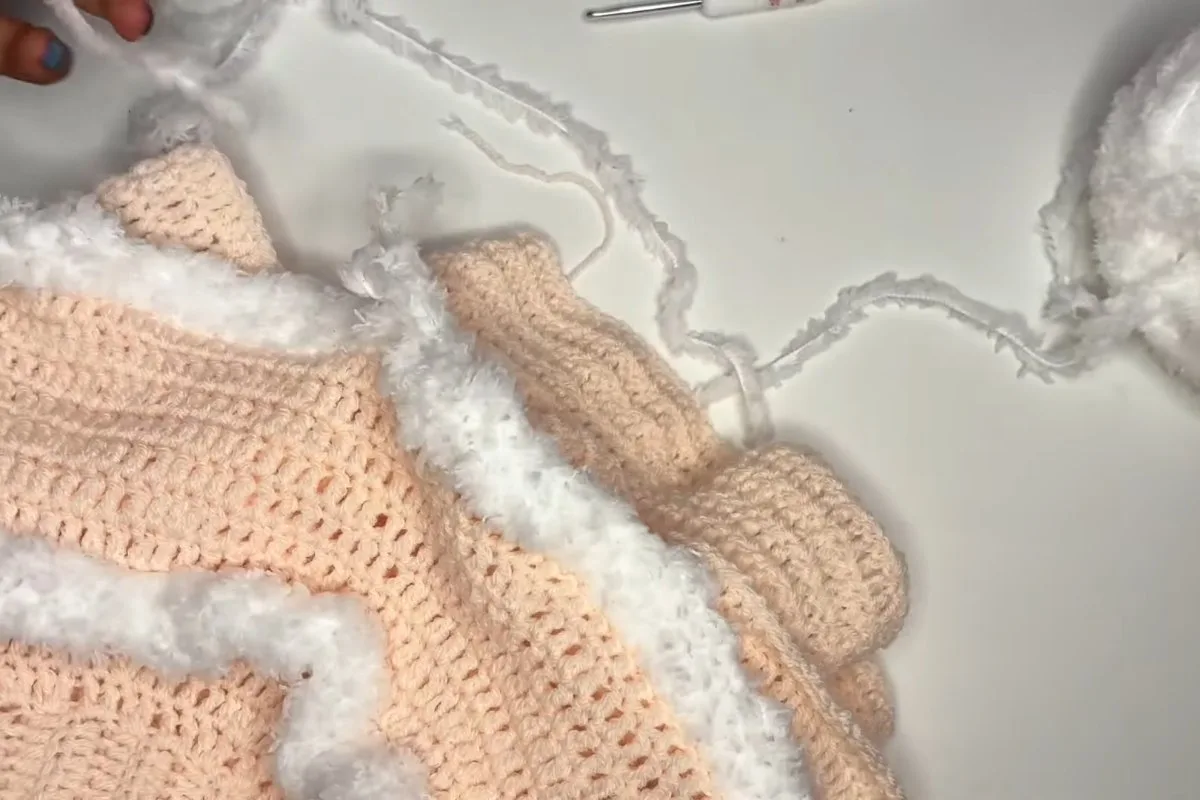
The correction up front: the creator of this design does not give a hook size, a yardage or a finished length. She does give every increase round as a count, plus one measurement, her own waist band, which she makes 22 in long for a 24 in waist. That is why the waist table below is our arithmetic from her example, and why you should swatch before you cast on.
This is a beginner-friendly crochet skirt because there is no pattern chart: you work a band, close it into a ring, and then widen the ring round by round. If you can make a double crochet, you can make it. Layer it over tights with a sweater, such as our crochet pullover sweater, and it works as an autumn skirt.
- Crochet Skirt at a Glance
- What You Need for a Crochet Skirt
- Crochet Skirt Waistband by Waist Size
- Crochet Skirt: Step by Step
- How the Crochet Skirt Grows
- Where a Crochet Skirt Goes Wrong
- Five More Free Crochet Skirt Patterns
- Crochet Skirt FAQ
- Pieces to Make With It
Crochet Skirt at a Glance
The crochet skirt is made in two parts. First a flat band, worked in rows and sewn into a ring with slip stitches. Then the skirt itself, worked in rounds down from the band, with nine increase rounds and a few plain ones between them.
| Part | What you work | Count |
|---|---|---|
| Waistband | Chain 10, then half double crochet in the back loop only, row after row | 10 stitches per row, as many rows as your waist needs |
| Round 1 | Chain 3, then 2 double crochets in each half double crochet along the band edge | 2 double crochets per band row |
| Rounds 2 to 3 | 5 double crochets then an increase, then 10 double crochets then an increase | increase = 2 double crochets in one stitch |
| Rounds 4 to 6 | Rounds 4 and 5 plain; round 6 plain in the back loops only | no increases |
| Rounds 7 to 8 | 15 double crochets then an increase; 30 double crochets then an increase | increase on every 16th and 31st stitch |
| Rounds 9 to 13 | Round 9 plain; rounds 10 and 11 as round 7; round 12 plain; round 13 plain in the back loops | two more increase rounds |
| Rounds 14 to 19 | 8 double crochets then an increase; 5 then an increase; 2 then an increase; then 3 plain rounds | the creator stopped at round 19 |
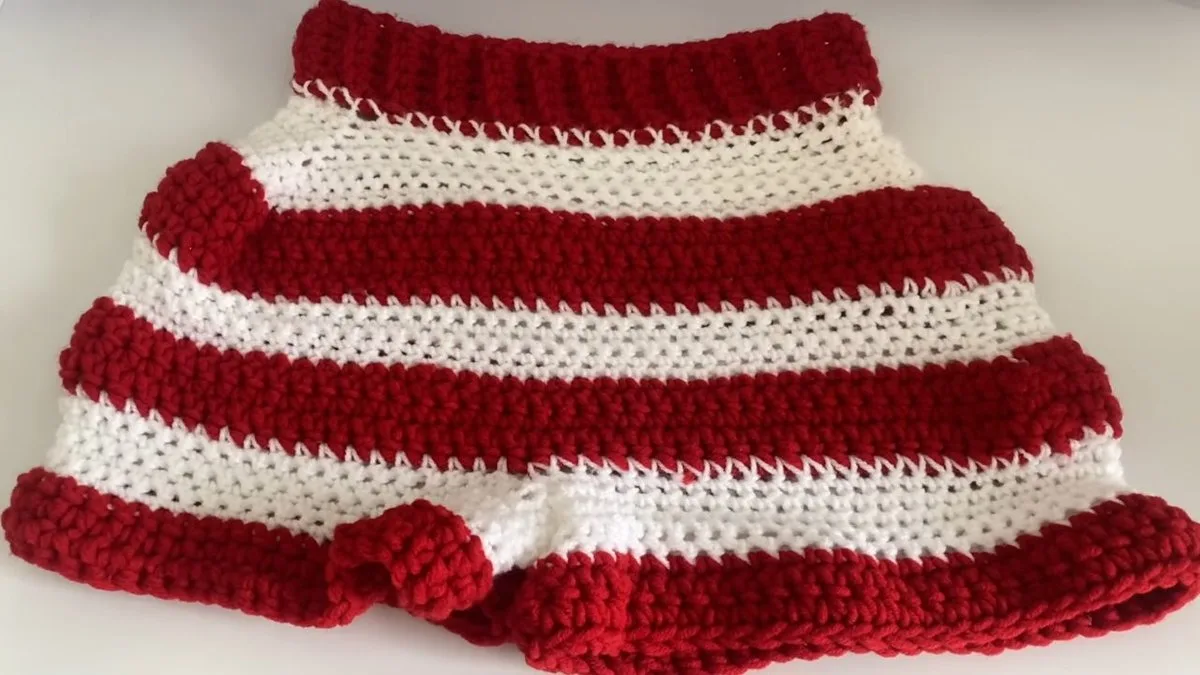
| Ruffles | Fluffy yarn, double crochet in the front loops of round 6 and round 13, plus a plain ruffle on the last round | no increases |
What makes it easy: there is no stitch multiple to chain to. The band decides your waist, and round 1 simply follows the band. The skirt has no single stitch multiple, because round 2 repeats a group of 6 stitches, round 3 a group of 11, and so on, so the last group in a round is often short. The creator simply works to the end of each round and carries on.
What You Need for a Crochet Skirt
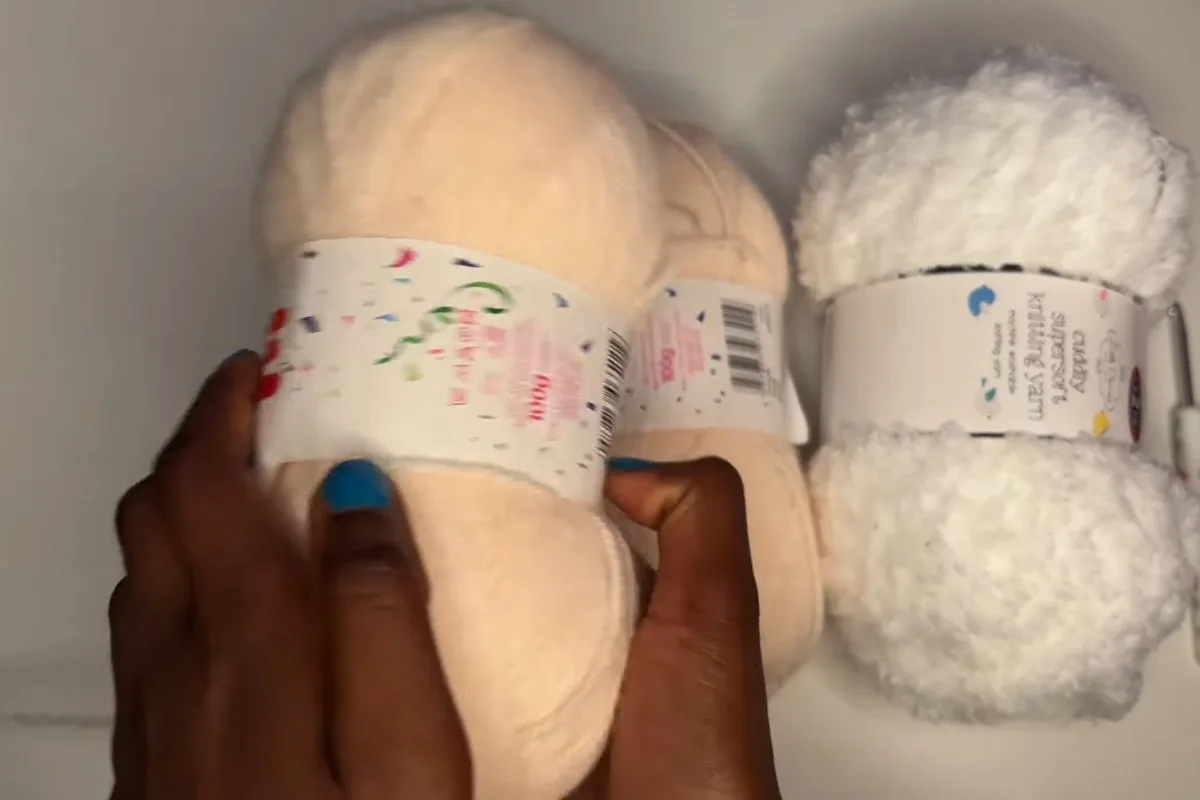
The kit is small: a smooth plain yarn for the body, a fluffy yarn for the ruffles, a crochet hook, a stitch marker and scissors. The creator works the body in a 4-ply yarn and says it is not the yarn she used for her first skirt, only one she wanted to use up.
| Item | What to use |
|---|---|
| Body yarn | A smooth 4-ply yarn, as the creator names it; a DK yarn is the closest standard weight |
| Ruffle yarn | A fluffy, soft knitting yarn in a contrast colour; you need a little, because only three rounds use it |
| Hook | Not stated by the creator, so choose the hook that suits your yarn label and swatch |
| Tools | Stitch marker for the first stitch of each round, scissors, darning needle for ends |
| Yardage | Not stated; the free skirts below range from 535 to 735 yd of lace weight to 3 to 6 hanks of DK |
| Skill level | Beginner: chain, slip stitch, half double crochet, double crochet, working in the back loop |
Hook and yarn: the Craft Yarn Council gives 4.5 to 5.5 mm for light (category 3) yarn, which includes DK, and 5.5 to 6.5 mm for medium (category 4). Crochet Cakes works its A-line skirt in DK on a 4.0 mm hook, half a millimetre under the light range, and KnitcroAddict uses a 3.0 mm hook with lace weight, above the 2.25 mm top of the lace range. Both are deliberate choices for a denser fabric, so a skirt hook often sits below the label range. Swatch first and pick the hook that gives a fabric that holds its shape and does not gape.
Terms: this design uses the double crochet naming convention, and we give both names where it matters. A half double crochet is a yarn over, hook in, pull a loop up and pull through all three loops. A back-loop stitch goes into the loop farthest from you, so the front loop is left as a ridge.
Crochet Skirt Waistband by Waist Size
The waistband is the only part of the crochet skirt that you measure against your body, so it is worth a minute. The creator has a 24 in waist and makes her band 22 in long, because the half double crochet in the back loop stretches. She also says you can simply make the band as long as your waist if you want no stretch at all.
| Size | Waist | Band length, 2 in under waist | Band length, no stretch |
|---|---|---|---|
| XS | 23 to 24 in (58 to 61 cm) | 21 to 22 in (53 to 56 cm) | 23 to 24 in |
| S | 25 to 26.5 in (64 to 67 cm) | 23 to 24.5 in (58 to 62 cm) | 25 to 26.5 in |
| M | 28 to 30 in (71 to 76 cm) | 26 to 28 in (66 to 71 cm) | 28 to 30 in |
| L | 32 to 34 in (81 to 86 cm) | 30 to 32 in (76 to 81 cm) | 32 to 34 in |
| XL | 36 to 38 in (91 to 97 cm) | 34 to 36 in (86 to 91 cm) | 36 to 38 in |
| 2X | 40 to 42 in (102 to 107 cm) | 38 to 40 in (97 to 102 cm) | 40 to 42 in |
| 3X | 44 to 45 in (112 to 114 cm) | 42 to 43 in (107 to 109 cm) | 44 to 45 in |
How we got these: the waist ranges are the Craft Yarn Council women’s size chart, and the band length is the waist minus 2 in, which is the creator’s own choice for a 24 in waist applied to every size. Other free skirts use different amounts: Caron fits its ribbed skirt with 0 to 1 in under the waist, and Crochet Cakes says its band over 1 in elastic stretches 3 to 4 in beyond the elastic size. Neither the creator nor we have a stretch figure for every yarn, so test the band against your waist before you close it.
Rows are the unknown: the creator does not say how many rows her band has, only that you keep working until it wraps around you. Count your rows when you close the band, because round 1 needs two double crochets for each one.
Crochet Skirt: Step by Step
Use the same hook all the way through and keep the fluffy yarn aside until the end. The body is worked in rounds that all begin with a chain 3 (which counts as the first double crochet) and end with a slip stitch into the top of that chain 3. Put a stitch marker in the first stitch of each round so you never lose your place.
Step 1: Chain 10 for the waistband
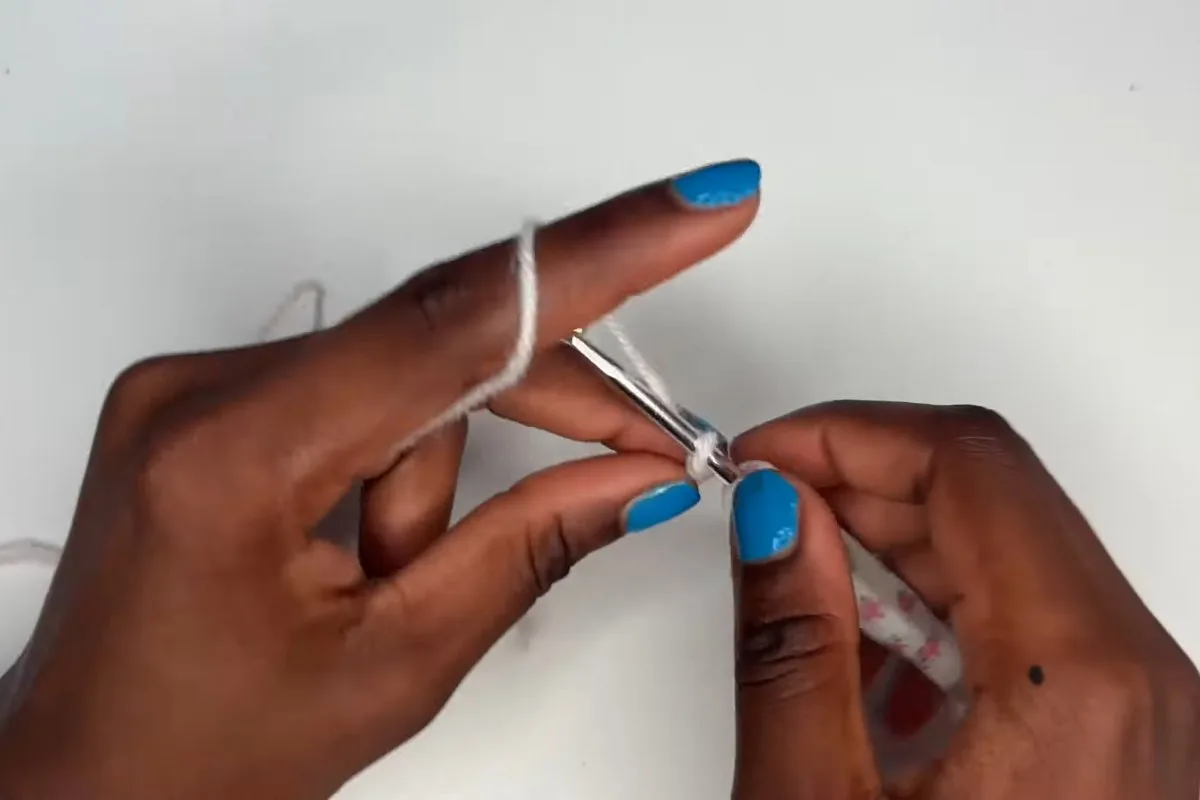
Make a slip knot and chain 10. Count the chains as you go, because the band is exactly 10 stitches wide. This chain is the width of the waistband.
Step 2: Work the first row of half double crochets
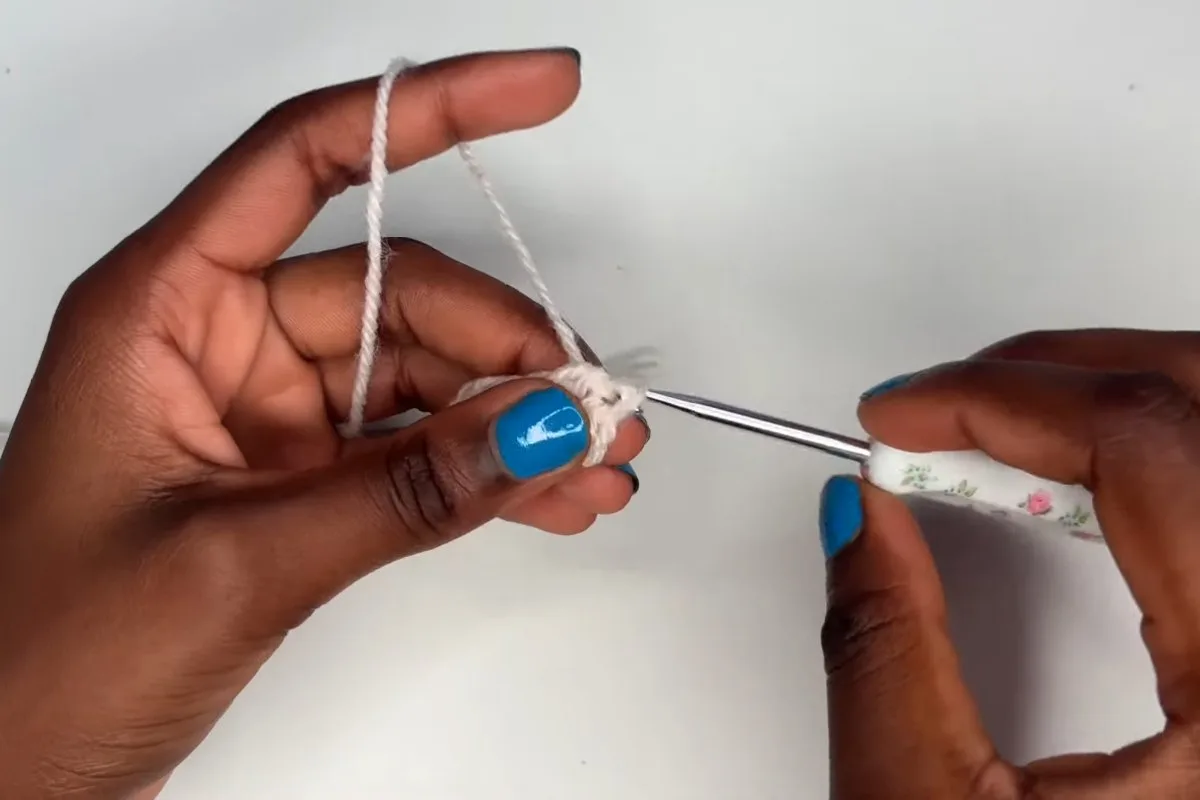
Chain 2 more for the turn. Then work a half double crochet into each chain: yarn over, hook in, pull up a loop, pull through all three loops. When the row is done you must have 10 half double crochets. If you are a beginner, put a stitch marker in the first stitch.
Step 3: Switch to the back loop only
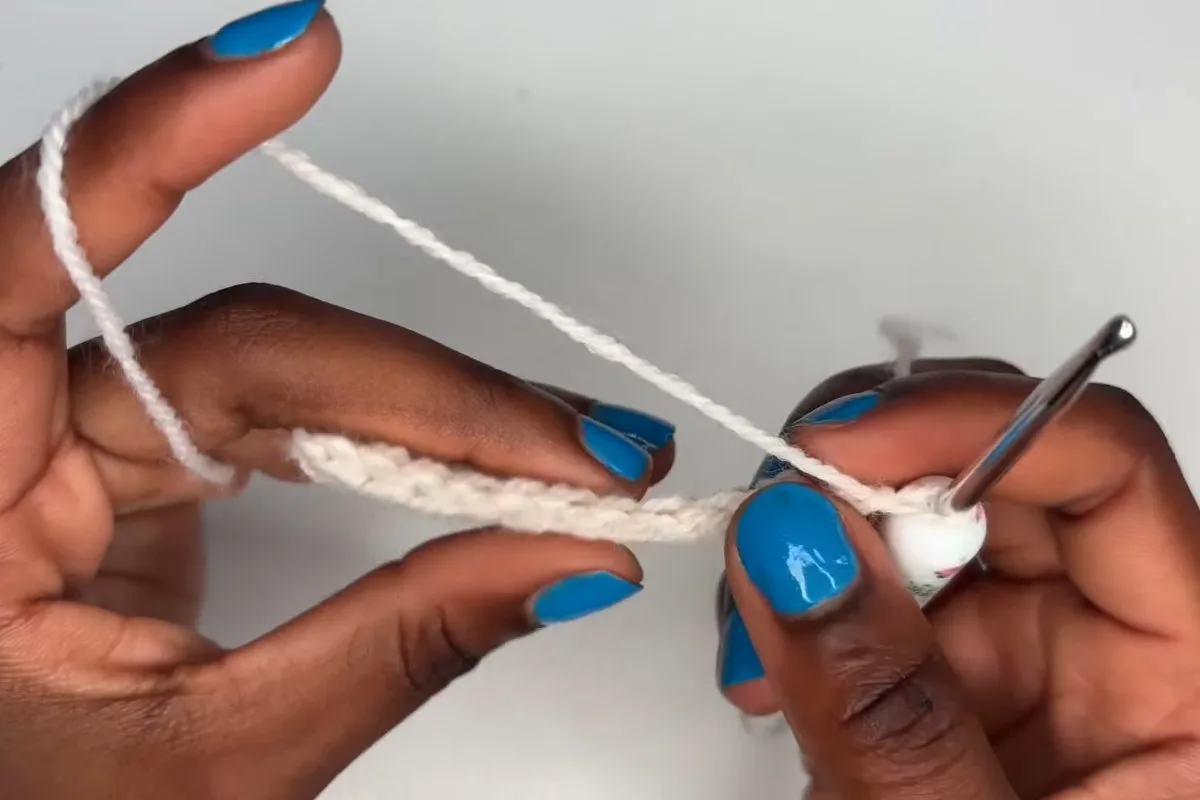
At the end of the row chain 2 (this chain does not count as a stitch) and turn. Now work every half double crochet into the back loop only, the single loop behind, not both. Continue row after row in the same way, always with 10 stitches.
Step 4: Make the band as long as your waist
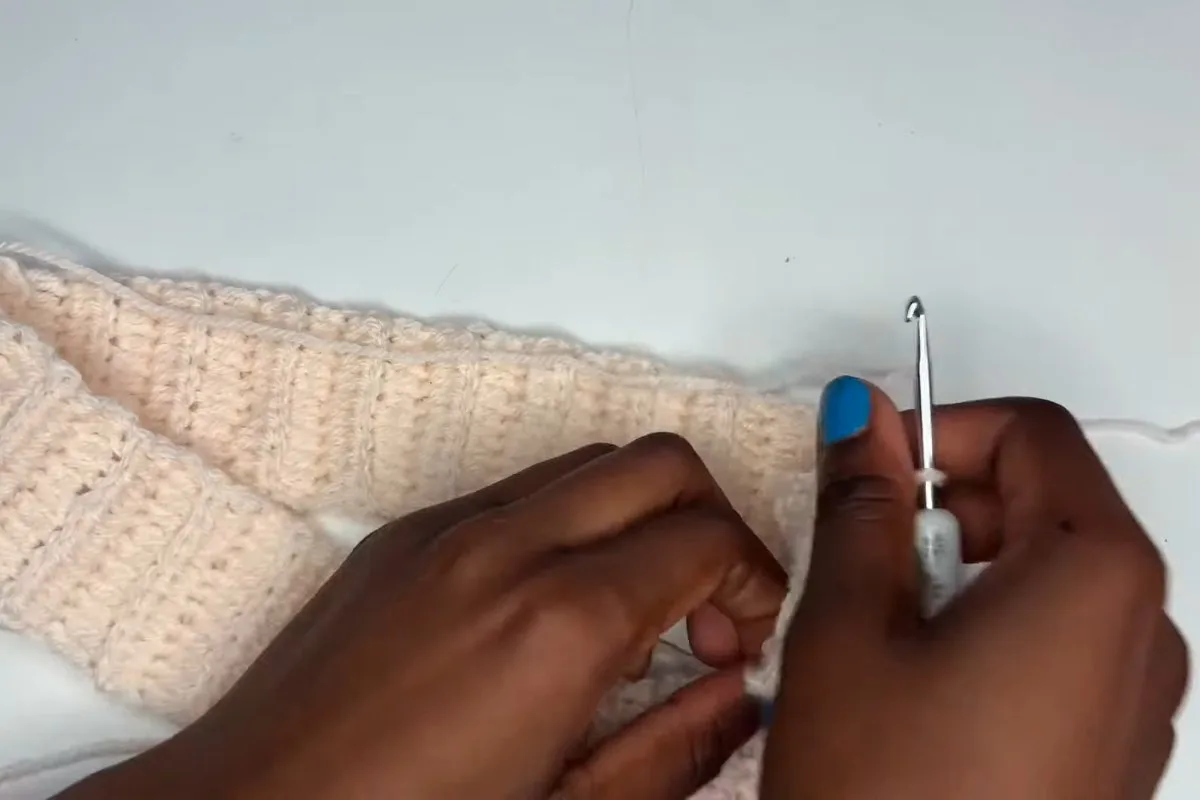
Keep working until the band wraps around your waist. The creator, with a 24 in waist, stops at 22 in so that the band stretches to fit. Use the table above for your size, and count the rows so you know your round 1 total.
Step 5: Close the band into a ring
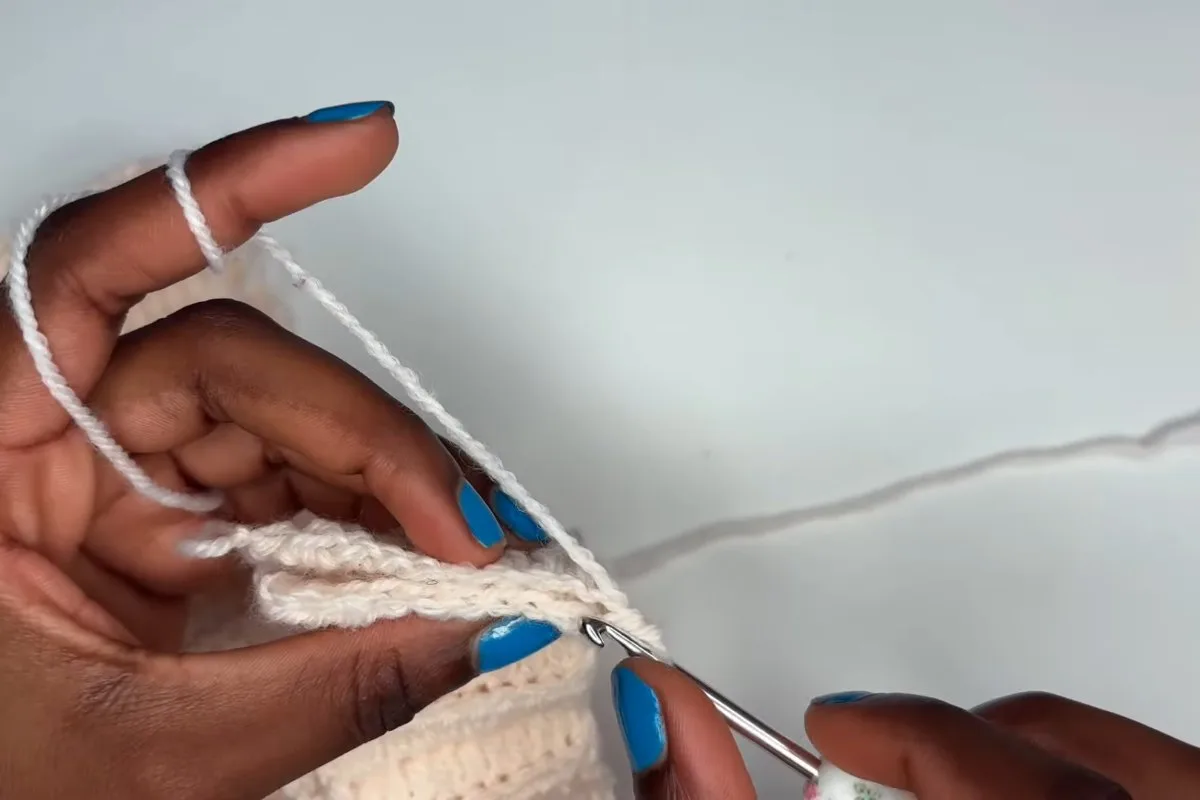
Chain 1, bring the two short ends together and slip stitch them closed through the back loops, going down the seam. Work all the way down so the seam sits flat. Turn it so the neat side faces out.
Step 6: Round 1: double crochet along the band
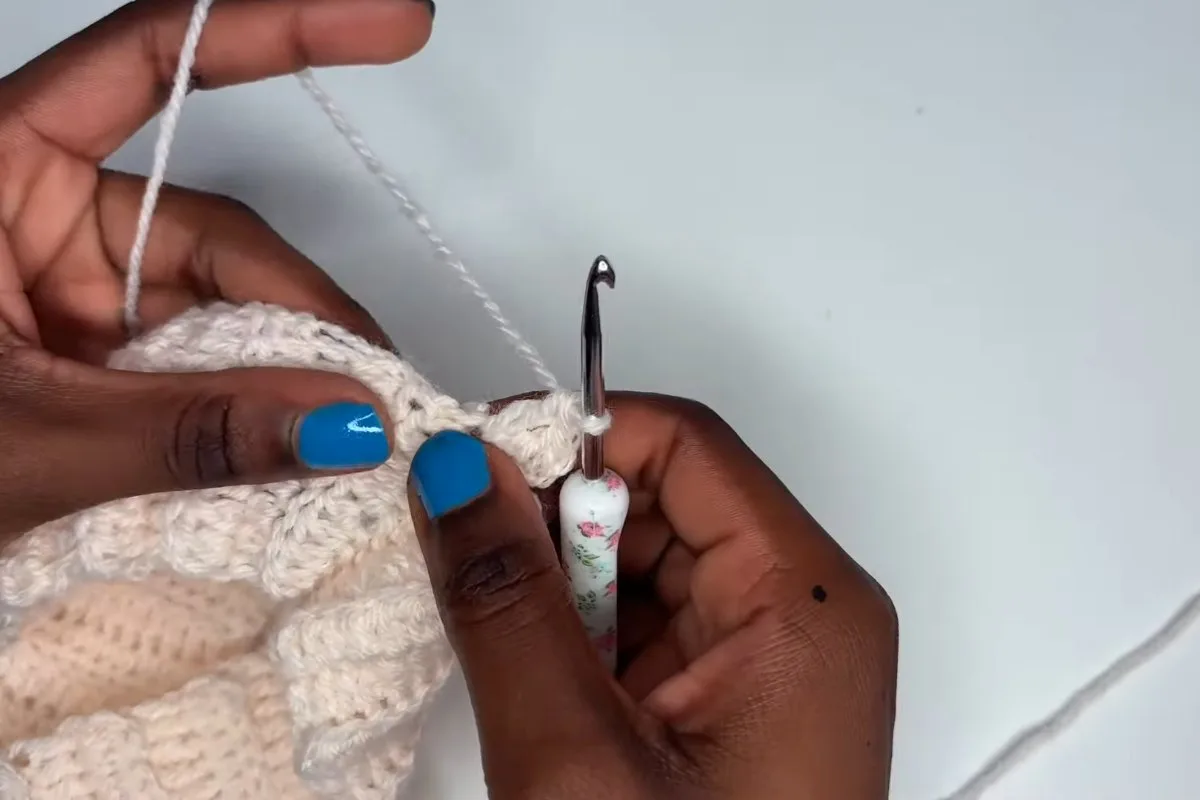
Chain 3 and work 2 double crochets in each half double crochet along the edge of the band. This round gives the first widening, and it holds 2 double crochets for each band row. This is our reading of the instruction: we count one half double crochet per row. Slip stitch into the third chain to finish.
Step 7: Round 2: 5 double crochets, then an increase
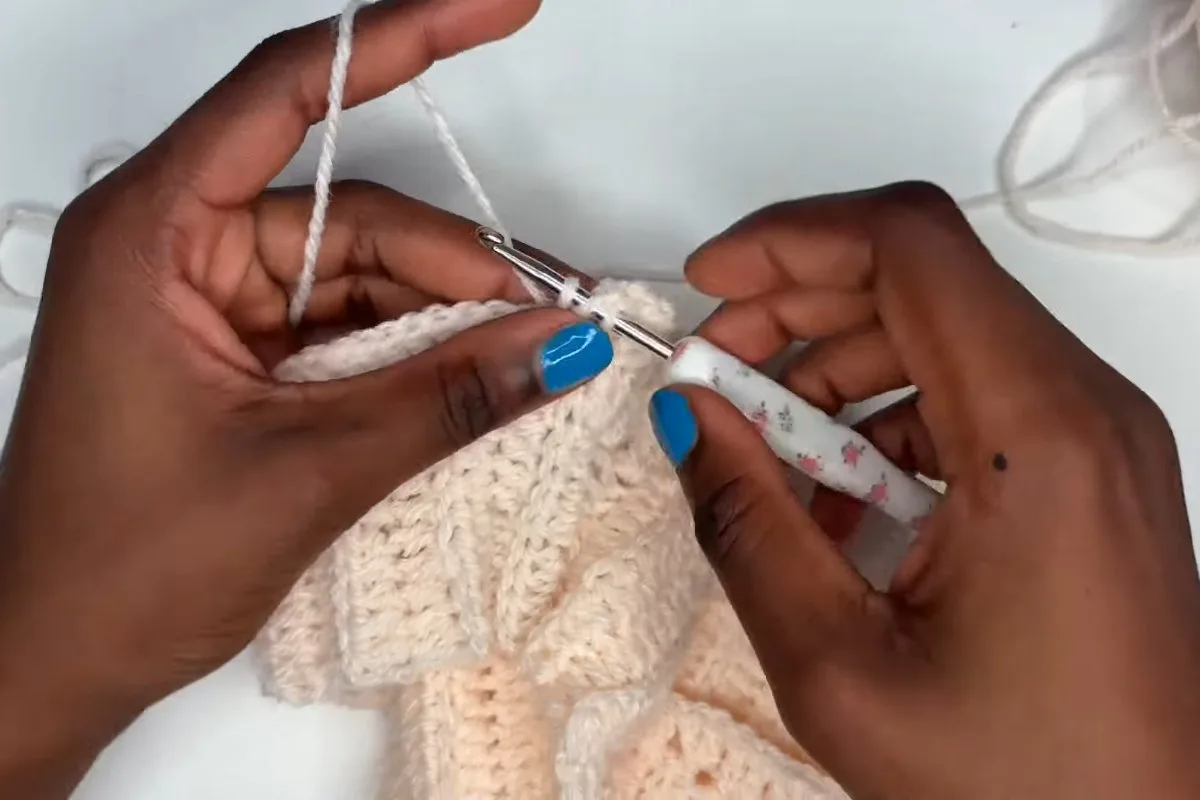
Chain 3, then work 5 double crochets. In the 6th stitch make an increase by putting 2 double crochets into it. Repeat 5 double crochets and an increase all the way round, then slip stitch to the top of the chain 3.
Step 8: Round 3: 10 double crochets, then an increase
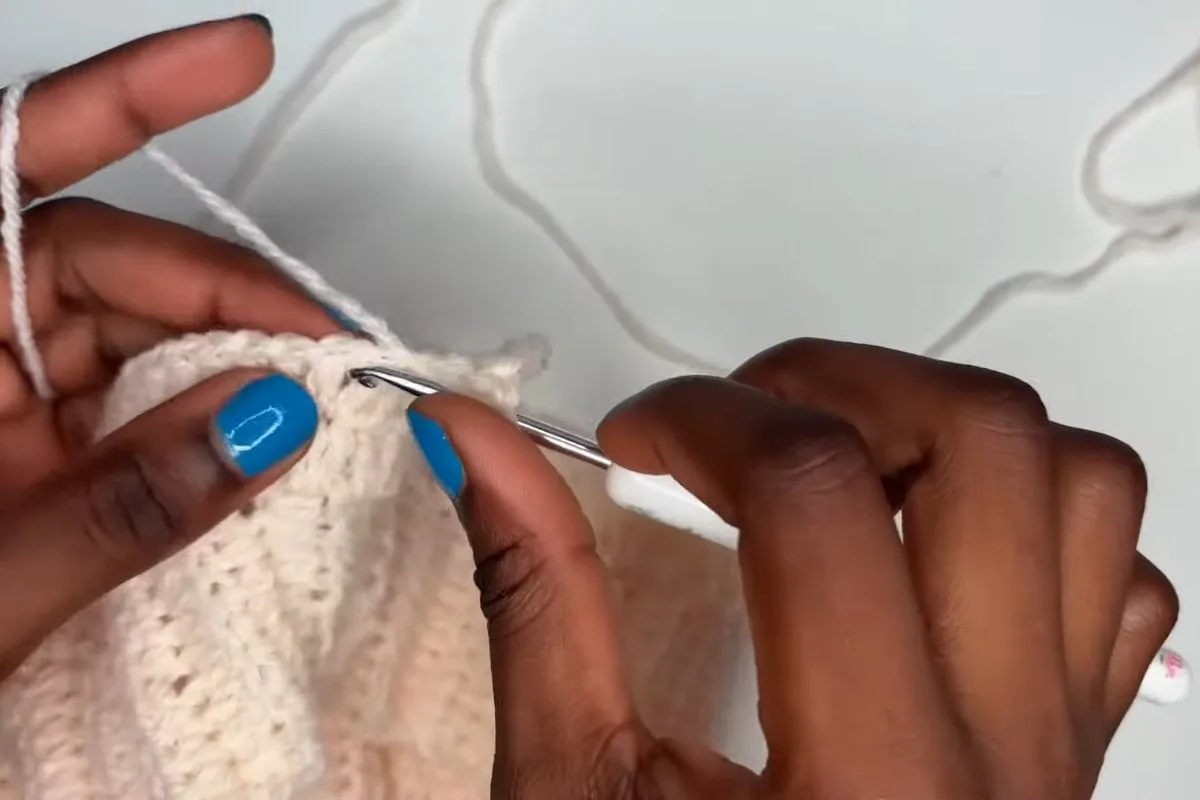
Chain 3 and work 10 double crochets, then increase in the 11th stitch. Repeat to the end of the round and slip stitch closed. The groups get longer as the skirt widens, so the increases become less frequent.
Step 9: Rounds 4 and 5: no increases
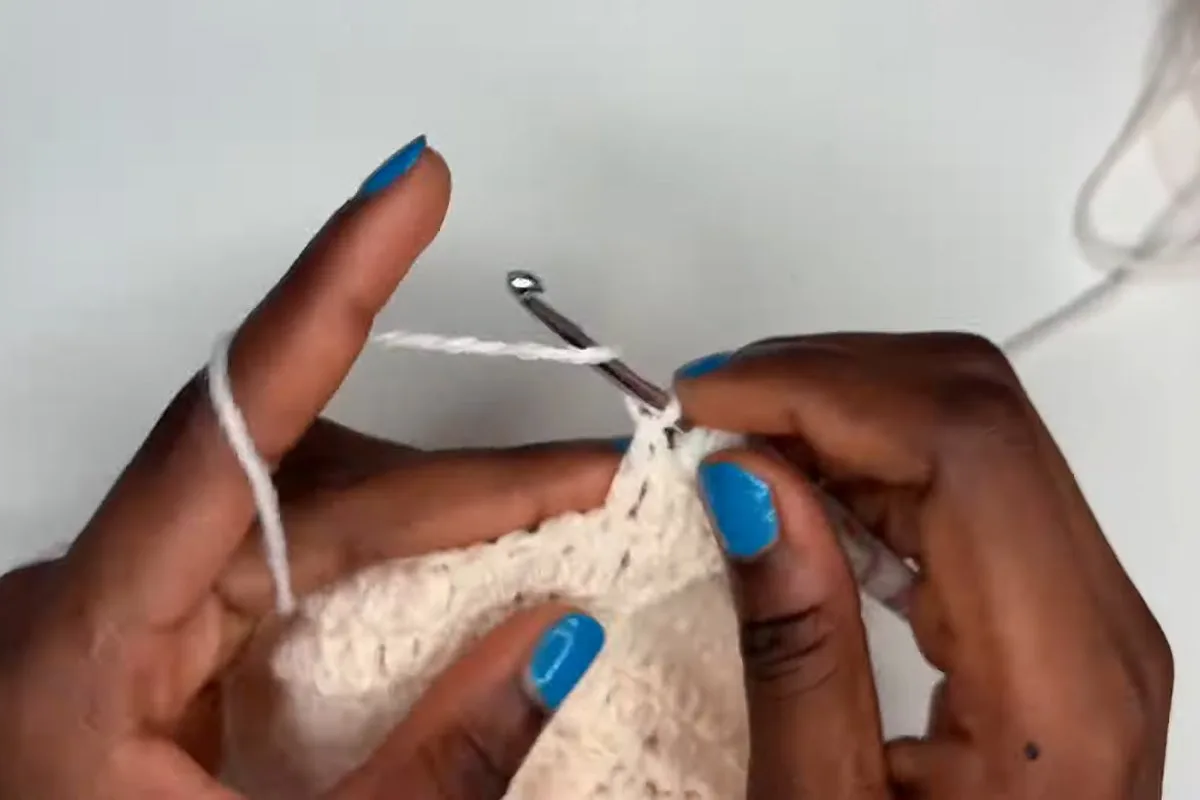
Chain 3 and work a double crochet in every stitch with no increases. Round 5 is the same. The creator says you can add increases here but advises against it, because the fabric gets hard to work.
Step 10: Round 6: back loops only
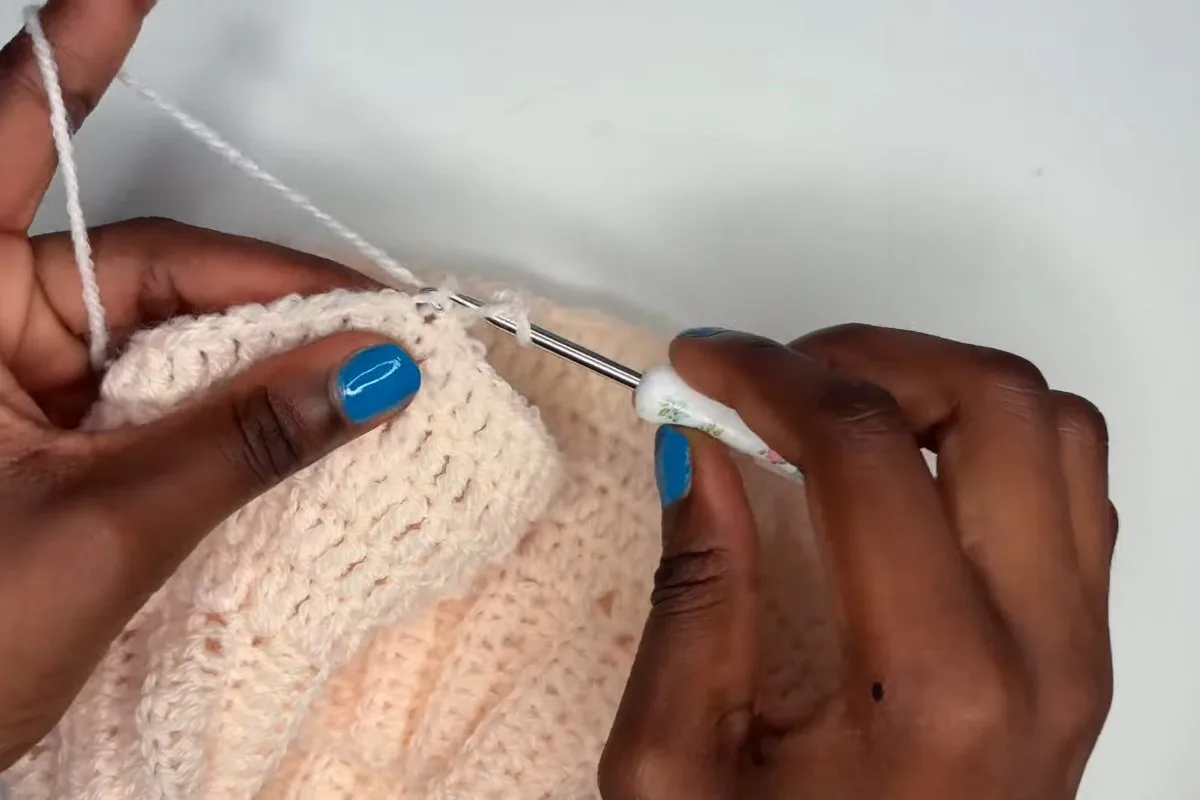
Chain 3 and work a double crochet into the back loop only of each stitch, no increases. This leaves a ridge of front loops where the first ruffle goes later.
Step 11: Round 7: 15 double crochets, then an increase
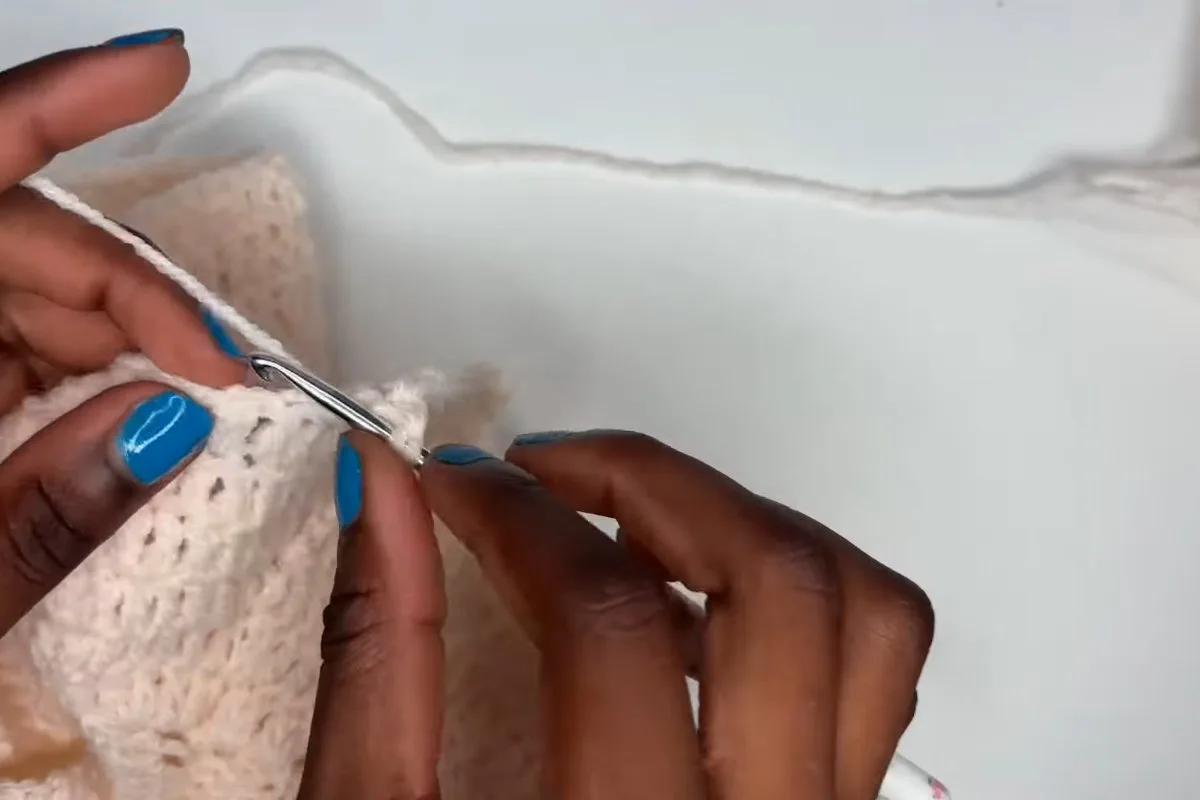
Chain 3, work 15 double crochets and increase in the 16th stitch. Repeat around, then slip stitch closed.
Step 12: Rounds 8 and 9: 30 double crochets, then plain
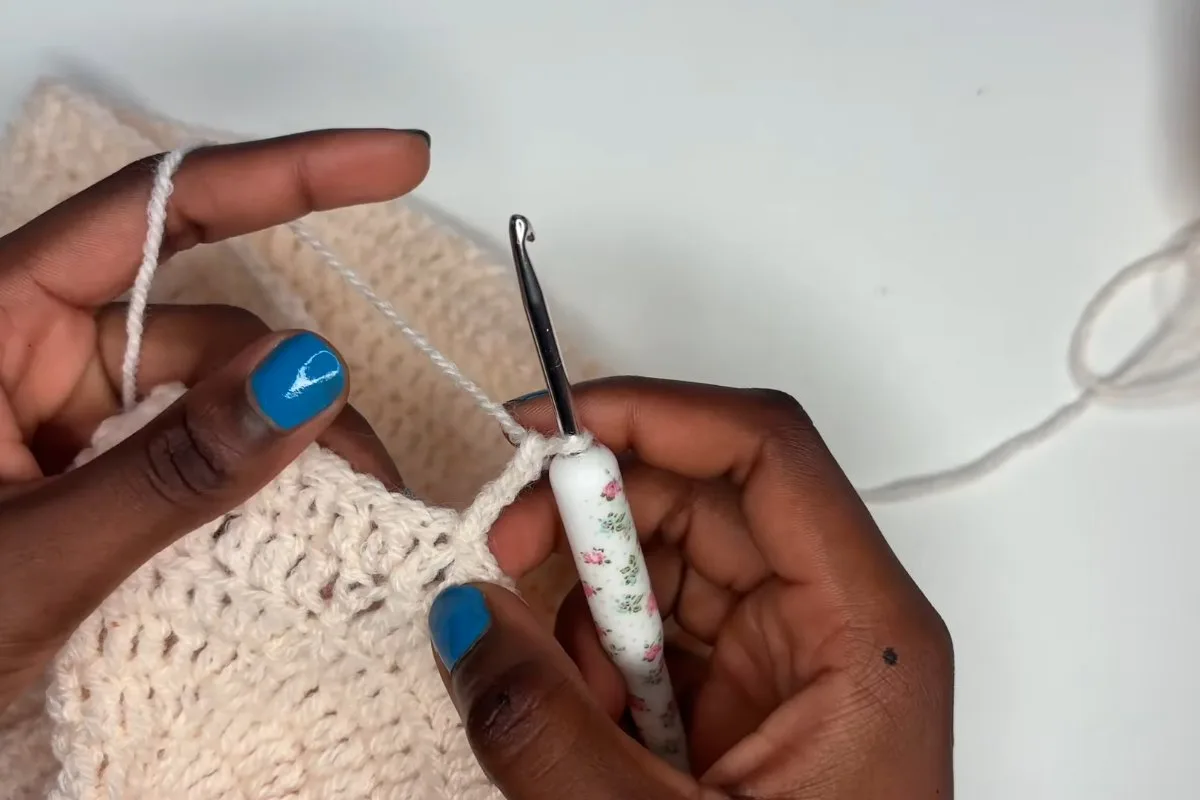
Chain 3, work 30 double crochets and increase in the 31st stitch. Repeat to the end, slip stitch closed. Round 9 is plain, with no increases.
Step 13: Rounds 10 to 12: two increase rounds and one plain
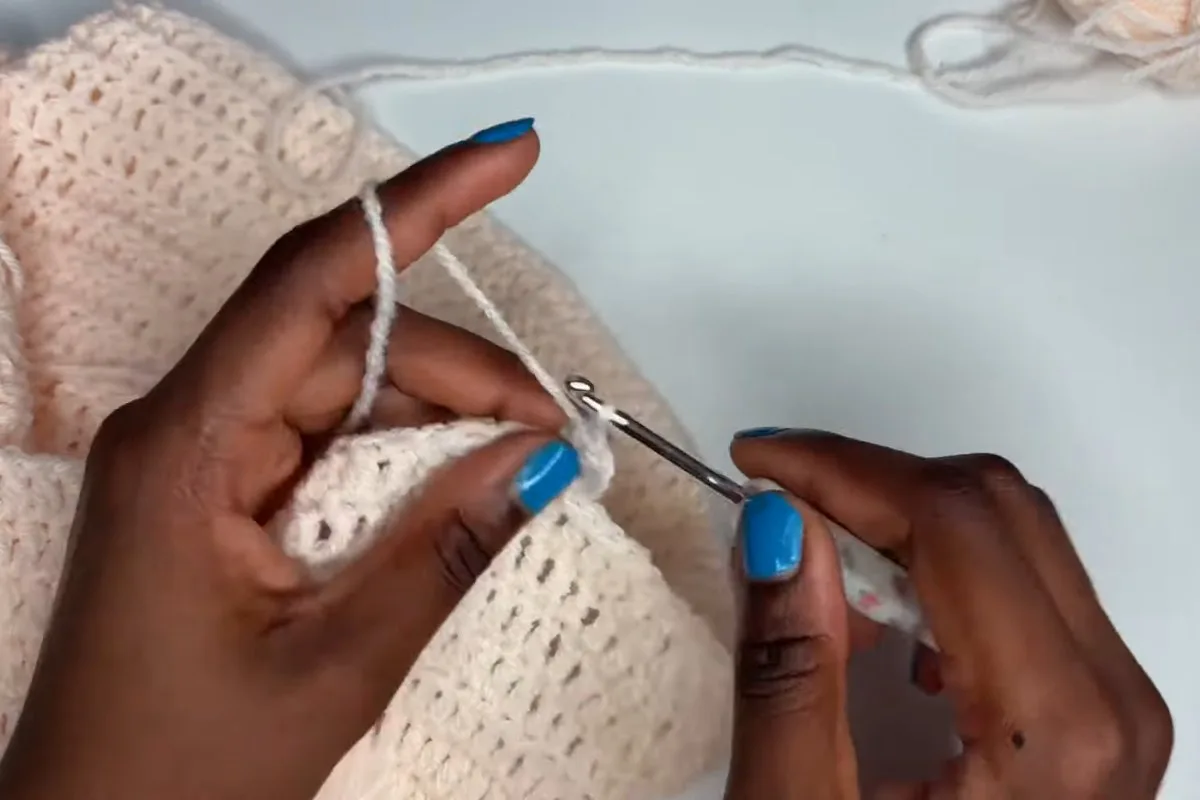
Rounds 10 and 11 repeat the same increase as round 7: 15 double crochets, then an increase. Round 12 is plain, no increases.
Step 14: Round 13: back loops only again
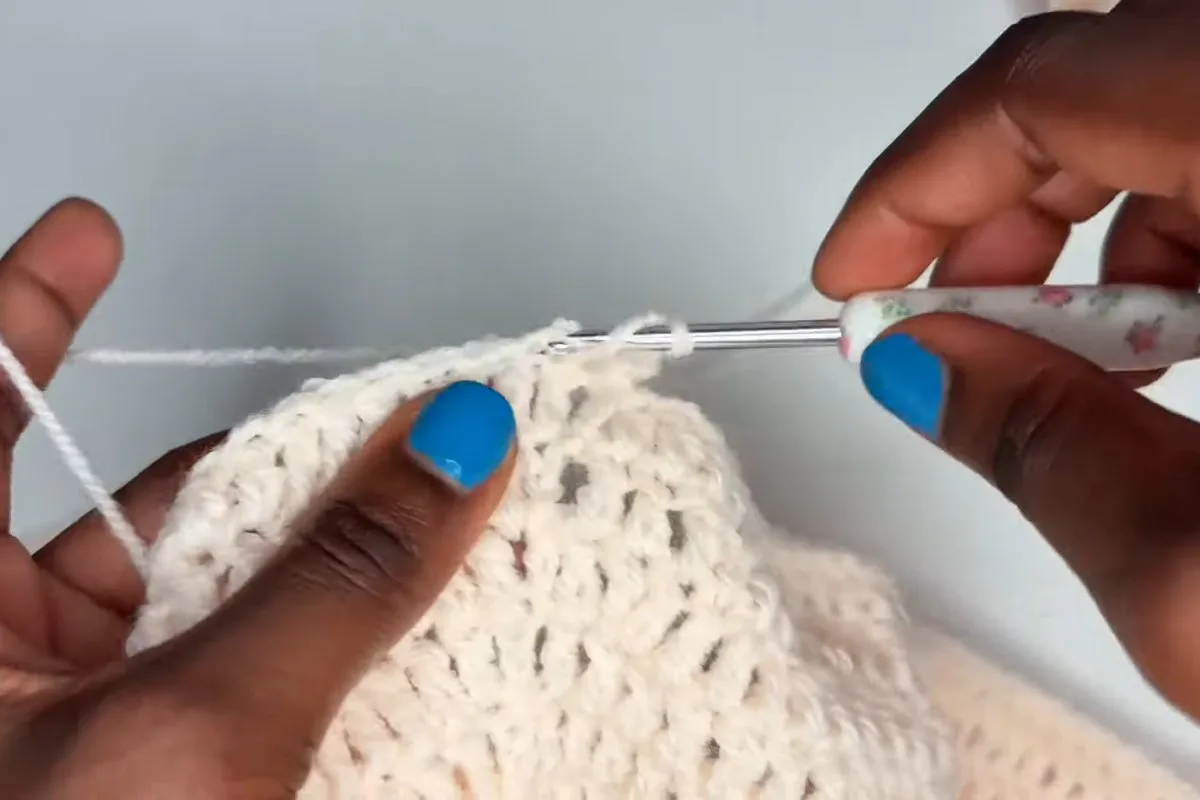
Work round 13 in the back loop only, exactly as you did round 6. It leaves the second ridge for the second ruffle.
Step 15: Round 14: 8 double crochets, then an increase
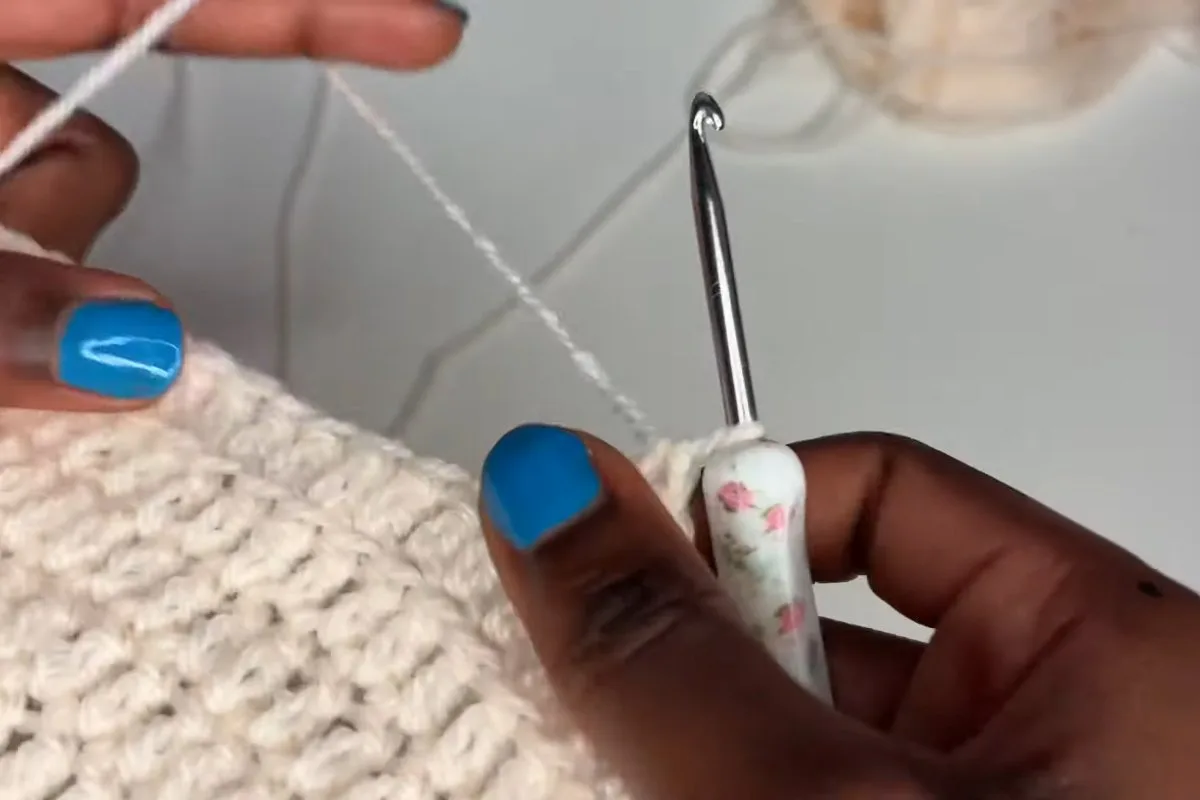
Chain 3, work 8 double crochets and increase in the 9th stitch. Repeat around and slip stitch closed. The increases are getting close together now, which makes the hem flare.
Step 16: Rounds 15 and 16: 5 and an increase, then 2 and an increase
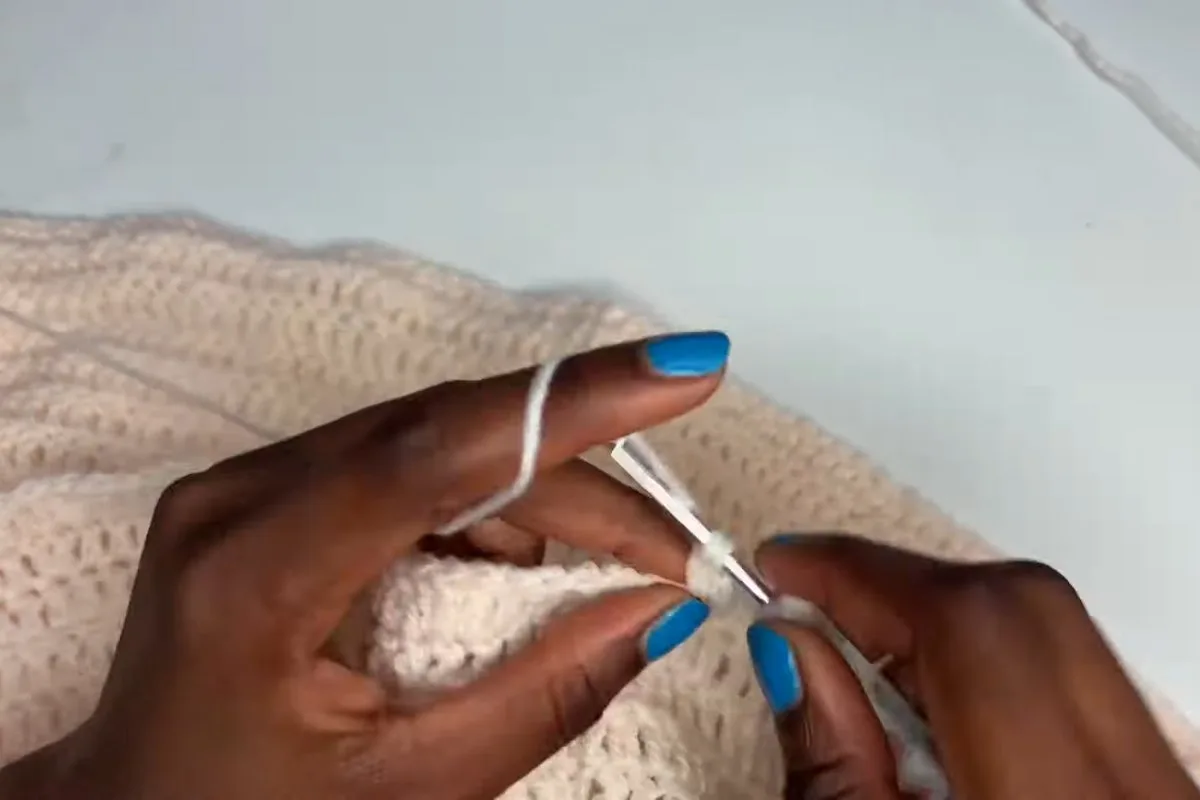
Round 15: 5 double crochets, then an increase, repeated all the way around. Round 16 is the tightest: 2 double crochets, then an increase. Slip stitch closed after each round. The creator says she does not want too much from this round, only a gentle frill.
Step 17: Rounds 17 to 19 and bind off
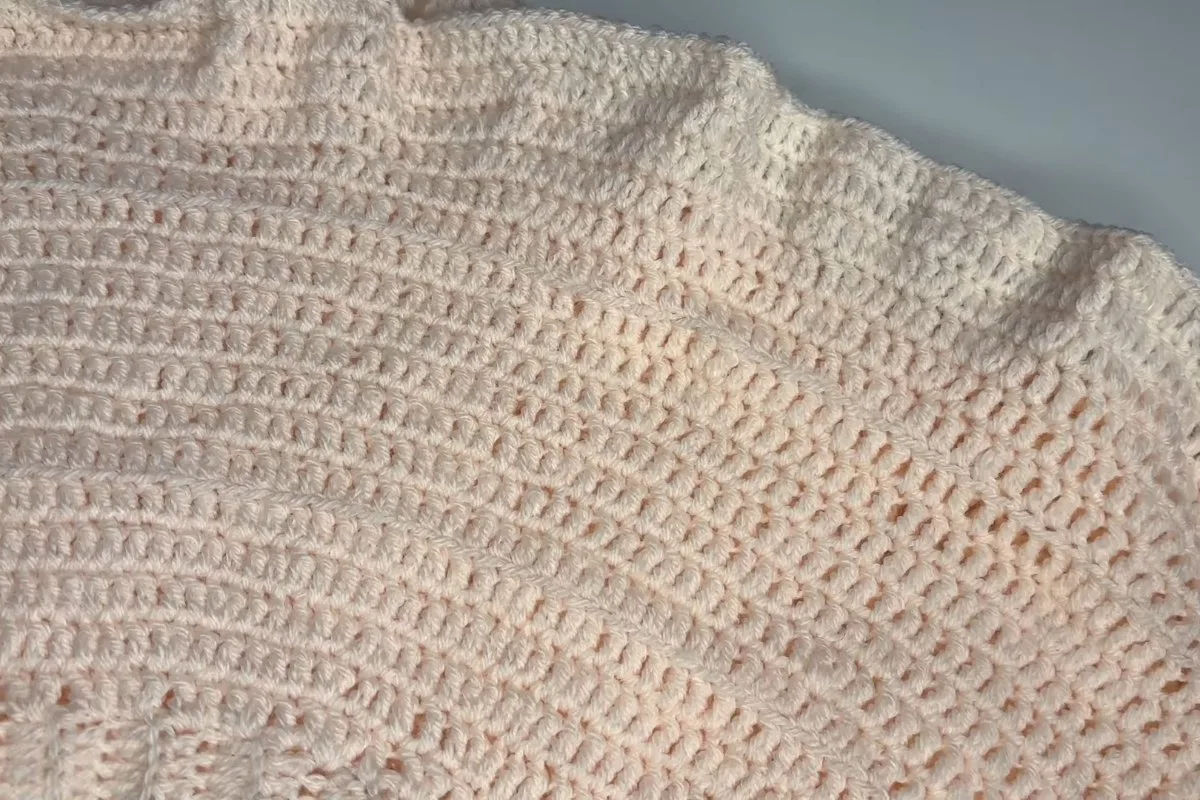
Work rounds 17, 18 and 19 plain, with no increases. The creator stopped at round 19 because she found that long enough, so hold the skirt against you and stop when the length suits you. To bind off, slip stitch into the top of the chain 3, chain 1 and cut the yarn.
Step 18: Add the ruffle to round 6
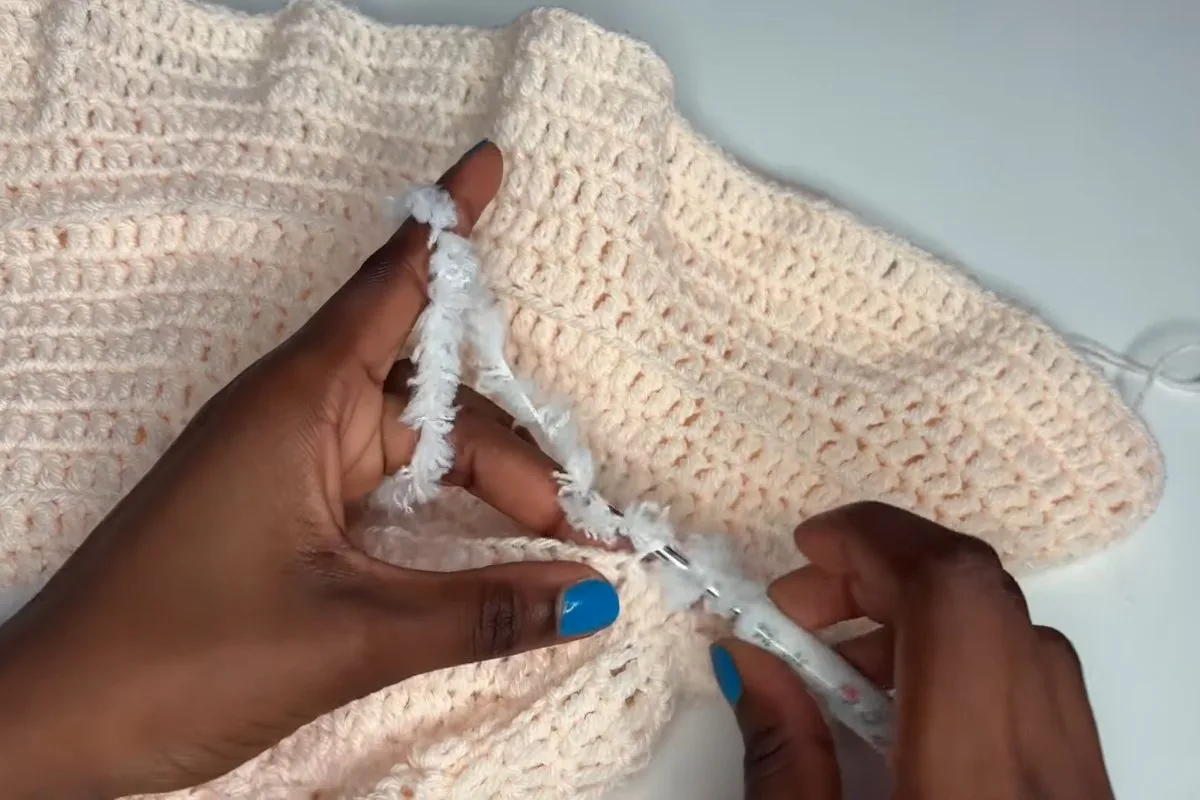
Join the fluffy yarn to the ridge on round 6: pick up one front loop, pull the yarn through and tie it to be secure. Go back into the same space, yarn over and pull through, chain 1, and then work a double crochet into every front loop. There are no increases. Close with a slip stitch where you began, chain 1, cut and tie off. Repeat on the ridge of round 13.
Step 19: Add the last ruffle on the final round
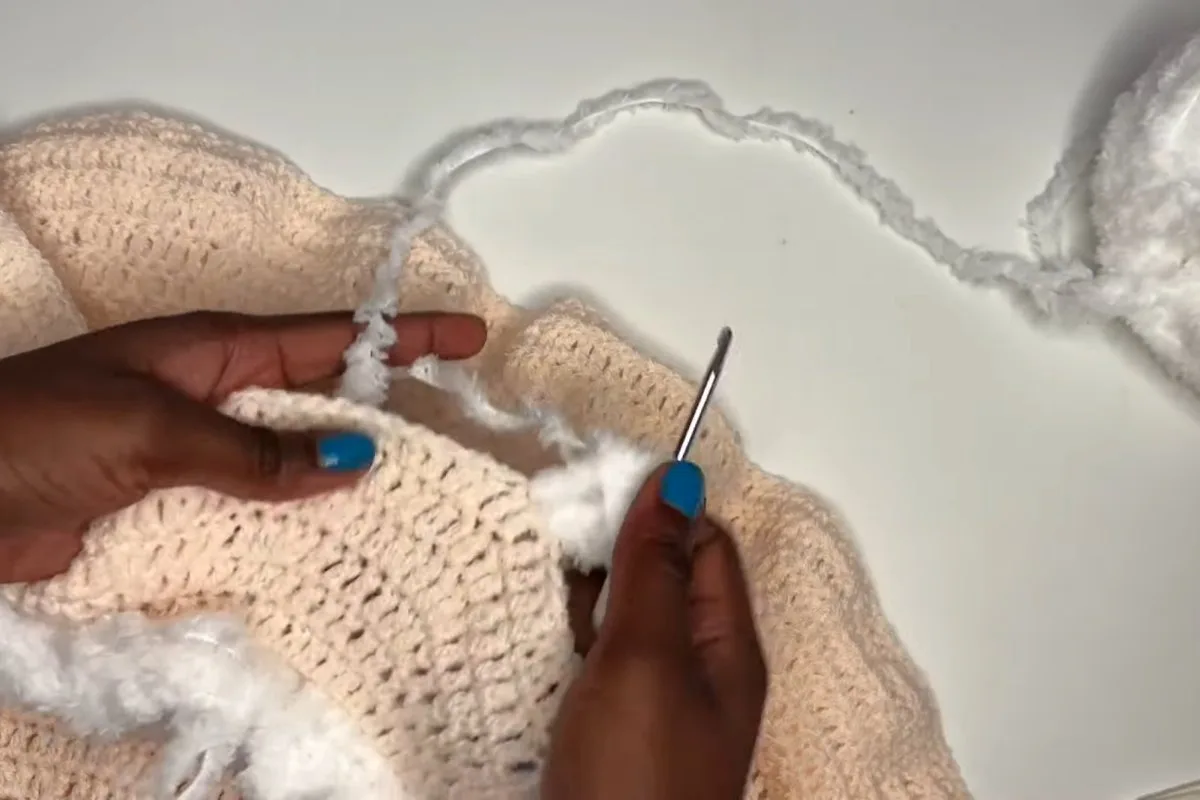
The last ruffle goes on the final round, where there are no loops left over. Attach the fluffy yarn anywhere, chain 3, work a double crochet in each stitch around with no loop to pick, slip stitch to the third chain, then cut and tie off. Weave in the ends.
How the Crochet Skirt Grows
Each increase round adds one stitch for every group of plain stitches, so the stitch count multiplies by a fixed fraction. That fraction is (plain stitches + 2) divided by (plain stitches + 1), because the increase turns one stitch into two. The table below multiplies the fractions together, and the last row is the creator’s numbers only, our arithmetic, not a measured skirt.
| Round | What you work | This round | Waist to here |
|---|---|---|---|
| Round 2 | 5 double crochets, then an increase | x 1.167 | x 1.17 |
| Round 3 | 10 double crochets, then an increase | x 1.091 | x 1.27 |
| Round 7 | 15 double crochets, then an increase | x 1.062 | x 1.35 |
| Round 8 | 30 double crochets, then an increase | x 1.032 | x 1.40 |
| Round 10 | 15 double crochets, then an increase | x 1.062 | x 1.48 |
| Round 11 | 15 double crochets, then an increase | x 1.062 | x 1.58 |
| Round 14 | 8 double crochets, then an increase | x 1.111 | x 1.75 |
| Round 15 | 5 double crochets, then an increase | x 1.167 | x 2.04 |
| Round 16 | 2 double crochets, then an increase | x 1.333 | x 2.72 |
The number to remember: the hem of this crochet skirt has about 2.7 stitches for every stitch at the waist. Round 1 already doubles the band row count, so a band of 60 rows would give 120 double crochets in round 1 and roughly 327 at the hem if every group divided exactly. They will not divide exactly, so treat 2.7 as a guide and not a promise, and count your own rounds.
Because the schedule is stated in plain counts, you can also stretch or shorten it. More plain rounds between the increases give a straighter skirt, and fewer give a fuller one. The creator advises against increasing in rounds 4 and 5, because the fabric gets hard to work, and she describes round 16 as the place where the frill starts.
Where a Crochet Skirt Goes Wrong
The waistband is too tight or too loose
A band made at your exact waist size has no stretch, so a crochet skirt that you cannot pull over your hips comes from a band that is too short. A band that slides down comes from making it too long. Start from the table and measure against yourself before you close the ring.
Round 1 puckers the band
Round 1 is worked along the band edge, not into the loops. Two double crochets in each row end is the rule, so if the band puckers you have skipped a row end. Count the row ends first, and place a marker every 20 or so.
The ruffle looks flat
The ruffle sits on the ridge left by a back-loop round. If you worked round 6 or 13 in both loops, there is no ridge. Work the ruffle yarn into the front loops only, and use a soft fluffy yarn, because a smooth yarn will not frill.
Care: follow the yarn label. Lion Brand advises wet or spray blocking for acrylic, because acrylic should not be steam blocked. Lay the skirt flat to dry so the ruffles keep their shape.
Five More Free Crochet Skirt Patterns
Here are five other free skirts we read. For each we list only what the page prints and say what is missing. Several of the big yarn-brand pages keep the hook and yardage in a PDF, so those fields stay blank here.
| Pattern | Construction | Hook | Yarn and size |
|---|---|---|---|
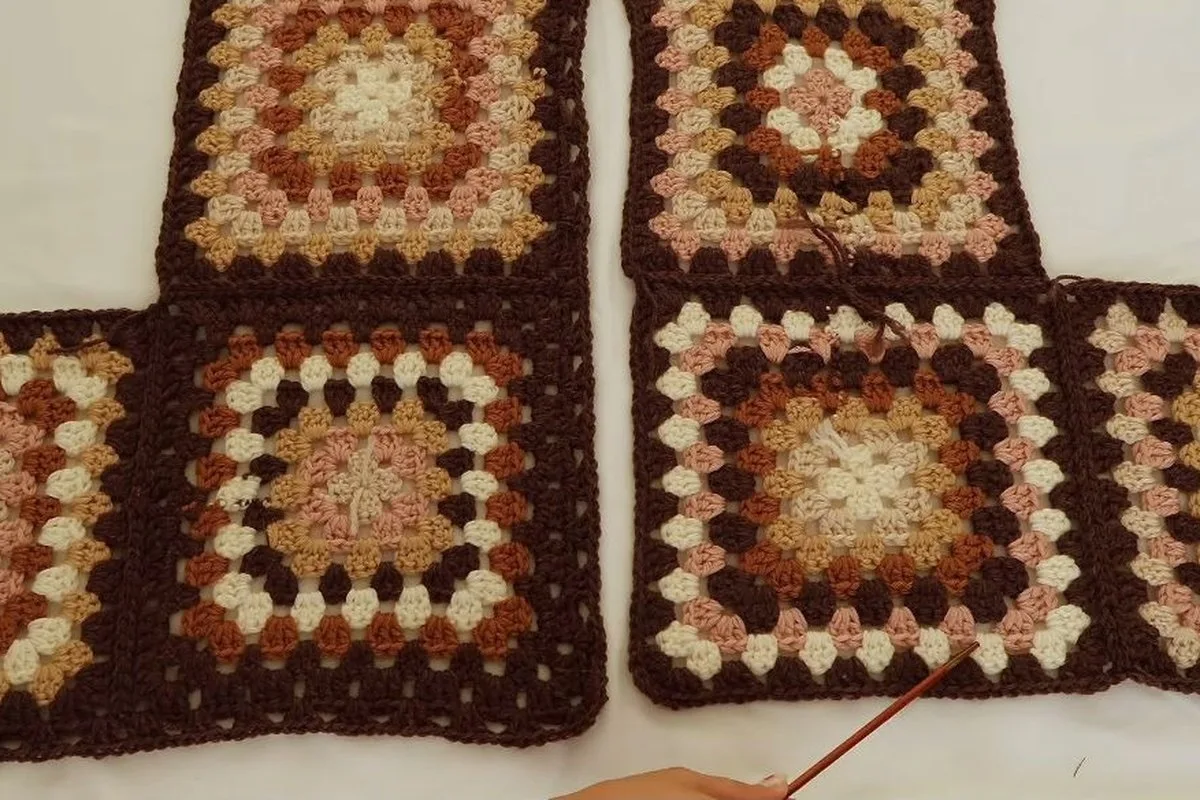
| Granny Goes Mod Skirt (Red Heart) | Granny squares seamed, applied waistband | 5.5 mm | All In One Granny Square, 2 skeins; hips 36 to 66 in finished |
| Solveig Skirt (Lion Brand) | Long skirt in double crochet, worked in rounds | not on page | Worsted blend; waist 30 to 50.5 in |
| How to Crochet a Skirt (KnitcroAddict) | Waistband rows, then V stitch top-down in rounds | 3.0 mm | Lace weight; color A 535 to 735 yd; waist 27.42 to 37.14 in |
| A-Line Skirt: Peach Fuzz (Crochet Cakes) | Elastic band, half double crochet top-down | 4.0 mm | DK; 3 to 6 hanks; waist 26 to 37 in |
| Striped Mini Skirt (Red Heart) | Striped mini with flat elastic | not on page | Super Saver, 5 skeins in 4 colors; sizes S to XL |
What the five pages leave out: none prints a gauge, and only KnitcroAddict gives a yardage on the page. Two use elastic in the waistband and two a drawstring, so the creator’s ribbed back-loop band, which needs neither, is the simplest to make.
Crochet Skirt FAQ
How do you make a crochet skirt for beginners?
Make a ribbed band of half double crochet worked in the back loop, close it into a ring, and then work double crochet rounds down from it. Add an increase every 6th, 11th, 16th or 31st stitch to widen the skirt, then finish with a fluffy ruffle.
What stitches do you need for this skirt?
Only the chain, the slip stitch, the half double crochet and the double crochet. The back loop is a position, not a new stitch.
How long should the waistband of a crochet skirt be?
The creator makes her band 2 in shorter than her 24 in waist, so 22 in, because the back-loop rib stretches. If you want no stretch, make the band as long as your waist.
How many stitches does the crochet skirt hem have?
About 2.7 times the number at the waist, from the increase schedule in the design. Round 1 holds 2 double crochets for each band row, so count your band rows first.
What hook size is best for a crochet skirt?
The creator does not state one. Free skirts we read use hooks from 3.0 to 5.5 mm, depending on yarn weight, so match the hook to your yarn label and swatch.
How much yarn does a crochet skirt need?
The design gives no yardage for this crochet skirt. The two free skirts that do print an amount range from 535 to 735 yd of lace weight to 3 to 6 hanks of DK, so buy extra and keep the label.
Pieces to Make With It
A crochet skirt pairs well with something warm on top. Try the crochet vest pattern for a layered look, or the crochet granny square cardigan if you want a cardigan that matches the colours. For the sweater side, see the crochet pullover sweater pattern. You can browse every crochet clothes pattern on the site.
Sources
- Red Heart, Granny Goes Mod Crochet Skirt
- Lion Brand, Solveig Skirt
- KnitcroAddict, How to Crochet a Skirt
- Crochet Cakes, Crochet A-Line Skirt
- Red Heart, Striped Mini Skirt
- Caron, Beginner Crochet Ribbed Skirt
- Craft Yarn Council, women’s size chart
- Craft Yarn Council, yarn weight system
- Lion Brand, what is blocking
Design credit: this skirt design comes from the crochet channel FISAYO.