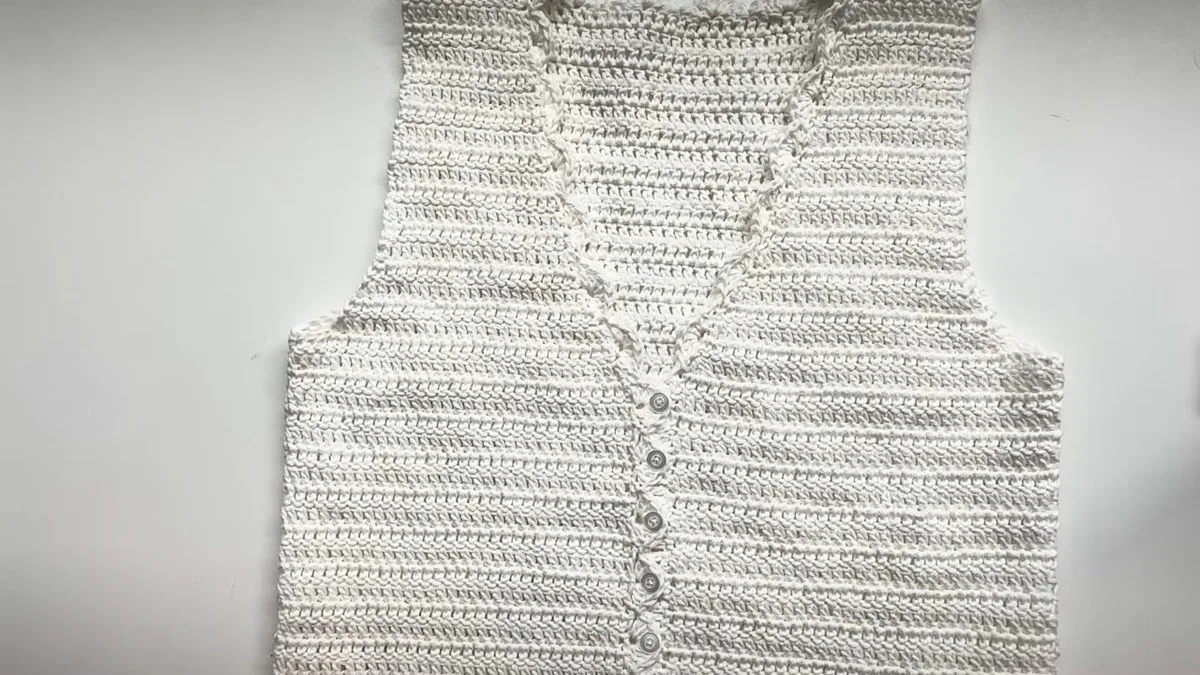
Scalloped Crochet Vest: Easy Pattern for a Happy Little Make
A scalloped crochet vest is a short, sleeveless layer in double crochet with a V at the front and a wavy hem, and this one is made flat in rows from one foundation chain with no pattern chart to decode. The shaping is simple: the body is a rectangle, the armholes are cut in with slip stitches and decreases, and the V-neck grows by one extra stitch every second row. Every stage below has its own photo, and the stitch counts the maker states are separated from the ones we worked out ourselves.
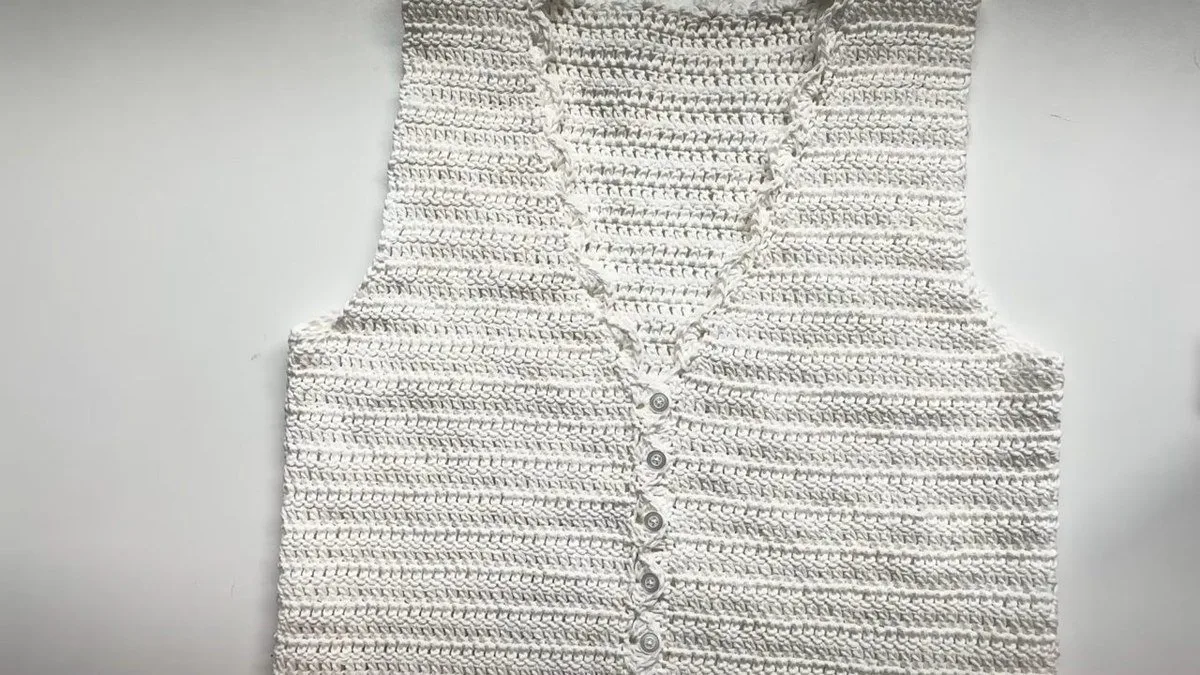
One thing to know first: the maker splits this design into two parts. Part one is the construction of the body, and part two is the edging and the buttons. This guide covers the construction, so it ends with the sewn side seams. The scalloped edge and the buttons come after that, and we do not describe them here because they were not part of the steps we followed. What we can tell you is what the maker says about the base chain: make it a multiple of 6 if you want the scalloped edge along the bottom, and we explain how to do that in the size chart.
The vest is cropped, with 20 rows in the base, and the maker advises you to lengthen it by adding rows. It is worked in an 8-ply cotton on a 5 mm hook. If you want a plainer layer first, see our crochet vest pattern, which is built from two squares and does not compete with this one.
- Scalloped Crochet Vest at a Glance
- What You Need for a Scalloped Crochet Vest
- Scalloped Crochet Vest Size Chart: Chains by Bust
- Scalloped Crochet Vest Pattern: Step by Step
- Where a Scalloped Crochet Vest Goes Wrong
- Fit, Length and Care for a Scalloped Crochet Vest
- Five More Free Crochet Vest Patterns
- Scalloped Crochet Vest FAQ
Scalloped Crochet Vest at a Glance
The scalloped crochet vest is worked in two stages. First you make the back as a wide panel and cut the armholes and neck into it. Then each shoulder strap carries straight on into a front half that is worked downward, getting wider as it goes, until it is 33 stitches across, which is half of the 66 foundation chains. The two halves are sewn together at the sides.
| Part | What you work | Count |
|---|---|---|
| Foundation | Chain half your bust measurement, and a multiple of 6 for the scalloped hem, plus 2 turning chains | 66 chains for an 82 cm bust |
| Base | Double crochet in the back bump of every chain, then chain 2 and turn | 20 rows (the cropped length) |
| Armholes | Slip stitch into 4 stitches, then double crochet two together at each armhole edge | 4 rows of decreasing |
| Back above the armholes | Plain double crochet rows | 11 rows when she starts, 12 when she recaps |
| Shoulder and neck | 12 double crochets and a double crochet two together, then two neck-decrease rows and one plain row | 14 stitches at the shoulder |
| Front half | Increase at the neck edge every second row, then at both edges, then 4 foundation double crochets at the armhole | 33 stitches, 20 rows |
| Join | Leave a long tail on the first half, sew both side seams on the wrong side | 2 seams |
Difficulty: a scalloped crochet vest is a confident-beginner to early-intermediate project. You need chain, double crochet, slip stitch, double crochet two together and foundation double crochet. There is no lace and no chart, but the row counts at the armholes and neck matter, so keep a tally on paper.
What You Need for a Scalloped Crochet Vest
The maker used 100% cotton, 8-ply, in a white called snow. She needed three full balls and started a fourth, so buy four. She does not print the weight or length of a ball, so we cannot give you a yardage, and we do not estimate one. The hook is 5 mm. You also need buttons, thread and a needle to sew them on, and a yarn needle to weave in the ends.
| Item | What to use |
|---|---|
| Yarn | 100% cotton, 8-ply (DK), about three balls and part of a fourth for an XS to S |
| Hook | 5 mm |
| Notions | Buttons, sewing thread and needle, a yarn needle, scissors, a tape measure |
| Yardage | Not given by the maker; buy a spare ball and check the label |
| Skill level | Confident beginner: chain, double crochet, slip stitch, decrease and increase |
Hook and yarn: in Australia and New Zealand, 8-ply means the weight other countries call DK, as this yarn shop guide explains. The Craft Yarn Council lists 4.5 to 5.5 mm for light (category 3) yarn, so a 5 mm hook sits inside that range and the pairing is sound. Cotton has no stretch, so check your tension on a swatch before you commit to 66 chains.
Terms: this pattern uses the double crochet naming convention. Chain is ch, double crochet is dc, slip stitch is sl st, and double crochet two together is dc2tog, which means you work two double crochets that share one final loop. A foundation double crochet makes a chain and a stitch in one move, and you use it to add stitches at the armhole.
Scalloped Crochet Vest Size Chart: Chains by Bust
The maker is an extra small to small. She measured her bust at about 82 cm, halved it to 41 cm, and chained 66, which is 1.61 chains for every centimetre. She adds that if you work from a different measurement, you should make the base chain an even number, and a multiple of 6 if you want the scalloped edge. The stitch multiple for the scallops is therefore 6. In our reading, a scallop that covers 6 stitches is why she asks for it, but she does not show the edging in this part, so check it against part two.
| Size | Bust (midpoint of range) | Half bust | Base chain (multiple of 6) | Each front half |
|---|---|---|---|---|
| XS | 74 cm | 37 cm | 60 chains | 30 stitches |
| S | 84 cm | 42 cm | 66 chains | 33 stitches |
| M | 94 cm | 47 cm | 78 chains | 39 stitches |
| L | 104 cm | 52 cm | 84 chains | 42 stitches |
| XL | 114 cm | 57 cm | 90 chains | 45 stitches |
How we got these: each bust is the midpoint of the Craft Yarn Council women’s size range, halved, multiplied by 1.61 and rounded to the nearest multiple of 6. This is our calculation from her size, not sizes she made. It only holds if your gauge matches hers, which she does not state, so swatch your own cotton, measure how many stitches fit in 10 cm, and multiply by half your bust in cm divided by 10.
She also gives two rules for larger sizes. Add more stitches at the shoulders, so that the V at the front ends in line with the armholes, and add more rows to the higher section above the armholes. Her advice is to try the work on yourself as you go and lengthen or shorten by changing the number of rows.
Scalloped Crochet Vest Pattern: Step by Step
Work every step with your 5 mm hook. Keep turning chains loose, because the edge of every row is the edge of your finished vest.
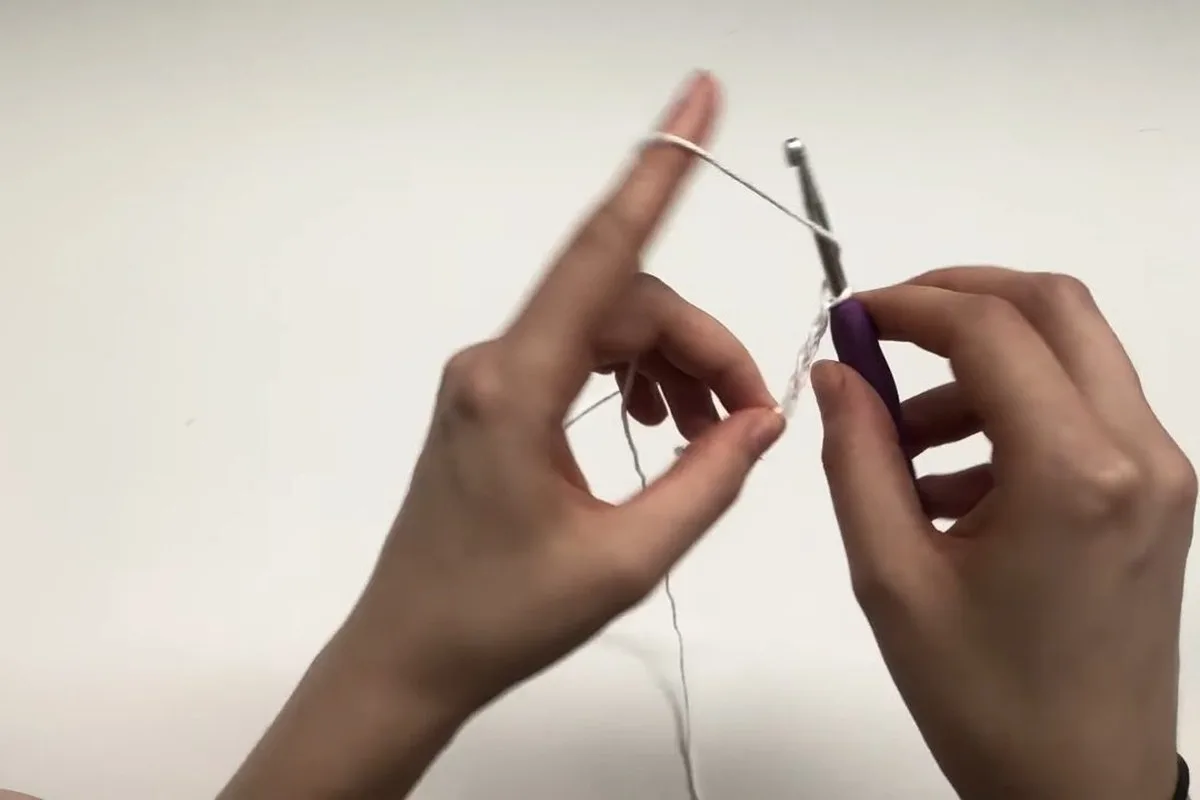
Step 1: Chain 66 and add two for turning
Start with a slip knot. Chain half your bust measurement in stitches, rounding to an even number and to a multiple of 6 for the scalloped hem. For the maker that is 66. Then chain 2 more, which will serve as the first turning chain. Count twice: an extra chain here moves the V of the neck off centre.
Step 2: Row 1, double crochet in the back bump
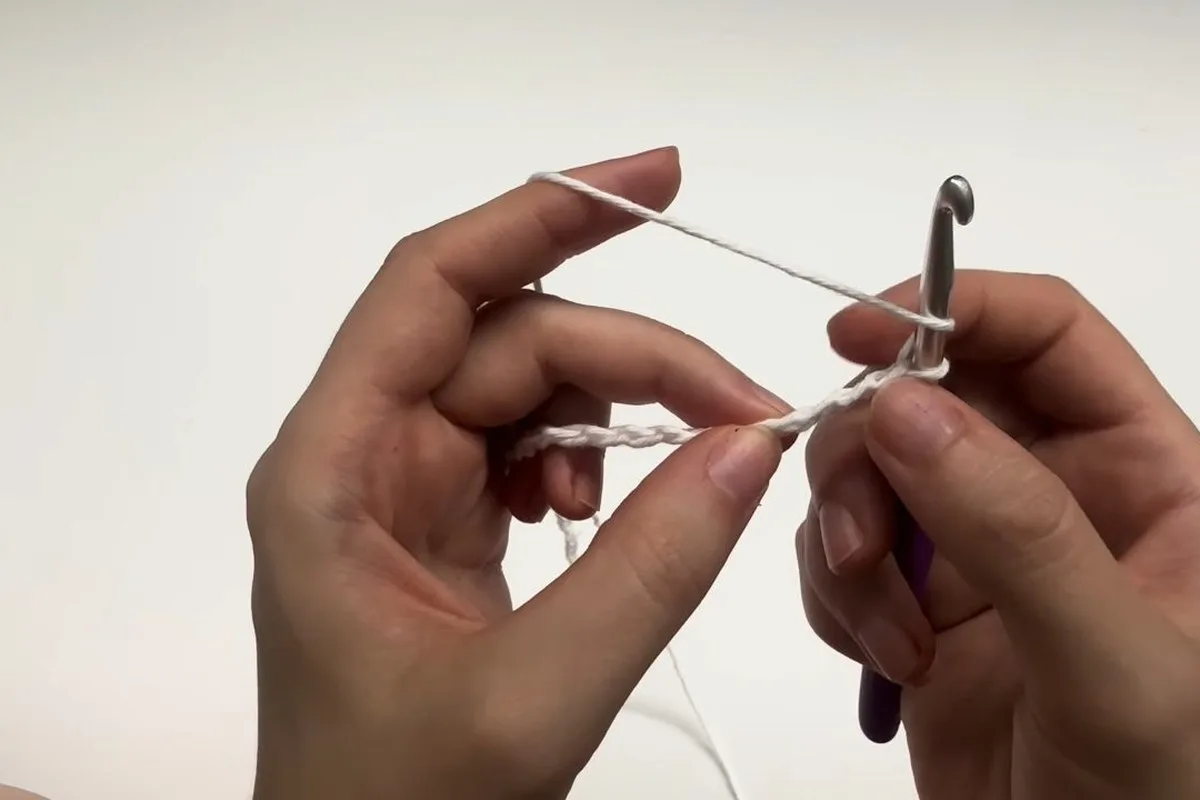
Skip the 2 turning chains and place your first double crochet into the back bump of the third chain from the hook. Yarn over, insert the hook under the bump, yarn over and pull up a loop, then yarn over and pull through two loops twice. Work one double crochet into the back bump of every chain. By our count that is 66 stitches.
Step 3: Work 20 rows of double crochet
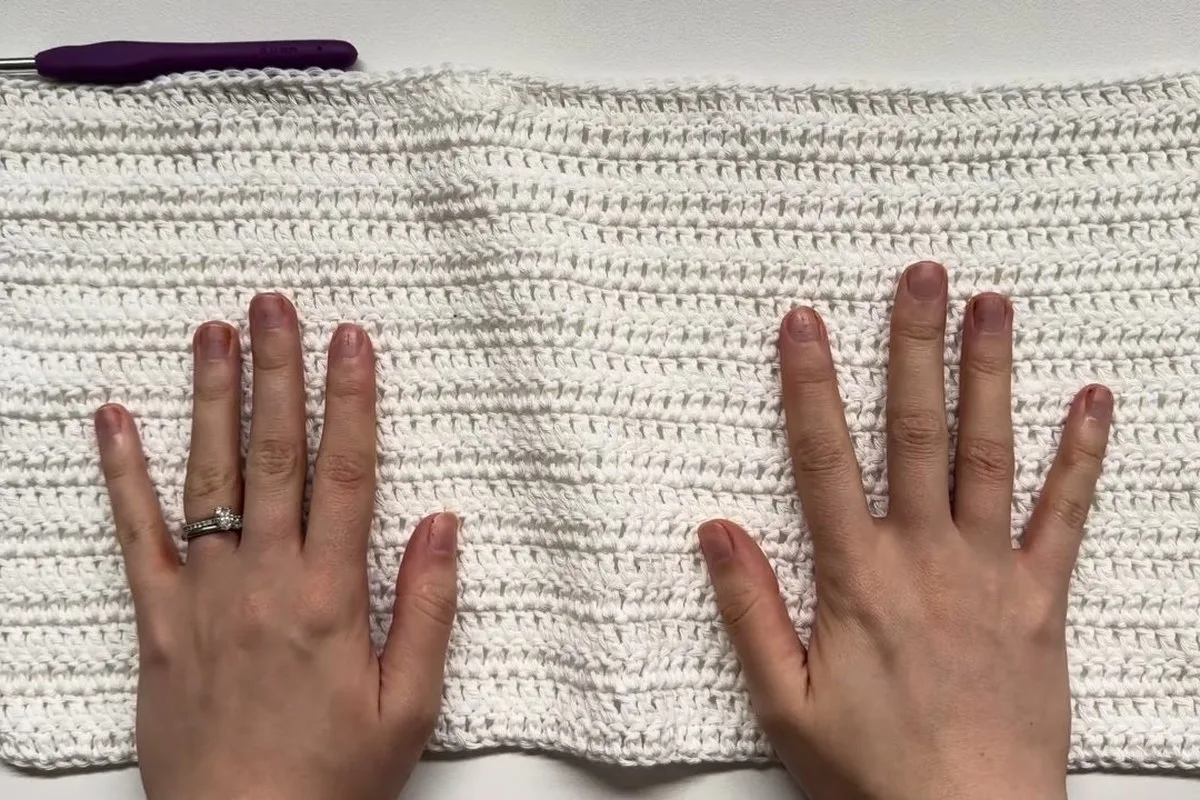
At the end of the row chain 2, turn, and place one double crochet into every stitch. Repeat this row until you have 20 rows. The maker says 20 rows give a cropped length, and that you should add rows for a longer top and make fewer for a shorter one. Measure it on yourself.
Step 4: Slip stitch and decrease to start the armholes
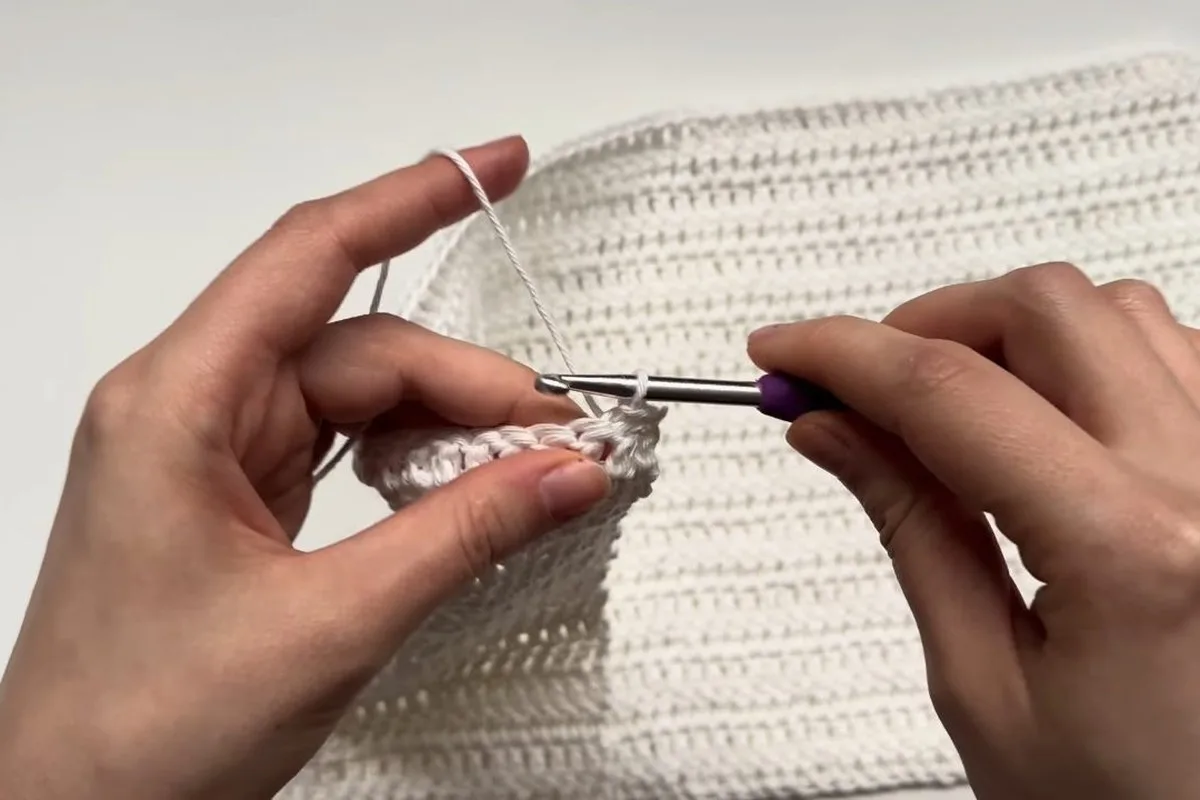
For the first armhole row, slip stitch into the next 4 stitches. Chain 2 and start with a dc2tog to make the angle: yarn over, insert into the stitch, pull up a loop, yarn over and pull through two, then yarn over, insert into the next stitch, pull up a loop, yarn over and pull through two, and finally yarn over and pull through all three loops. Work double crochet into every stitch until 6 stitches are left, work one more dc2tog, and leave the last 4 stitches unworked. They mirror the 4 you slip stitched on the other side.
Step 5: Four decrease rows, then straight rows
Each next row is chain 2, turn, dc2tog over the next two stitches, double crochet across, and a dc2tog over the last two stitches. You want 4 rows of decreases in total, and you do the first one in step 4. By our arithmetic, 66 stitches become 50 once the fourth row is done. Then work plain double crochet rows. She says 11 plain rows when she begins and counts 12 when she recaps, so the difference is one row; choose by measuring the armhole against your own body.
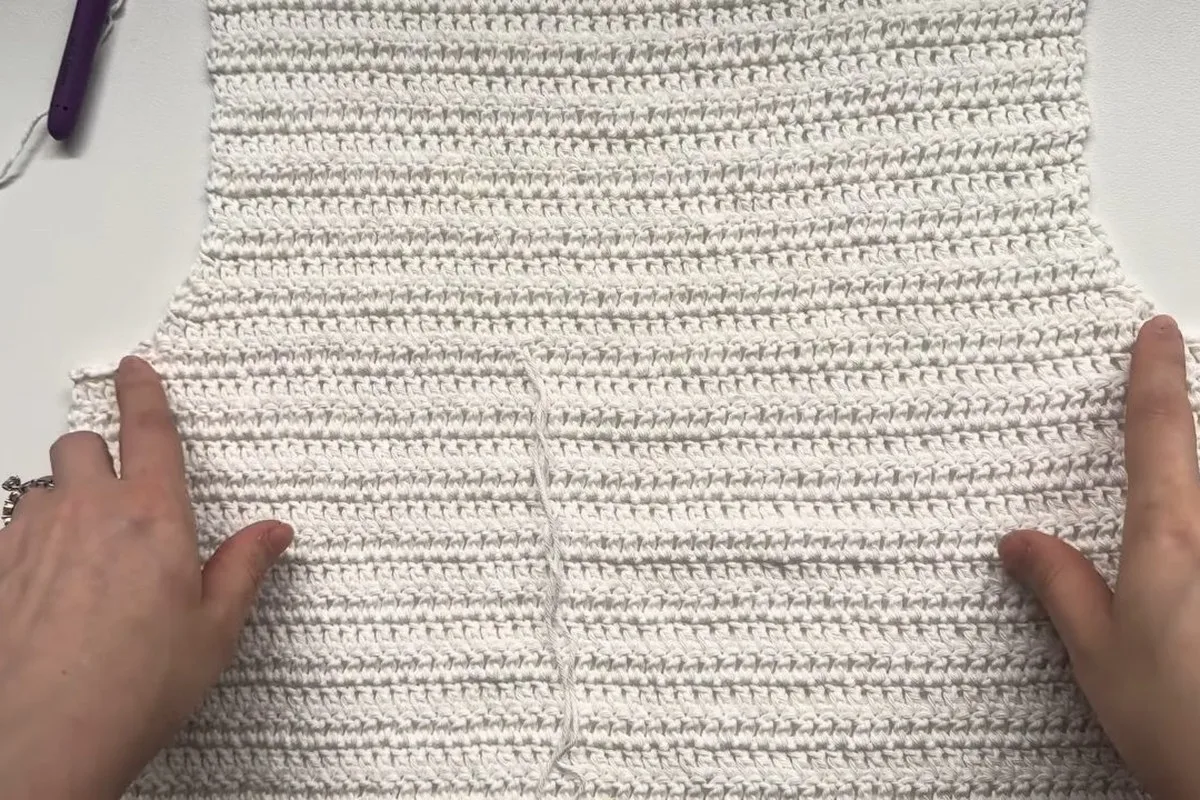
Step 6: Split for the shoulder and shape the neck
To start one shoulder, chain 2, turn, and place a double crochet in the next 12 stitches. Work a dc2tog over the next two stitches, which uses 14 stitches in all. Chain 2, turn, and work a dc2tog into the first two stitches of the neck edge, then finish the row in double crochet. That gives two rows with a neck decrease. Finally work one row of plain double crochet across.
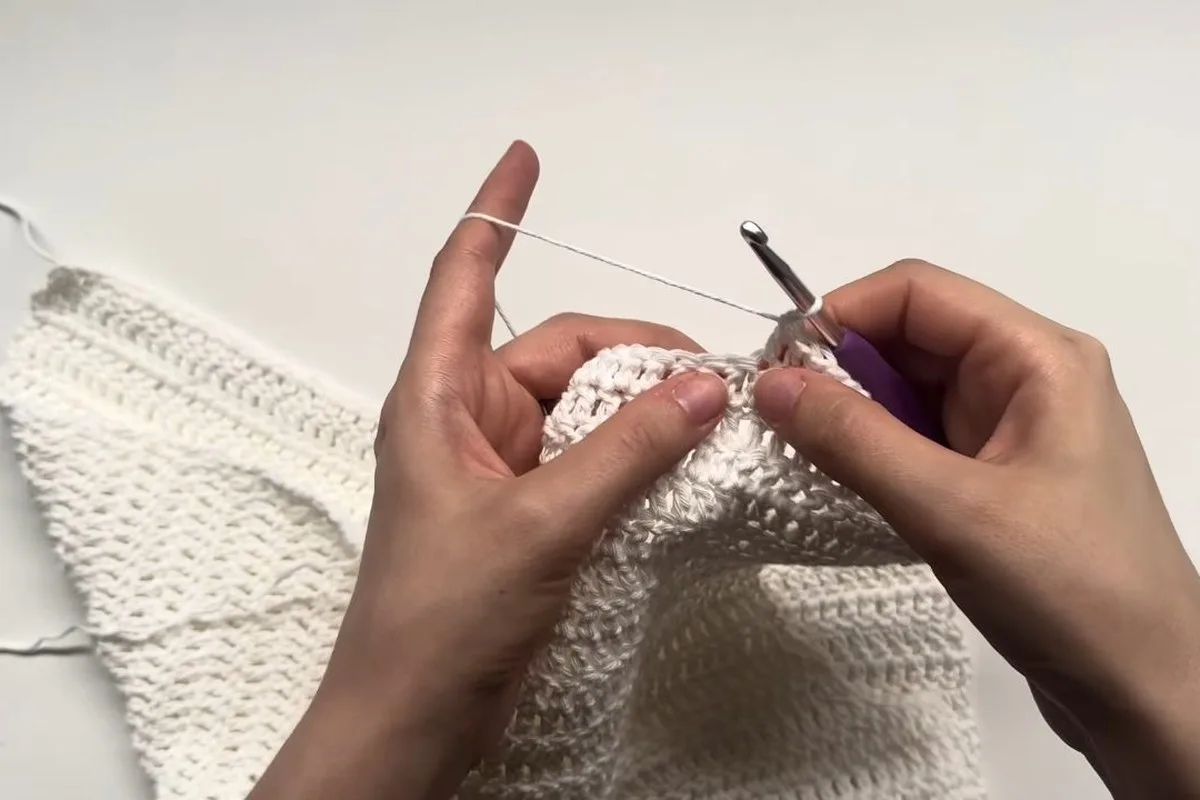
Step 7: Check the back against the recap
The maker sums up the back like this: 20 rows for the base, 4 rows of armhole decrease, 12 plain rows, and 2 rows of neck decrease. That is the back of the scalloped crochet vest finished. Measure it flat before you continue, because the front must match it row for row.
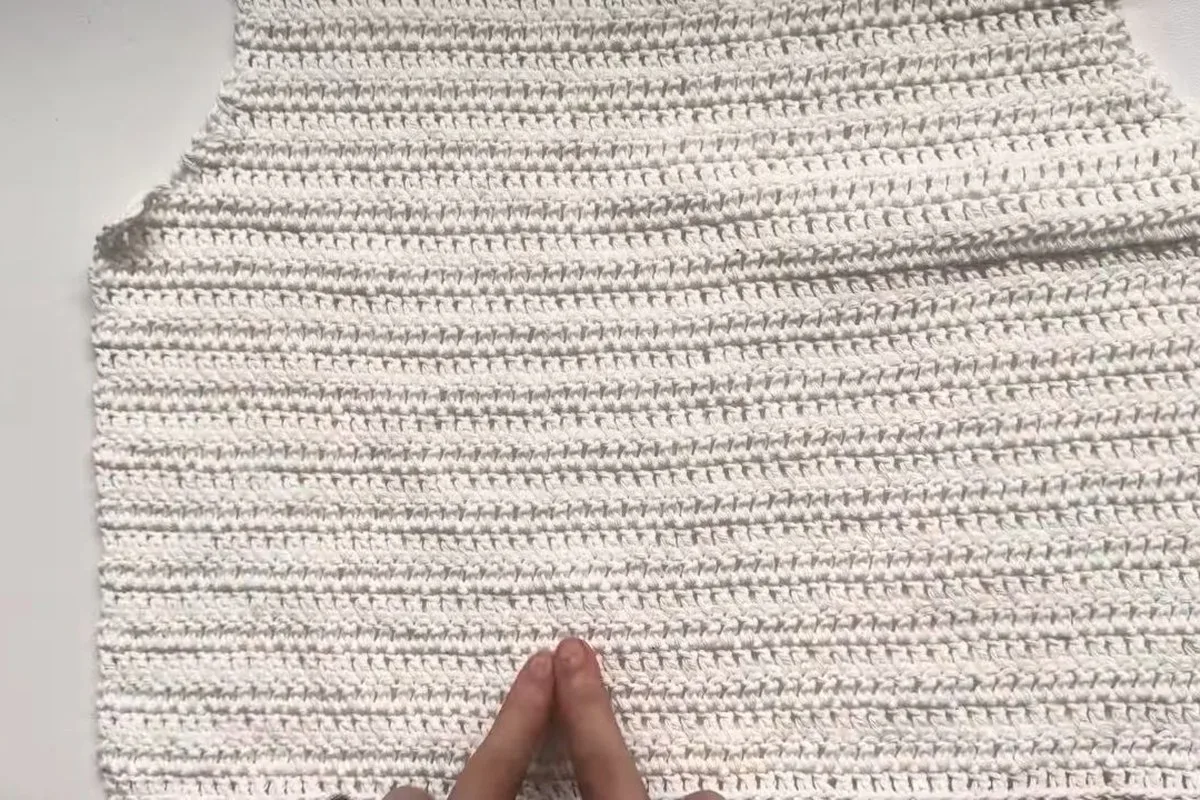
Step 8: Start the front and increase every second row
The front is worked on from the shoulder strap. After one row with no increase, chain 2, turn, and place 2 double crochets into the first stitch, then one in every stitch to the end of the row. Next row, chain 2, turn and work plain double crochet. Keep alternating on the scalloped crochet vest front: an increase row, then a plain row. Stop only when you come back to 33 stitches, half of the 66 chains. She also warns that once you reach the armhole area you must start adding increases on the other side too, so the front matches the back.
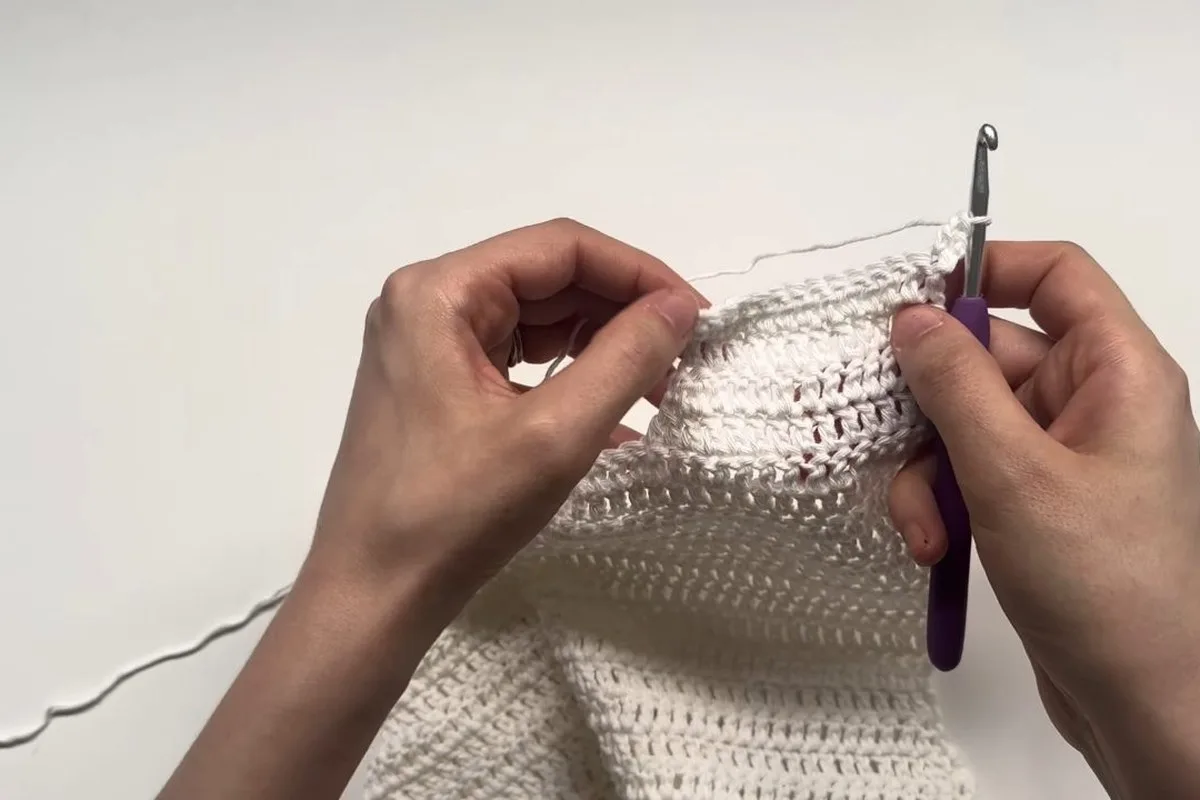
Step 9: Match the armhole with four increase rows
Count your front rows. Once you have 14, which is the 12 plain back rows plus the 2 neck rows, you are ready to copy the armhole. Work 4 rows with an increase at the start and at the end of each row: chain 2, turn, 2 double crochets in the first stitch, one in every stitch, and 2 double crochets in the last stitch. To make the V come faster, she also increases at the neck edge in every one of these rows.
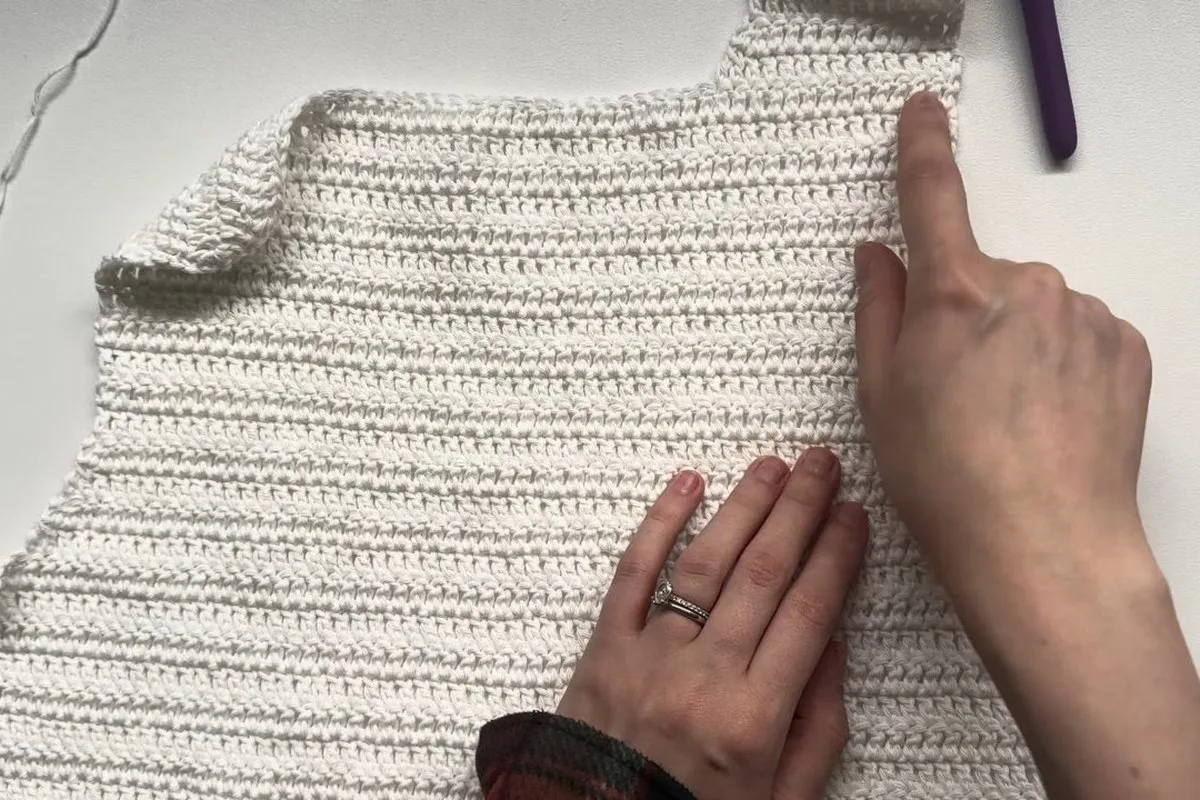
Step 10: Chain 4 to rebuild the armhole stitches
When you cut the armholes on the back you slipped past 4 stitches. Now you add them back. At the end of the row chain 4 for the 4 stitches, then chain 2 as the turning chain and turn. Find the back bumps of the new chains, skip the 2 turning chains, and place a double crochet in the third chain. You should end up with 4 new double crochets.
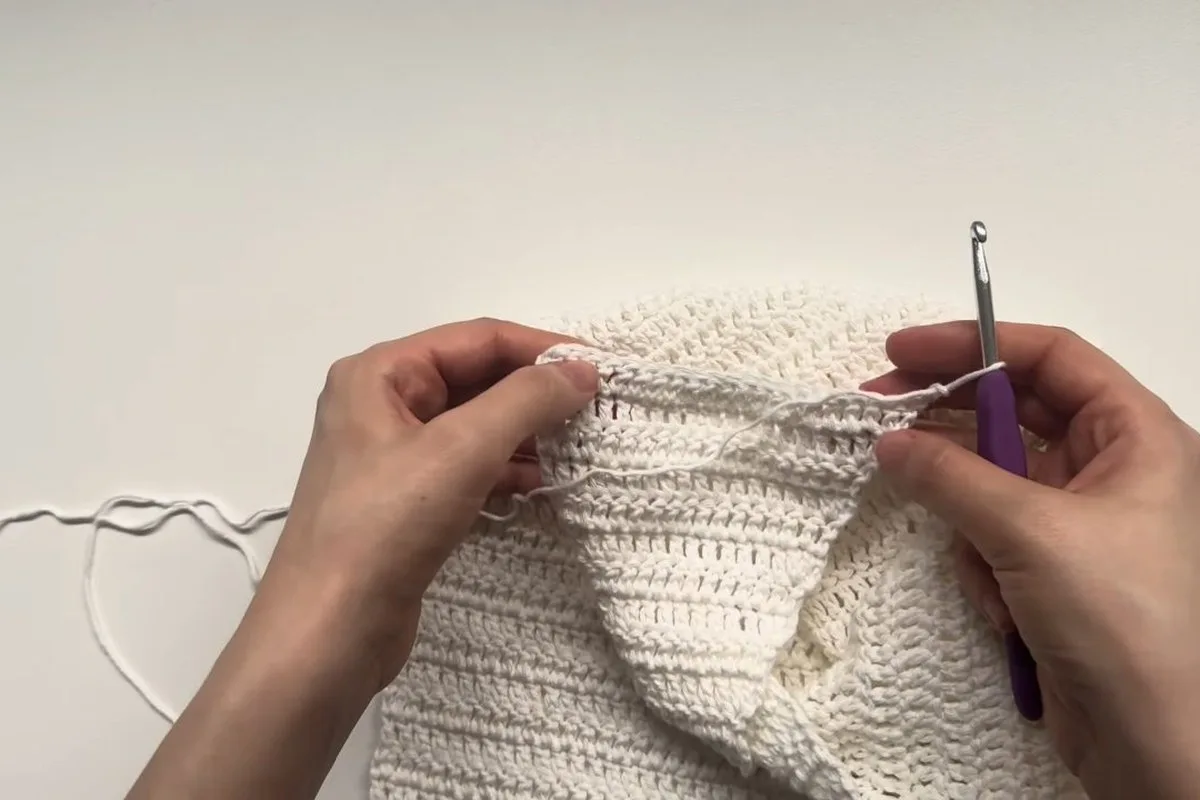
Step 11: Reach 33 stitches and finish the first half
Now the only place you can still increase is the neck edge. Keep going until you have 33 stitches. By her count the row with the extra four stitches gives 31, the next row gives 32 and the next gives 33. After that, no more increases: place 33 double crochets in every row until you have a total of 20 rows for the front half. Cut the yarn and leave a very long tail, because you will sew the first side seam with it.
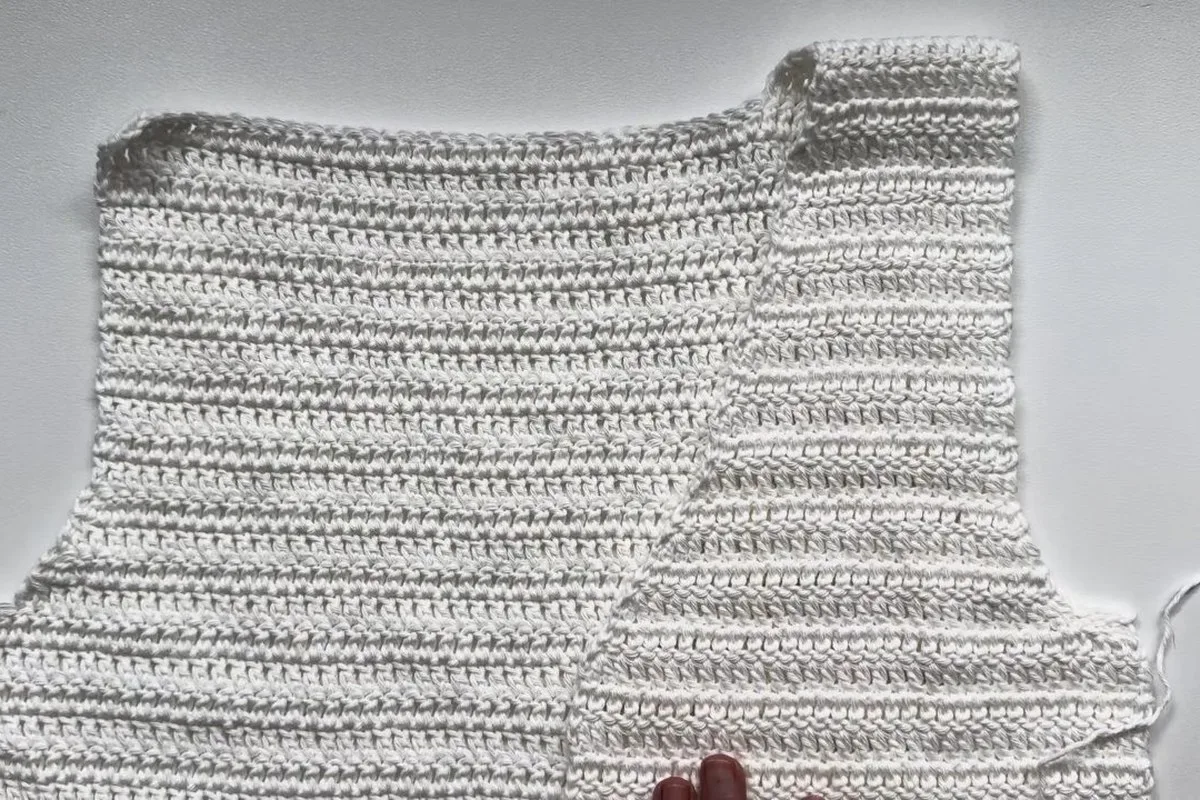
Step 12: Join yarn for the second side
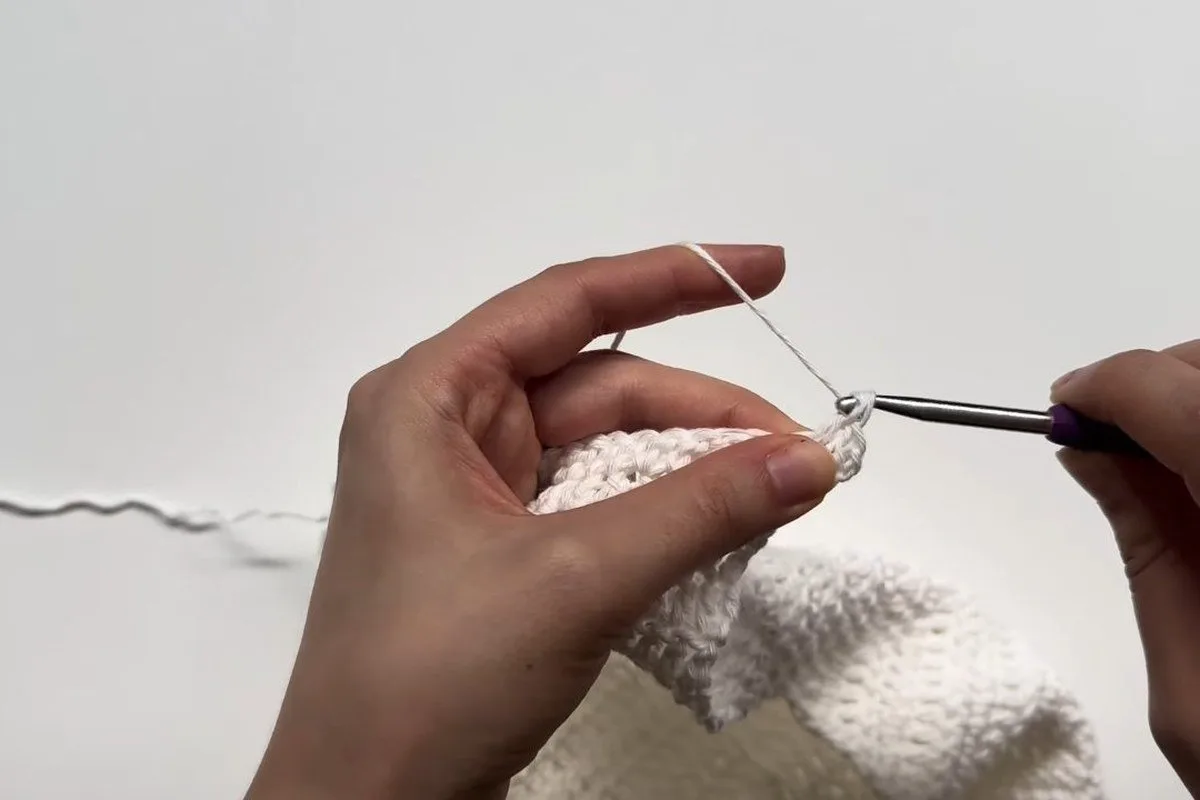
The second side of the scalloped crochet vest is the same as the first, done in the opposite direction. Look at the back and you will see the front of a stitch on that side, so do not join where you left off. Join where the work faces the other way, so the front of a row sits on the back of the last row. To find the right place, count back 14 stitches from the edge, because you worked 12 double crochets and a dc2tog on the first side.
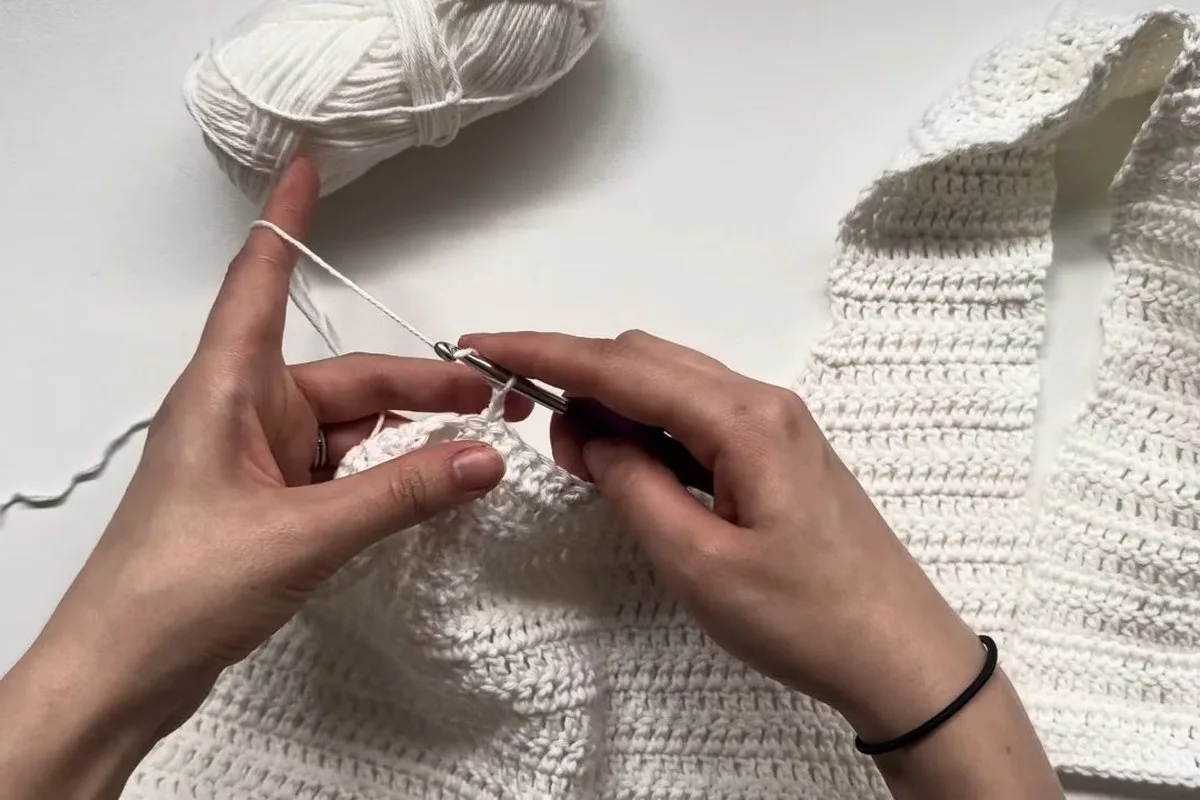
Step 13: Decrease at the neck, then alternate increase rows
Chain 2 and start with a dc2tog in that same stitch, then work 12 double crochets to the end. Chain 2, turn, and work a double crochet in every stitch, ending with a dc2tog in the last two stitches. Do the second neck-decrease row the same way, and then one plain row. After that alternate: a plain row, then a row with 2 double crochets in the last stitch. Keep this up until you reach the armhole area.
Step 14: Add foundation double crochets at the armhole
At the armhole, do the four rows with an increase at both edges, as in step 9. On the row after them, work an increase at the neck edge, double crochet across, and then make 4 foundation double crochets at the end of the row to rebuild the armhole. Yarn over, insert into the same stitch, yarn over and pull through, yarn over and pull through one loop, then through two, and through two again. Repeat for each new stitch. The second half should then have 33 stitches, like the first.
Step 15: Compare the two halves
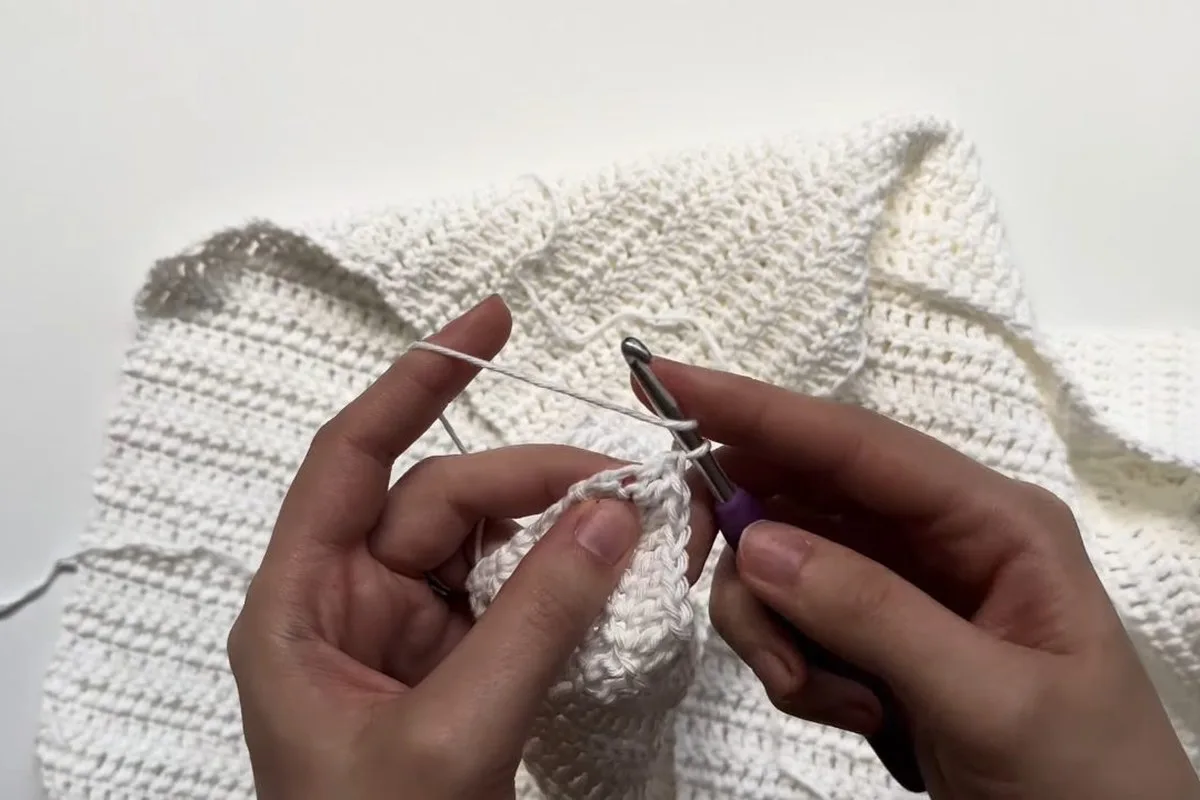
Keep working plain double crochet rows, 33 stitches wide, until this half has the same number of rows as the first. Lay both halves side by side. They should be the same height with a matching V, and the armhole notches should line up.

Step 16: Sew the side seams
Turn the work so the wrong side faces up, with the seam on the inside. For the first seam use the long tail you left earlier. Thread it onto a needle, find a loop in the middle of one stitch on one side and the matching loop on the other, and then match loops between the rows. Keep going to the armhole. Do the second side seam the same way, starting at the hem and working up. Weave in the ends, and the body is ready for the scalloped edging and buttons.

Where a Scalloped Crochet Vest Goes Wrong
The rows do not match. The armholes only line up if the front has the same number of rows as the back. Write the row count on a scrap of paper and tick off each row. The maker says to measure the work on yourself as you go.
The stitch count drifts. Each dc2tog loses a stitch, and each increase gains one. Count at the end of the four armhole rows (50 in our arithmetic) and again at 33 on each front half. A count that is out by one at the armhole is easy to fix there and hard to fix later.
The two halves face different ways. The second shoulder is joined where the work faces the other way, so the front of a row sits on the back of the last row. If you join at the wrong edge, the V leans the other way.
The chain is not a multiple of 6. Count in tens and put a marker every 20 chains. The multiple matters only if you want the scalloped hem, but it is far easier to get right at the start.
Fit, Length and Care for a Scalloped Crochet Vest
The maker’s scalloped crochet vest is cropped, so it ends above the waist, and she says plainly to add rows if you want it longer. Cotton does not spring back like wool, so it will grow a little with wear. Make the scalloped crochet vest to your exact bust measurement rather than a size up, and then tie or button it closed.
Follow the care label on your yarn. Cotton is usually washable, but wash temperatures differ between brands, and the maker does not name a safe temperature, so we do not print one. Lay a crochet garment flat to dry so the rows keep their shape. For a closed-front sweater built from the same stitch, see our crochet pullover sweater pattern.
Five More Free Crochet Vest Patterns
If you want to compare constructions, here are five free vest patterns. We checked that each page loads and offers the pattern for free. Several give the hook and yardage only in a PDF, and we say so rather than guess. None is a scalloped vest.
| Pattern | Designer | What it is | What the page gives |
|---|---|---|---|
| Unique V Neck Cropped Vest | Cre8tion Crochet | Cropped V-neck vest, front and back, in dc and V-stitch | 9 mm hook, chunky yarn, 218 to 436 yd across XS to XL |
| Free Striped Crochet Vest | Red Heart | Striped vest with square armholes, XS/S to 4/5XL | 5 or 5.5 mm hook, 2 skeins; counts in the PDF |
| Rustic Summer Vest | Red Heart | Two identical V-stitch panels | 5 mm hook, finished chest 98.5 to 157.5 cm |
| Next Generation V-Neck Vest | Teresa Chorzepa, Lion Brand | Child-size half double crochet V-neck vest | 12 hdc and 10 rows = 4 in; child sizes only |
| Drapey Crochet Vest | Red Heart | Sizes S to 3X | Free download; hook and counts in the PDF |
How this one differs: the design here uses a single plain stitch, which means a beginner can focus on shaping rather than on a stitch pattern. The Cre8tion vest is worked in chunky yarn on a 9 mm hook, so its yardage cannot be compared with a DK cotton. None of the pages we read prints a gauge for this construction, so a swatch is the only reliable guide.
Scalloped Crochet Vest FAQ
How do you crochet a scalloped crochet vest?
Chain half your bust, in a multiple of 6, work double crochet rows for the base, shape the armholes with slip stitches and decreases, split for the shoulders, work the fronts down with increases, sew the side seams and add the scalloped edging.
What hook size is best for a crochet vest in cotton?
The maker uses a 5 mm hook with 8-ply cotton, and the Craft Yarn Council lists 4.5 to 5.5 mm for light yarn. Swatch first, because cotton has no stretch.
How many chains do I need for a scalloped crochet vest?
Half your bust measurement multiplied by your own gauge, rounded to a multiple of 6. The maker’s size is 66 chains for an 82 cm bust, and our chart runs from 60 to 90 chains for sizes XS to XL.
How much yarn does a scalloped crochet vest take?
The maker used three full balls of 8-ply cotton and started a fourth for an XS to S. She does not give the length of a ball, so buy a spare and check the label.
How do you make a V-neck on a scalloped crochet vest?
Increase one stitch at the neck edge of each front half every second row until it is 33 stitches wide, which is half of the 66 base chains. The back has matching neck decreases.
Can I make this scalloped crochet vest longer?
Yes. The maker says her 20 base rows give a cropped look and that you should add rows to make it longer. Add them to the base and to the higher section above the armholes.
More Crochet Clothes to Make Next
Once your first scalloped crochet vest is done, try a plainer layer such as our crochet vest pattern, a sweater with sleeves like the crochet pullover sweater pattern, or a cosy crochet baby cardigan for a small one. You can also browse every crochet clothes pattern on the site.
Sources
- Cre8tion Crochet, Unique V Neck Cropped Vest
- Red Heart, Free Striped Crochet Vest
- Red Heart, Rustic Summer Vest
- Lion Brand, Next Generation V-Neck Vest
- Red Heart, Drapey Crochet Vest
- Craft Yarn Council, women’s size chart
- Craft Yarn Council, yarn weight system
- iWoolknit, what ply is this yarn
Pattern credit: this scalloped vest design comes from the crochet channel Tanya.