Crochet Star Blanket: 5, 7 and 12 Point Free Patterns
A crochet star blanket’s point count is fixed in round one and can never be changed afterwards. Count the stitches worked into that first ring and divide by the number of points: the answer is always a whole number, which is why a 5 point star starts with 20 stitches, a 7 point star with 14, and a 12 point star with 12.
That rule answers most of what people ask about crochet star blankets, including the question every roundup gets wrong. Every figure below comes from a designer’s page or a yarn label.
The numbers before you start
Points are set in round one. That stitch count divides evenly by the point count, every time.
Yardage: about 1,500 yd of worsted or 1,600 yd of DK at 40 in; about 2,500 yd and 2,800 yd at 60 in.
Hook: half a millimetre above the yarn label, with a second hook another half millimetre up.
Curling means the fabric is too tight, ruffling means too many stitches. Opposite faults, opposite fixes.
Point to point is a diameter. A 60 in crochet star blanket covers about as much lap as a 42 in square.
How many points does a star blanket have?
Common free patterns run from 5 points to 12, and the number is decided by how many stitches go into the starting ring. Every round after that increases only at those corners, so nothing later can add or remove a point. It is also the check to run on any pattern you find: if round one does not divide evenly by the points in the photograph, the increases cannot be spaced equally and the fabric pulls out of true early.
| Pattern | Stitches in round one | Points | Stitches per point |
|---|---|---|---|
| Five-Point Star Blanket | 20 | 5 | 4 |
| 6 Day Star Blanket | 14 | 7 | 2 |
| 12 Point Star Blanket | 12 | 12 | 1 |
Is the 6 Day Star Blanket six or seven points?
Seven, and round one proves it: chain 3 as the first stitch, then 13 more into the ring for 14 total, two stitches for each of the seven points. The six is the number of days. Beth McKee Elliott, who publishes as Betty McKnit, traces the name to her earlier 6-Day Kid Blanket, toddler sized in chunky yarn. Most roundups still call it six pointed.
How do you crochet a 5 point star blanket?
You start with 20 stitches in a magic ring, four for each of the five points. The Five-Point Star Blanket chains 3 as the first tall stitch, then works 19 more and closes with a slip stitch. The corners appear in round two, where chain spaces mark the positions every later increase will use. Worsted weight, 4.5 mm hook.
What is a 12 point star blanket?
The densest construction: one stitch per point in round one, twelve corners, short shallow points. Bella Coco’s 12 Point Star Blanket puts 12 tall stitches into a magic circle, forms twelve V shaped corners by round three, then repeats rounds 7 to 9 to size, on a 5 mm hook in aran weight. Lion Brand’s rendition finishes at 68 inches in DK, and notes gauge is not critical.
Worth knowing before you search: star blanket also names the eight pointed Morning Star quilt, wičháȟpi owíŋža, which carries deep meaning in Plains Indigenous communities. It is a pieced quilt, not crochet, and it is why searching returns results with nothing to do with a hook.
How much yarn do I need for a star blanket?
About 1,500 yards of worsted for a 40 inch star and about 2,500 yards for a 60 inch one. Those are the figures the designer of the 6 Day Star Blanket publishes for her own pattern.
| Finished size | DK, yarn weight 3 | Worsted, yarn weight 4 |
|---|---|---|
| 40 in (101.5 cm) baby star | about 1,600 yd | about 1,500 yd |
| 60 in (152.5 cm) throw | about 2,800 yd | about 2,500 yd |
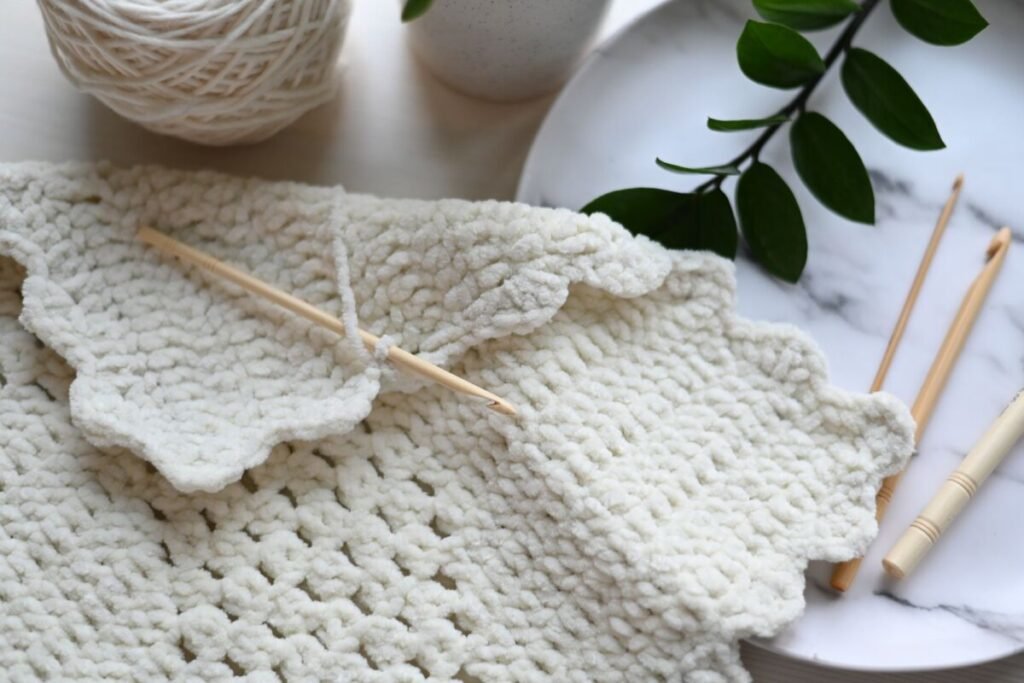
Super bulky is the outlier. The Interstellar Star Blanket reaches 58 inches on three balls of chenille style yarn in the 1,000 g put-up, 733 yards each, so 2,199 yards. Fewer yards than a worsted star, far more yarn by weight and by cost.
How many skeins for a baby star blanket?
Between two and six, decided by the put-up rather than the pattern. Take the 1,500 yards a 40 inch worsted star needs and divide by what is on the ball:
- 364 yd skeins (198 g worsted): 1,500 ÷ 364 = 4.1, so 5 skeins.
- 1,020 yd balls (454 g worsted): 1,500 ÷ 1,020 = 1.5, so 2 balls.
- 302 yd balls (100 g DK, needing 1,600 yd): 1,600 ÷ 302 = 5.3, so 6 balls.
Round up, and buy the spare in the same dye lot on the same day. A star has no fixed finishing round, so running short does not mean stopping early in a tidy place. It means the outer rounds change colour halfway through a point.
Does DK use more yarn than worsted?
Yes, by length. The 6 Day Star Blanket is published in both weights at both sizes by one designer, so the comparison holds everything else constant: 1,600 yards against 1,500 at 40 inches, and 2,800 against 2,500 at 60 inches. That is 7 percent more, then 12. A thinner strand covers less area per yard, and the gap widens as the star grows.
Why is my star blanket curling?
Because the fabric is too tight for the area each round has to cover. A crochet star blanket grows outward from a centre, so every round has a longer edge to fill, and dense stitches stop the increases keeping pace until the piece pulls into a bowl. The designer’s fix is direct: if the points curl in the setup rounds, move up a hook size. Lay the work flat after every round through the first ten. A cup at round six is a two minute fix; at round forty it is hours of frogging.
Why does my star blanket ruffle?
The opposite fault, and a counting error rather than tension. Betty McKnit’s page puts it plainly: ruffling means you have most likely added too many stitches. The usual culprit is one extra worked into a valley, the dip between two points where the pattern asks for a cluster and an ordinary stitch slips in. Count from one point tip to the next and compare with the side beside it. A larger hook will not save a ruffle: it adds fabric, and a ruffle already has too much.
What hook size stops curling?
Half a millimetre above what the yarn label recommends, with a second hook another half millimetre above that. A shape worked in the round needs a looser fabric than the label assumes. Start from the Craft Yarn Council label ranges.
| Yarn weight | Label hook range | First star hook | Second star hook |
|---|---|---|---|
| 3, DK or light | 3.5 to 4.5 mm | 4.0 to 5.0 mm | 4.5 to 5.5 mm |
| 4, worsted or aran | 4.5 to 5.5 mm | 5.0 to 6.0 mm | 5.5 to 6.5 mm |
| 6, super bulky | 6.5 to 9.0 mm | 7.0 to 9.5 mm | 7.5 to 10.0 mm |
If it still cups at the larger hook, recount round one. A count that does not divide evenly by your point number will never lie flat.
How long does a star blanket take to crochet?
The most famous star promises six days in its name, and the designer stands behind it. What the name does not say is which blanket. The six came from a toddler sized blanket in chunky yarn, so read it as six days for a small star in thick yarn, not a 60 inch throw in DK.
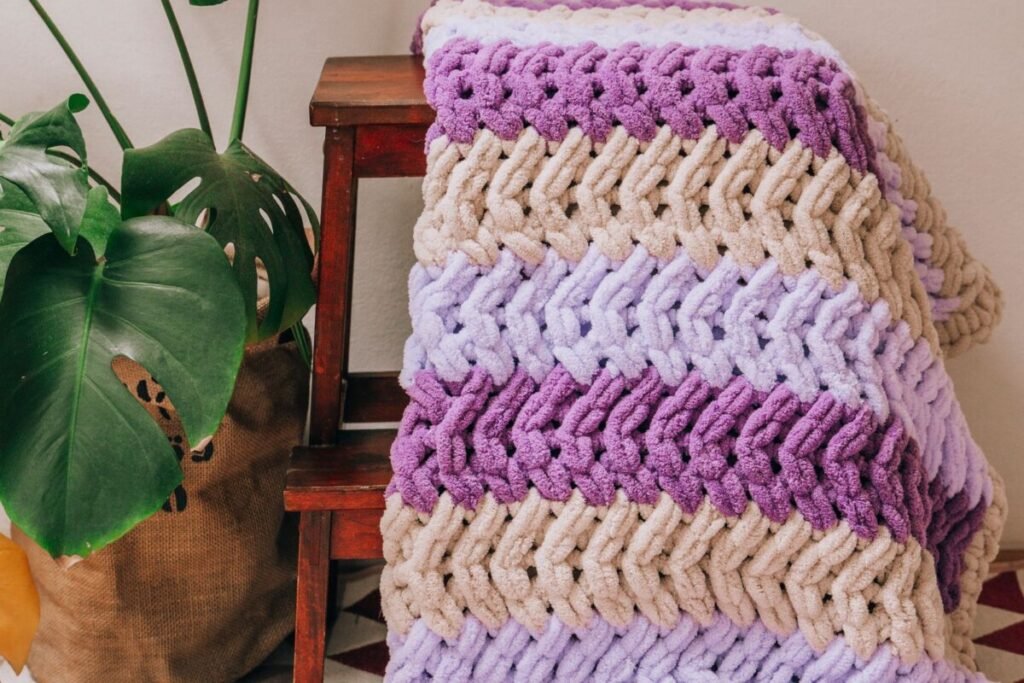
Yarn thickness sets the pace, and the labels let you measure it. A worsted acrylic gives 12 single crochet and 15 rows over 4 inches, so 180 stitches fill a 4 inch square. Super bulky chenille gives 7 and 8, so 56 do: a third of the work for the same area.
What size should a star blanket be?
Published crochet star blankets run from 38 to 68 inches, but the quoted number is a diameter, not an edge. Point to point measures the widest part, and the valleys come in a long way from that line, so a star covers less lap than a square carrying the same number.
The arithmetic: the largest square inside a 60 inch circle has sides of 60 divided by the square root of two, or 42.4 inches. Your star sits inside that circle, so a 60 inch star gives roughly the coverage of a 42 inch square. Size up from what you would choose for a rectangle.
| Pattern | Points | Point to point | Yarn weight |
|---|---|---|---|
| Bernat Star, and Dreamtime Star Baby | not stated | 38 in / 96.5 cm | baby, super bulky |
| 6 Day Star Blanket, baby | 7 | 40 in / 101.5 cm | DK or worsted |
| Interstellar Star Blanket | not stated | 58 in / 147.5 cm | super bulky |
| 6 Day Star Blanket, throw | 7 | 60 in / 152.5 cm | DK or worsted |
| 12 Point Star Blanket | 12 | 68 in / 172.7 cm | DK |
No fixed finish means you choose the size at the table rather than at the shop. The 6 Day page suggests stopping at round 12 for a lovey, and it scales up. For an infant, keep the fabric closed rather than lacy and leave off fringe and tassels for unsupervised sleep, following current paediatric guidance rather than a craft site.
What to buy and what it costs
A 60 inch crochet star blanket costs about the same in DK as in worsted, and close to four times more in super bulky. Yarn is almost all of the budget, so the weight is the whole decision. Prices checked August 2026 at list, with the arithmetic shown so you can redo it.
| Route | Yardage | Per ball | Balls | Yarn cost |
|---|---|---|---|---|
| DK, 60 in star | 2,800 yd | 302 yd, $4.50 | 10 | $45.00 |
| Worsted, 60 in star | 2,500 yd | 1,020 yd, $14.99 | 3 | $44.97 |
| Super bulky, 58 in star | 2,199 yd | 108 yd, $7.99 | 21 | $167.79 |
| Worsted, 40 in baby star | 1,500 yd | 1,020 yd, $14.99 | 2 | $29.98 |
Super bulky looks cheap because each ball is, but at 108 yards you need 21 and the total lands near $168. Buying worsted in the 1,020 yard put-up rather than 364 yard skeins cuts dye lot risk from seven balls to three. Buy a multicolour star’s colours together: there is no seam to hide a mismatch in. Tools: two hooks half a millimetre apart, a tapestry needle, a tape measure.
Where to get the patterns
All four crochet star blanket patterns are free on the designer’s or the yarn company’s own page. We link rather than republish, because their page is the one that carries their corrections.
- 7 points: the 6 Day Star Blanket by Betty McKnit. Nine setup rounds, then rounds 2 to 7 repeated.
- 12 points: the 12 Point Star Blanket by Bella Coco, with video.
- 5 points: the Five-Point Star Blanket.
- Super bulky: the Interstellar Star Blanket, free, 58 inches point to point.
A note on stitch names
Crochet runs on two naming conventions and star patterns are written in both. The same stitch is a double crochet under one and a treble under the other, and it is the stitch every pattern here uses in round one. Betty McKnit publishes both sets of abbreviations; Bella Coco writes tr for what the other calls dc. The tell is the shortest stitch in the list: if that is double crochet, every name has shifted up by one. That changes the finished size, not the point count.
Frequently asked questions
Is the 6 Day Star Blanket six or seven points?
Seven. The designer’s page says seven pointed, and round one puts 14 stitches into the ring, two per point. The six is the number of days, from an earlier toddler sized blanket in the same family.
How much yarn do I need for a star blanket?
About 1,500 yards of worsted or 1,600 of DK at 40 inches, and 2,500 or 2,800 at 60 inches. Divide by the yardage on your ball, round up, buy the spare in the same dye lot.
Does DK use more yarn than worsted?
Yes. In the same pattern at the same size, DK needs about 7 percent more yardage at 40 inches and 12 percent more at 60 inches, because a thinner strand covers less area per yard.
Why is my star blanket curling?
The fabric is too tight for the area each round has to cover, so the piece pulls into a bowl. Move up half a millimetre in hook size. Star patterns are written for a hook larger than the label recommends for this reason.
Why does my star blanket ruffle?
Too many stitches, usually one extra worked into a valley. Count from one point tip to the next and compare with the side beside it. A larger hook makes a ruffle worse, not better.
Sources
- Betty McKnit, 6 Day Star Blanket. Points, rounds one and two, sizes, yardage in both weights, the two hook rule, curling, ruffling.
- Bella Coco Crochet, 12 Point Star Blanket. Round one count, the twelve corners, the repeat.
- Lion Brand, 12 Point Star Blanket. Finished size, yarn weight, gauge.
- My Amigurumis, Five-Point Star Blanket. Round one count, hook.
- Yarnspirations, Interstellar Star Blanket and its Ravelry listing; Bernat Star Crochet Blanket; Dreamtime Crochet Star Baby Blanket. Sizes, hook, gauge, quantity.
- Craft Yarn Council, Standard Yarn Weight System. Label hook and gauge ranges.
- Cost arithmetic labels: Bernat Blanket (150 g, 108 yd), Pound of Love (454 g, 1,020 yd), Paintbox Simply DK (100 g, 302 yd).
- Morning Star quilt tradition: International Quilt Museum and the Aktá Lakota Museum.