Free Crochet Bag Patterns: 9 Bags With Yarn and Strap Specs
Nine free crochet bag patterns were opened and checked against each designer’s own page for this guide. Four of the nine never say how long the strap is. Three publish no gauge at all. And six state a yarn total that cannot be turned into a number of balls to buy. The roundups that rank for this search publish none of those figures either, so the table below is the comparison nobody else is printing.
Every bag here is free on the designer’s own site. We link to their page and never reproduce their instructions. What we add is the arithmetic.
On this page
- Five numbers a bag pattern has to give you
- Nine free crochet bag patterns, side by side
- How much yarn a crochet bag actually takes
- Why these yardages will not tell you what to buy
- How long the strap is, and why four pages will not say
- Bag hooks run smaller than the label says
- The stitch multiple, and the two places a bag goes wrong
- The Bombshell Bow Bag, step by step
- Frequently asked questions
- Where to go next
- Sources
Five numbers a bag pattern has to give you
Free crochet bag patterns have to give you five figures before you pick up a hook: finished size, yarn weight, total yardage, hook size, and strap length. A blanket forgives four of those. A bag does not, because a bag is a load bearing object and the strap is the part that touches your shoulder.
Strap length is the figure the field drops. Of the nine patterns checked, eight have a strap or handle and only three designers publish a finished crocheted strap length in inches. A fourth publishes a length only because the strap is bought hardware rather than crocheted. The remaining four give a chain count instead, which is not a measurement unless the page also gives you a chain gauge, and none of them do.
- Finished size. All nine, but not always measured the same way. One market bag states 18 in wide and 29 in tall, and the 29 in includes the handles while the 18 in does not.
- Yarn weight and yardage. Two publish no project yardage whatsoever.
- Hook. All nine, and three sit outside the band their yarn’s own weight class recommends.
- Gauge. Missing from three. Two of those substitute a motif or base measurement, which works.
- Strap length. Three.
Nine free crochet bag patterns, side by side
Each of these free crochet bag patterns was read from the designer’s own page, never from another roundup. A blank cell means the designer does not publish that figure, and a blank cell is information: it tells you what you will have to work out yourself.
| Bag | Finished | Yarn | Total | Hook | Gauge per 4 in | Strap |
|---|---|---|---|---|---|---|
| Cotton Tote, Oombawka Design Crochet | 15 by 17.5 in | worsted cotton | 493 yd | 5.5 mm | 10 sts, 10 rows | 20 in |
| Easy Tote, Jo to the World Creations | 16 by 11 in, 4 in deep | worsted acrylic, held double | 860 yd | 6.5 mm | 7 sts, 13 rows | 40 in |
| Granny Square Bag, Make and Do Crew | 15 by 12.5 in | worsted cotton | not stated | 5.5 mm | not stated | not stated |
| Granny Square Bag large, The Loopy Lamb | 17 by 17 in | worsted acrylic | 180 yd | 5.5 mm | not stated | bought, 28 to 51 in |
| Harper Bucket Bag, TL Yarn Crafts | 6.5 in across, 9 in tall | bulky cotton blend | not stated | 5.0 mm | not stated | not stated |
| Annies Boho Shoulderbag, Knitting with Chopsticks | 8.5 by 7.5 in | bulky alpaca blend | 250 yd | 6.0 mm | 14 sts, 19 rows | 32.5 in |
| Willow Mesh Market Bag medium, Briana K Designs | 22 by 14 in | worsted cotton blend | 310 yd | 5.5 mm | 12 sts, 7 rows | not stated |
| Circle Clutch, Indie Crochet Patterns | 9 by 6.5 in | worsted, held double | not stated | 6.0 mm | 10 sts, 12 rows | none by design |
| Mesh Market Bag, Delia Creates | 18 in wide, 29 in with handles | worsted recycled cotton | 525 yd | 5.0 mm | 8 sts, 9 rows | not stated |
How much yarn a crochet bag actually takes
Yarn use runs from 0.62 yd per square inch to 3.92 yd per square inch across these nine bags, a spread of more than six to one. The rate comes from dividing each designer’s stated total yardage by their own stated finished area. Two bags of identical size can differ by a factor of six in yarn, purely on fabric choice, which is why no single answer to this question exists.
| Bag | Area | Yardage | Rate |
|---|---|---|---|
| Granny Square Bag large, open motifs | 289 sq in | 180 yd | 0.62 yd per sq in |
| Willow Mesh Market Bag, open mesh | 308 sq in | 310 yd | 1.01 yd per sq in |
| Mesh Market Bag, open slip stitch | 522 sq in | 525 yd | 1.01 yd per sq in |
| Cotton Tote, dense fabric | 262.5 sq in | 493 yd | 1.88 yd per sq in |
| Annies Boho Shoulderbag, dense single crochet | 63.75 sq in | 250 yd | 3.92 yd per sq in |
Read it as a budgeting tool. Measure the bag you want, multiply width by height, then multiply by about 1 yd per square inch for an open mesh or about 1.9 yd per square inch for a dense fabric. A dense bag measuring 10 by 20 in of fabric lands near 468 yd on that arithmetic, which is two or three balls of most worsted cotton rather than one.
One pattern is left out of that table on purpose. It is worked with two strands held together and states 860 yd without saying whether that is yarn consumed or fabric produced. At 1,020 yd per ball, that ambiguity decides whether you buy one ball or two.
Why these yardages will not tell you what to buy
Six of the nine patterns state a project total with no per ball breakdown to check it against, so the yardage cannot be converted into a shopping quantity without doing the division yourself. One tote gives 285 g rather than a ball count. One granny square bag gives grams only, per colour, and never a project yardage. One bucket bag gives neither yardage nor grams, only the instruction to get two balls.
Do the conversion at the yarn label, not at the pattern. A worsted cotton at 173 yd and 158 m per 100 g ball turns a 493 yd tote into three balls. A bulky cotton blend at 219 yd and 200 m per ball covers most small bags in two. Watch which unit you are reading: labels print yards and metres side by side, and reading 158 m as 158 yd understates a tote by roughly 35 yd.
How long the strap is, and why four pages will not say
Three designers publish a finished crocheted strap length: 20 in, 40 in and 32.5 in. Those are not competing answers, they are three different bags. The 20 in strap is a short tote handle. The 40 in strap is a full shoulder strap, and that designer helpfully also states the drop, about 10 in from the top of the bag to the top of the strap, which is the number you actually feel when you wear it. The 32.5 in strap belongs to a small crossbody.
Ask for the drop, not the total. A strap sewn to both sides of a bag doubles back on itself, so a 22 in strap gives an 11 in drop. Drop is what decides whether the bag sits at your hip or under your arm.
Four pages give a chain count in place of a measurement. One bucket bag says only to chain 165 loosely, with no chain gauge anywhere on the page, so those chains cannot be converted into inches. Another gives handles of 60 chains, a third gives 75. A chain count is a reproducible instruction, but it is not a specification: it tells you nothing before you commit the yarn.
Only one designer treats strap stretch as a design problem, instructing you to measure unstretched because the stitch relaxes as soon as the bag carries weight. On this point that single sentence outweighs the other eight pages.
Bag hooks run smaller than the label says
Three of the nine patterns use a hook outside the range the Craft Yarn Council recommends for their yarn’s weight, and in all three cases it is deliberate. Two bulky yarn bags are worked at 5.0 mm and 6.0 mm against a recommended band of 6.5 to 9.0 mm. One worsted bag is worked at 5.0 mm against a band of 5.5 to 6.5 mm.
Council recommendations target fabric with drape, which is what a garment or a blanket wants. A bag wants the opposite. The crossbody here is worked at 14 sts per 4 in on a bulky yarn whose weight class expects 8 to 11 sts per 4 in, and its designer chose that density so the strap would survive being worn.
Go down one or two hook sizes from the ball band for any bag that will carry weight. Check it against the fabric, not the chart: if you can push a fingertip through the stitches, a set of keys will find the same gap.
The stitch multiple, and the two places a bag goes wrong
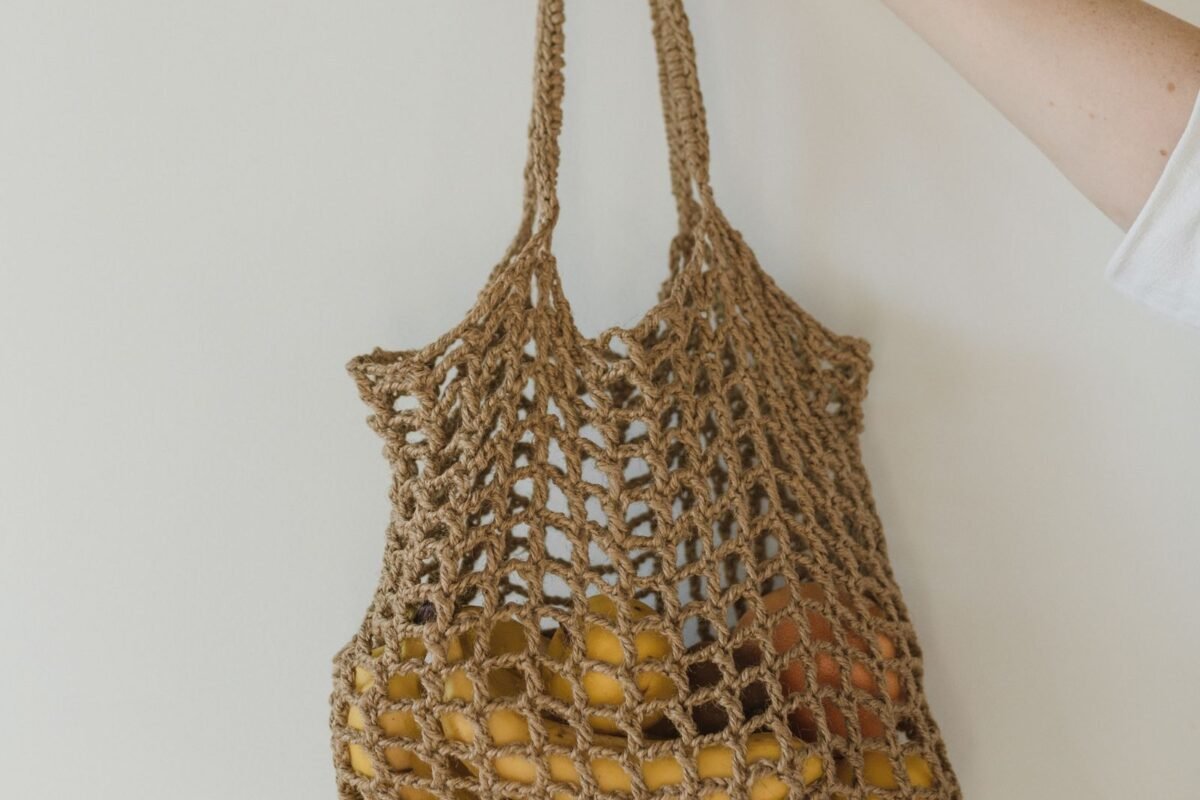
Check the multiple before row one, because a repeating stitch pattern fails at the end of the first row, after you have already worked every stitch in it. The tote in this set works over a multiple of 2 plus 1, and its chain of 41 fits that exactly. Most of the others are worked in the round from a base or a magic circle of 12 sts, where there is no foundation chain to get wrong.
First failure: the base sags and the bag turns into a pouch. A flat base worked in the same open stitch as the sides will not hold a rectangle once anything sits in it. Work the base in solid stitches even when the body is mesh, and work it at the tighter hook.
Second failure: the strap grows and never goes back. Fibre decides this more than stitch does. A yarn company puts cotton stretch at 2 to 5 per cent under weight against 15 to 20 per cent for wool and acrylic, and names cotton its first choice for straps on that basis. Those figures are published without a stated test method, so treat the ratio as directional rather than laboratory grade, but the direction is not in doubt and it matches what the patterns do: the one bag in this set built entirely in acrylic is also the only one that hangs its load on bought hardware instead of crocheted fabric.
One more measurement worth knowing before you trust a mesh. The slip stitch market bag chains 28 and states a finished width of 18 in, but 28 sts at its own published gauge of 8 sts per 4 in works out to 14 in. The missing 4 in is the mesh opening up, which is by design in a market bag and a warning anywhere else. Swatch it, load the swatch, and measure again.
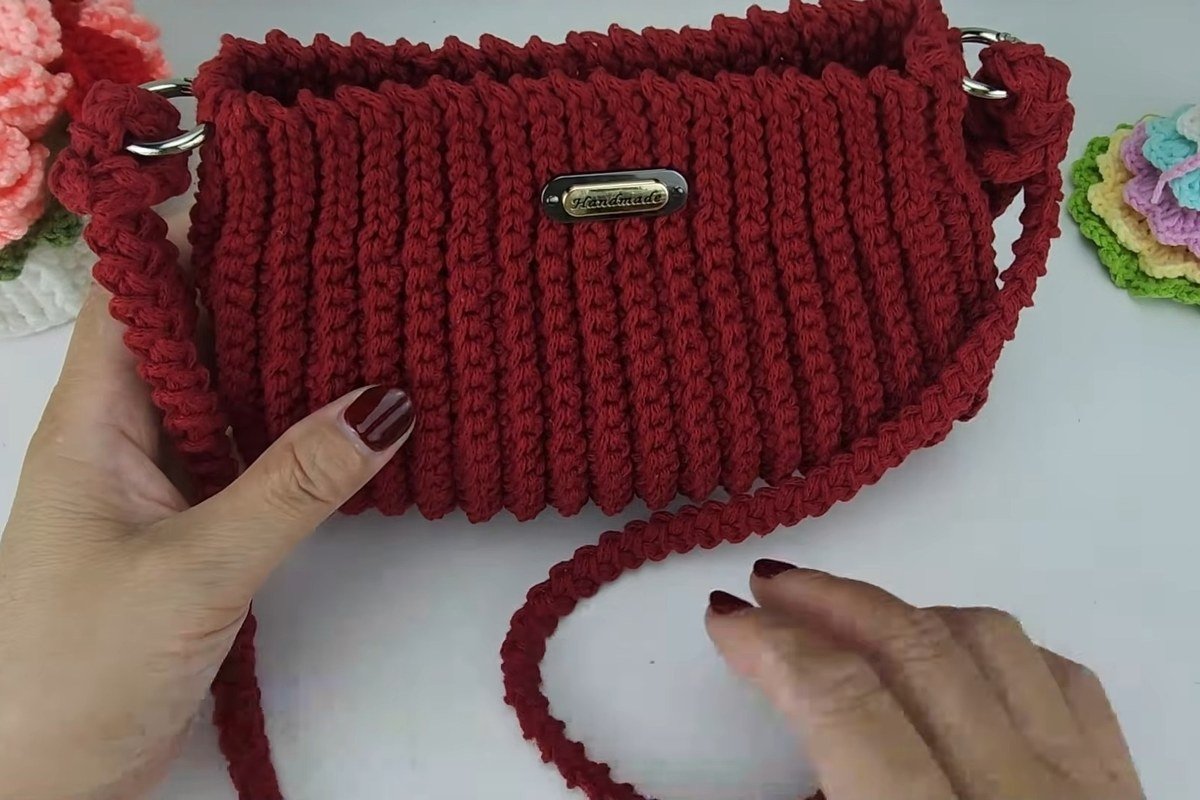
The Bombshell Bow Bag, step by step
This one is ours, designed for this guide as the simplest construction that still holds its shape: a single flat rectangle, folded in half and seamed up both sides, with a colour block strap and a bow. Every count below is derived from one gauge, and the arithmetic is printed so you can resize it rather than copy it.
Specification. Worsted weight cotton, 5.0 mm hook, single crochet throughout. Gauge 14 sts and 16 rows per 4 in, which is one hook tighter than the ball band and gives the firm fabric this bag needs. Finished bag 10 by 10 in, strap drop 11 in. Yarn needed, at 1.88 yd per square inch from the dense fabric rate above and 249 sq in of fabric in total: about 468 yd.
- Swatch first. Work a square in single crochet and measure. At 14 sts per 4 in you are getting 3.5 sts per in. If your gauge differs, recalculate every count below from your own number rather than following ours.
- The body. Width 10 in at 3.5 sts per in is 35 sts, so chain 36 to allow the turning chain. Work in single crochet until the piece measures 20 in, which is 80 rows at 4 rows per in. The 20 in folds in half to make a 10 in tall bag.
- Fold and seam. Fold the rectangle in half widthways, right sides together, and seam up both side edges. Turn it out.
- The strap. A drop of 11 in needs a strap of 22 in total, which is 77 chains at 3.5 sts per in. Work it 5 sts wide, giving a strap about 1.4 in across. Alternate two colours every few rows for the block look. Sew each end flat to the inside of the side seam, not to the top edge, so the load pulls on the seam.
- The bow. A rectangle 6 by 3 in is chain 22 and 12 rows. Pinch it at the centre, wrap a short strip of yarn around the pinch, and sew it to the front.
- Finish. One round of single crochet around the top opening firms the edge and stops it flaring.
Frequently asked questions
How much yarn do I need to crochet a bag?
Multiply the width by the height of the fabric, then multiply by the rate for your fabric. Across nine verified patterns that rate runs from 0.62 yd per square inch for open granny motifs to 3.92 yd per square inch for dense single crochet. A mid sized dense tote lands near 493 yd, an open mesh market bag of similar size near 310 yd.
How long should a crochet bag strap be?
Published lengths across these patterns are 20 in for a short tote handle, 32.5 in for a small crossbody, and 40 in for a full shoulder strap. Work in drop rather than total length: a strap sewn to both sides doubles back, so 22 in of strap gives an 11 in drop.
What is the best stitch for a crochet bag that will not sag?
Single crochet worked tightly. It is the densest of the basic stitches and holds shape better than taller stitches, which is why the firmest bag in this set uses it at 14 sts per 4 in. Keep mesh for market bags that are meant to stretch around their contents.
Is cotton or acrylic better for a crochet bag?
Cotton, for anything that carries weight. A yarn company puts cotton stretch at 2 to 5 per cent under load against 15 to 20 per cent for wool and acrylic. Those figures come without a published test method, so read them as a direction rather than a measurement, but cotton being the firmer choice is consistent across every pattern here.
What hook size should I use for a crochet bag?
One or two sizes smaller than the ball band. Three of these nine patterns already do this deliberately, working bulky yarn at 5.0 mm and 6.0 mm where the recommended band is 6.5 to 9.0 mm. Band recommendations aim at drape, and drape is what makes a bag sag.
Do I really need to check gauge for a bag?
Yes, more than for a blanket. A blanket that comes out slightly large is still a blanket, but a strap that comes out long changes where the bag hangs. Three of these nine pages publish no gauge at all, and two of those substitute a measurement you can check instead, such as motifs finishing at 4.75 in or a base reaching 4.25 in across.
Where to go next
- Crochet accessories, for more wearable projects with their numbers stated up front.
- Moss stitch crochet, a dense flat fabric that suits a bag body as well as it suits a blanket.
- Pumpkin granny square, if you want to build a bag from motifs rather than from one piece.
- Crochet baby shoes, another small project where gauge decides the finished size.
Sources
- Cotton Tote Bag, Rhondda Mol, Oombawka Design Crochet
- Easy Tote Bag, Jo to the World Creations
- Granny Square Bag, Jess Coppom, Make and Do Crew
- Granny Square Bag, Ashley Parker, The Loopy Lamb
- Harper Bucket Bag, Toni Lipsey, TL Yarn Crafts
- Annies Boho Shoulderbag, Knitting with Chopsticks
- Willow Mesh Crochet Market Bag, Briana K Designs
- Circle Clutch, Mary Beth Cryan, Indie Crochet Patterns
- Mesh Market Crochet Bag, Delia Randall, Delia Creates
- Standard Yarn Weight System, Craft Yarn Council
- How to stop crochet bag straps from stretching, Mary Maxim
- Cottage Cotton yarn label, Herrschners