Moss Stitch Crochet: Odd or Even Chain, Plus Free Patterns
Whether a moss stitch crochet foundation chain should be odd or even is not a property of the stitch. It is decided by which chain row 1 starts in, and across seven free pattern pages checked for this guide both answers turn out to be correct, each paired with its own starting point.
That settles the question readers ask most about moss stitch crochet, and explains how two trustworthy designers print opposite instructions without either being wrong. Below: the parity rule as arithmetic, published gauges, yardage checked against the yarn label, and the figure that answers whether moss stitch eats yarn.
Moss stitch at a glance
| Stitch multiple | 2, plus whatever your row 1 start consumes |
| Hook sizes in these patterns | 5.0 mm to 9.0 mm |
| Yarn weights used | category 3 through category 6 |
| Published gauge | 16 to 20 units per 4 in at 5.0 mm, counting chain spaces |
| Throw yardage | 1,556 yd to 1,835 yd at 5.0 mm |
| Yarn per square inch | about 0.99 yd of worsted at 5.0 mm |
| Skill level | Beginner, one row repeated |
On this page
- How many chains to start with
- Is moss stitch a yarn eater
- How much yarn a blanket takes
- How to crochet the moss stitch
- Moss, linen, granite and seed stitch
- Which hook size to use
- Where moss stitch goes wrong
- Seven free patterns, numbers checked
- Questions readers ask
- Where to go next
- Sources
How many chains do you start moss stitch with, odd or even?
Count the chain your row 1 skips before its first stitch, then make sure the chains left over divide by 2. That is the whole rule. An even foundation works when row 1 begins in the 2nd or the 4th chain from the hook. An odd foundation works when row 1 begins in the 3rd chain, or when row 1 is a solid row of stitches and the chain spaces only start on row 2.
As arithmetic: chain 160 starting in the 4th chain leaves 156, which divides by 2. Chain 144 starting in the 2nd leaves 142. Chain 21 starting in the 3rd leaves 18. All three work. Change the start point without changing the chain and the row fails at the far end.
| Pattern | Chain | Row 1 starts in | Parity |
|---|---|---|---|
| Moss Stitch Baby Blanket | 101 | solid first row | odd |
| The Elemental Throw | 160 | 4th chain | even |
| Crochet Moss Stitch Throw | 144 | 2nd chain | even |
| Alpenhaus Ripple | 132 | chevron repeat of 19 | even |
| Bella Coco tutorial | multiples of 2 plus 1 | 3rd chain | odd |
| Persia Lou tutorial | 18 | 4th chain | even |
| Magic Owl washcloth | 48 | 4th chain | even |
The confusion is documented in public on a designer’s own page. One tutorial instructed an even number of chains while its sample read 17. A reader queried it, and the designer corrected the sample to 18. That is what happens when parity is treated as a rule of the stitch rather than a consequence of the row 1 start.
The stitch count that makes people frog a good row
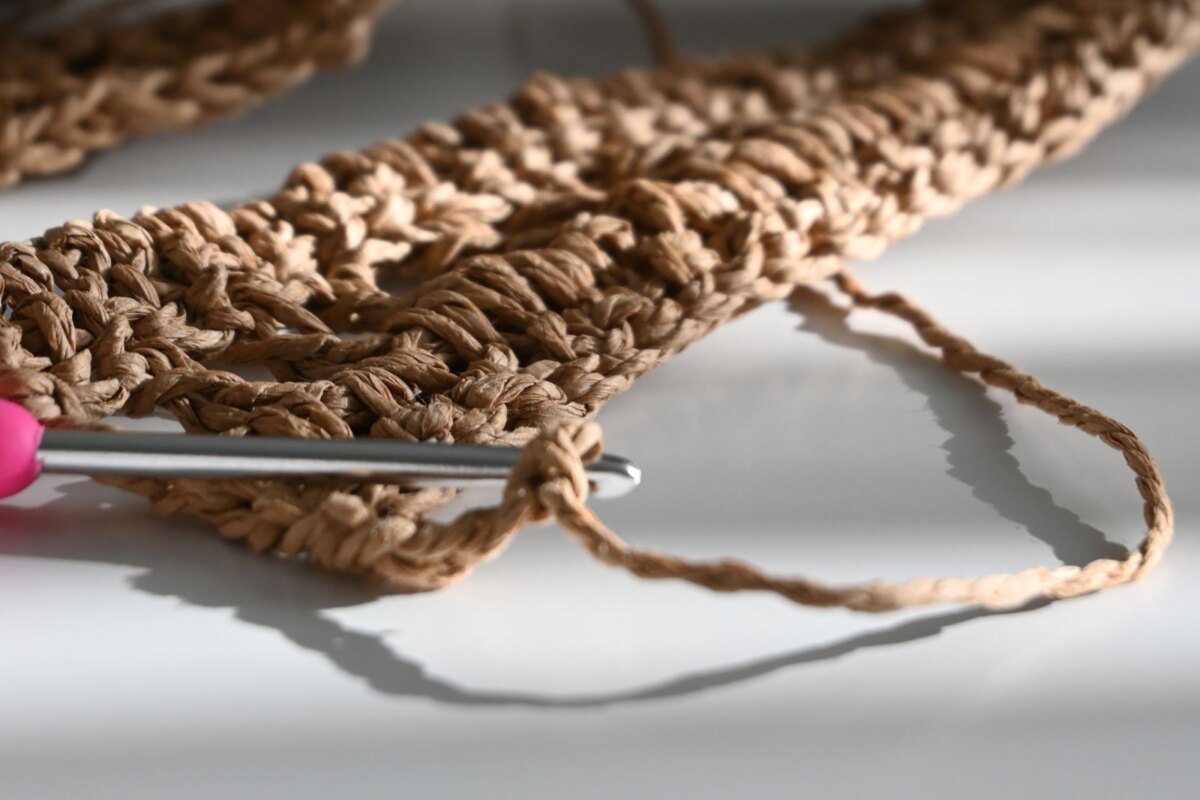
One audited page tells readers to expect half the starting chain plus one stitch. From an even chain that is off by one. Chain 20, start in the 2nd chain, and you get exactly 10 stitches, not 11. The plus one appears only when the foundation is odd, so readers who count correctly conclude they dropped a stitch and frog a good row.
Is moss stitch a yarn eater?
No. On the same yarn and the same hook, moss stitch puts 63 stitches into a 4 inch square where plain single crochet puts 110. That is 47 fewer, or 43 percent, and the chain spaces replacing them use less yarn than the stitches they stand in for.
That figure is calculated here rather than quoted, because no ranking page publishes it. It comes from two gauges for one ball of yarn at one hook size. The label for a category 5 yarn gives plain single crochet as 10 stitches by 11 rows per 4 in on a 6.5 mm hook, or 110 in the square. A designer working that same yarn on the same hook publishes a moss gauge of 14 stitches including chain spaces by 9 rows, and one moss unit is a stitch plus a chain, so that is 7 by 9, or 63.
One caveat: the moss half of that pair is measured on a ripple version of the stitch, the only place a designer and a yarn label publish gauges for the same ball on the same hook. Straight moss stitch will sit close, not exactly on it. Swatch before buying for a large blanket.
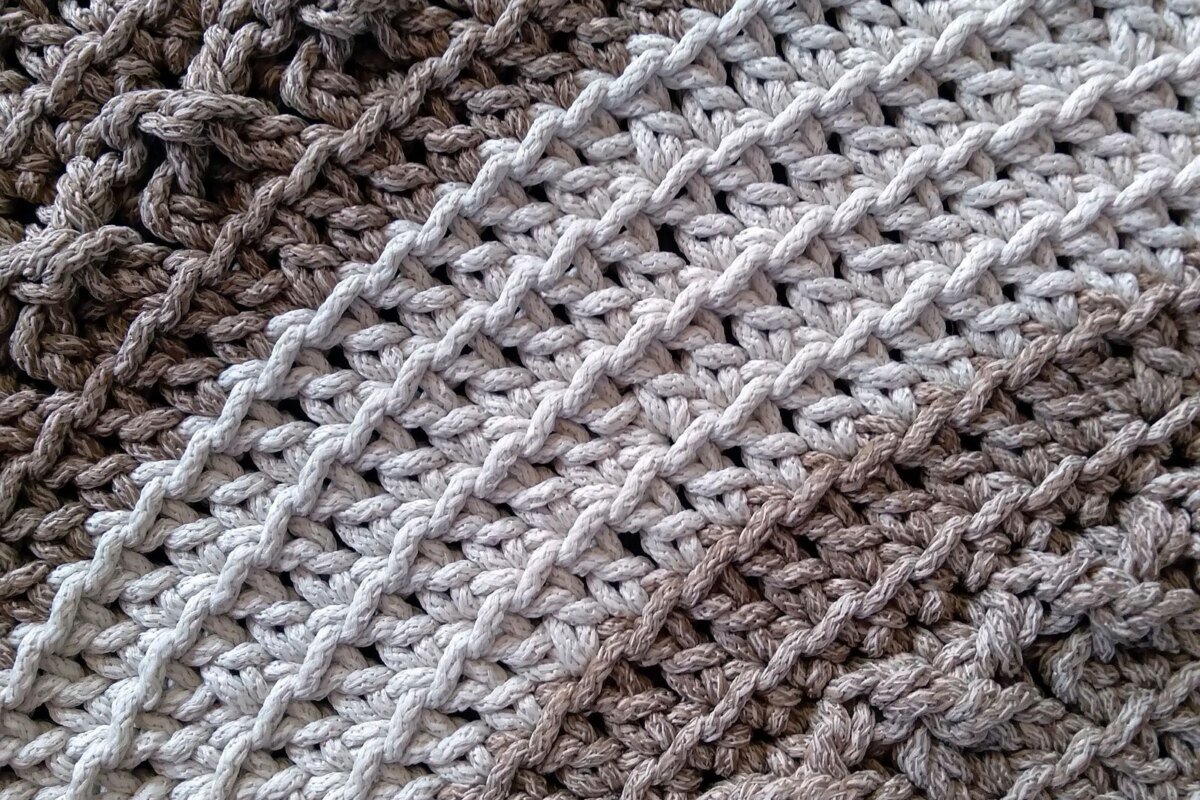
The stitches that genuinely eat yarn are the tall, dense ones at a tight gauge, not the airy repeats. One washcloth page puts it practically: the fabric is less dense than one made entirely of single crochet, and fewer stitches per inch means less yarn.
How much yarn does a moss stitch crochet blanket take?
Budget about 0.99 yd of worsted per square inch of finished fabric at a 5.0 mm hook. That is a second figure calculated for this guide, from the published yardage and finished size of two independent throws worked at the same weight and hook. One lands at 1.06 yd per square inch, the other at 0.92, and agreement inside 15 percent is what makes the average worth planning against.
Applied, that is roughly 1,700 yd for a 34 in by 50 in throw, before a border, and none of these patterns publishes what its border consumes. The same label check on our fall blanket patterns moved several published totals.
The label trap that costs a blanket 108 yards
Yarn labels print two numbers that look interchangeable and are not. One blanket here is published as needing about 1,125, and that figure is grams. It also equals the metre total, since 9 skeins at 125 m is 1,125. Reprint it as yards and you understate the blanket, because 9 skeins at the label’s 137 yd is 1,233 yd. The gap is 108 yd, most of a ball.
When a yardage looks suspiciously round, check which unit the designer wrote. Two figures on that page disagree with each other too: the larger size lists 14 skeins but 1,606 g, and 1,606 divided by 125 is 12.85. Buy on the skein count.
How to crochet the moss stitch, step by step
Moss stitch is one row repeated: a short stitch, a chain, skip the space beneath, a short stitch into the next gap. Once row 2 is on the hook there is nothing new to learn, which is why it suits a first blanket.
- Chain an even number.
- Row 1: work a short stitch into the 2nd chain from the hook, then chain 1, skip the next chain, and work a short stitch into the chain after it. Repeat to the end, finishing in the last chain.
- Row 2: chain 1 and turn. Work a short stitch into the first chain space, then chain 1 and a short stitch into the next chain space, all the way across. Stitches now sit in the gaps of the row below, never into the tops of stitches.
- Repeat row 2 until the piece measures what you want.
Two naming conventions describe that short stitch differently and patterns rarely say which they use, so we give both: it is a single crochet under one and a double crochet under the other. If a pattern is producing a tall, loose fabric instead of a firm woven one, you are reading it in the wrong convention.
One refinement, from a single page of the eight reviewed: work row 1 into the back ridge of the chain rather than the top loops. The bottom edge then mirrors the top, and ridges are easier to count.
Is moss stitch difficult, and is it fast?
It is rated beginner by the tutorials that rate it, and fast for the reason quantified above: 63 stitches cover a 4 inch square instead of 110. The one designer here calling it more intermediate than easy is describing a chevron version, where shaping sits on top of the basic repeat. Plain moss stitch has none.
Moss stitch, linen stitch, granite stitch and seed stitch
Moss, linen, granite and woven stitch are four names for one fabric, and a designer’s page in this set says so in a single line. Any of them calls for the same alternation of a short stitch and a chain. Nothing changes but the label.
Crochet seed stitch is different despite the name overlap. What some patterns call crochet seed stitch is the lemon peel stitch, alternating two stitch heights rather than a stitch and a chain. Knitted moss and seed stitch are different again, with no chain spaces at all. If you arrived from a knitting pattern, the two share a word and nothing else.
Which hook size for moss stitch, and why two designers went smaller
Go one step below the hook the yarn label recommends. Two throws checked here use a 5.0 mm hook with a category 4 worsted, where the Craft Yarn Council standard range for that weight is 5.5 mm to 6.5 mm. Two independent designers making the same choice is a deliberate density decision, not a misprint.
The reason follows from the stitch. Half of every row is chain space, so the fabric is already open. Working at the recommended hook gives a blanket you can see daylight through, fine for a summer throw and disappointing on a winter sofa. Dropping a size closes it up without making it stiff.
The lever runs both ways: a smaller hook gives a denser, stiffer fabric, a larger hook a lacier one. At the far end, a category 6 super bulky on a 9.0 mm hook sits inside the standard for that weight, 9 mm to 15 mm, and makes a blanket in an evening.
Where moss stitch goes wrong
Two failure modes account for most abandoned moss stitch crochet blankets, and both are edge problems rather than fabric problems.
The edges creep inward or outward. Every row ends in either a chain space or the turning chain, and choosing differently on different rows adds or drops a stitch. Over 94 rows, one stitch lost every fourth row turns a straight edge into a wedge. Decide on row 3 where the last stitch goes, never vary it, and count every tenth row.
The blanket comes out narrower than the chain predicted. Moss stitch draws in as the chain spaces take up working tension. One throw chains 144, which at its published 16 units per 4 in should give 36 in, and finishes at 34 in. That 2 in of draw-in is normal and the designer adds chains for it. Measure a swatch after ten rows, not after two.
A third problem sits on a designer page rather than in your hands. One baby blanket publishes a gauge of 8 stitches per 4 in and a chain of 101, giving 50 stitches and 49 chain spaces. Read it as stitches only and the blanket is about 25 in wide, as units about 49 in. The stated width is 32 in, and neither reading reaches it. Swatch that one first.
Seven free moss stitch crochet patterns, with the numbers checked
Every figure below came from the designer’s own page or the yarn manufacturer’s label, never from a roundup. Where a designer publishes no number, the table says so instead of guessing.
| Pattern | Finished size | Hook | Yarn | Yardage |
|---|---|---|---|---|
| Moss Stitch Baby Blanket, Jo to the World | 32 in by 32 in | 6.5 mm | category 4 | 1,020 yd |
| The Elemental Throw, LeeLee Knits | 32 in by 54 in | 5.0 mm | category 4, two colours | 1,835 yd |
| Crochet Moss Stitch Throw, The Crochet Village | 34 in by 50 in | 5.0 mm | category 4, two colours | 1,556 yd |
| Alpenhaus Ripple, Mama In A Stitch | 37 in by 59 in | 6.5 mm | category 5 | 1,233 yd from the label |
| Moss Stitch tutorial, Bella Coco | not published | 5.0 mm | category 3 | not published |
| How to Crochet the Moss Stitch, Persia Lou | not published | 9.0 mm | category 6 | not published |
| Moss Stitch Washcloth, Magic Owl Studios | not published | 5.5 mm | category 4 cotton | not published |
Three of the seven publish no gauge and no yardage at all, the largest gap in the material on this stitch. They teach the hand movements well and leave you unable to resize anything or estimate what to buy. One tells readers to use the hook needed to obtain gauge, then never prints a gauge.
The Elemental Throw is the only pattern here whose chain, gauge and width agree exactly: 160 units at 20 per 4 in is 32 in. If you want numbers you can resize with confidence, start there. For a shaped project checked the same way, see our crochet star blanket guide.
None of these instructions are reproduced here. Each link goes to the designer’s own page, where the pattern belongs and stays maintained.
Questions readers ask about moss stitch crochet
Do you need an odd or even number of chains for moss stitch?
Either, depending on where row 1 starts. Subtract the chain your first stitch skips into, and the remainder must divide by 2. A 2nd or 4th chain start needs an even foundation, a 3rd chain start or a solid first row needs an odd one.
Does moss stitch use more yarn than single crochet?
Less. At the same hook and yarn it places 63 stitches in a 4 inch square against 110 for plain single crochet, and the chain spaces filling the difference take less yarn than stitches would.
What is the difference between moss stitch and seed stitch in crochet?
Moss stitch alternates a short stitch with a chain space. Crochet seed stitch, also called lemon peel, alternates two stitch heights and has no chain spaces. Moss stitch is the flatter, more woven of the two.
Is moss stitch the same as linen stitch and granite stitch?
Yes. Moss, linen, granite and woven stitch all describe the same alternation of a short stitch and a chain. The name varies by designer and region, the fabric does not.
How much yarn do I need for a moss stitch crochet blanket?
Around 0.99 yd of worsted per square inch at a 5.0 mm hook, so about 1,700 yd for a 34 in by 50 in throw. Buy extra for a border, since the patterns checked here do not publish border yardage.
Why is my moss stitch crochet blanket getting narrower?
The last stitch of the row is landing somewhere different from one row to the next. Decide whether it goes into the final chain space or the turning chain, keep that choice every row, and count on every tenth row.
Is moss stitch good for a baby blanket?
It is a common choice and works up quickly, but the fabric is open by design. For sleep, follow current paediatric guidance on loose weave and avoid long fringe or tassels, rather than taking safety advice from a craft page.
Where to go next
- Blanket stitches and borders, for repeats and edgings that pair with an open fabric.
- Free blanket patterns, yardage checked against the yarn label.
Sources
- Moss Stitch Baby Blanket, Jo to the World Creations
- The Elemental Throw, LeeLee Knits
- Crochet Moss Stitch Throw Blanket, The Crochet Village
- Alpenhaus Ripple Moss Stitch Blanket, Mama In A Stitch
- Moss Stitch, Linen Stitch, Bella Coco
- How to Crochet the Moss Stitch, Persia Lou
- Moss Stitch and Washcloth Pattern, Magic Owl Studios
- Yarn Weight System, Craft Yarn Council
- Hue + Me yarn label, Lion Brand
- Pound of Love yarn label, Lion Brand